nMOS Transistor | Ids versus Vds derivation | Part-1/2 | VLSI | Lec-11
TL;DR
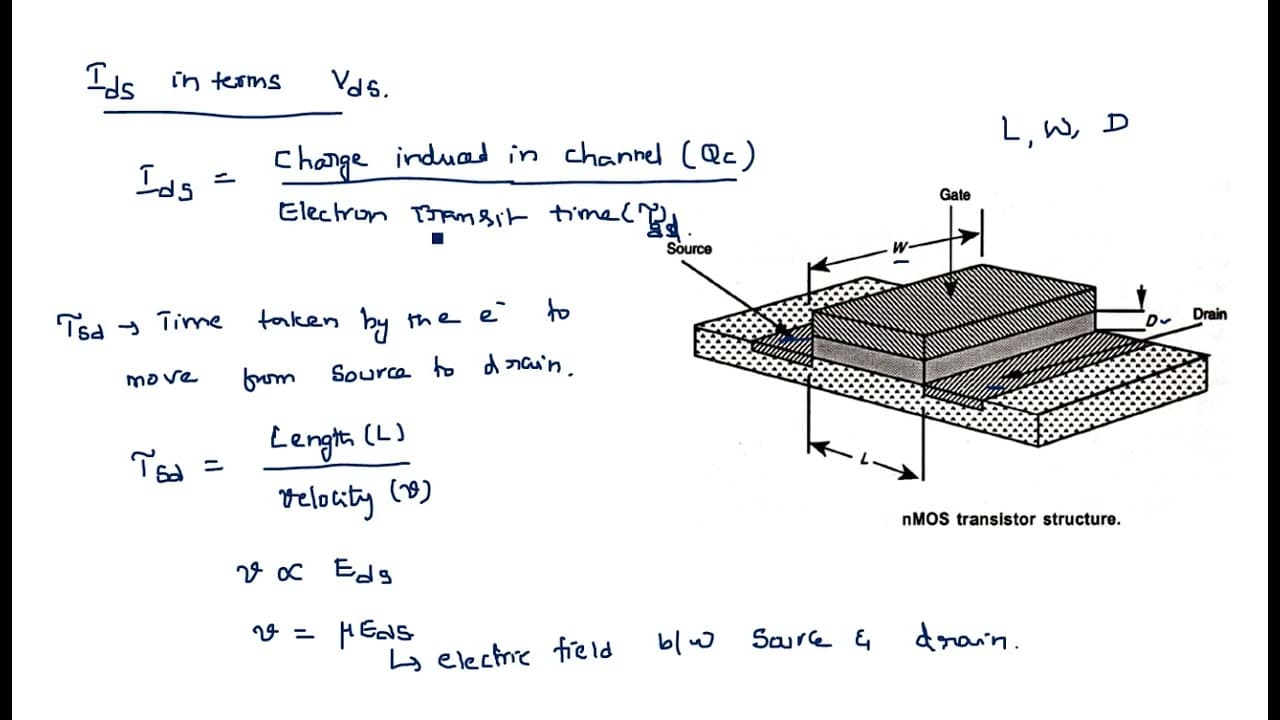
This video explains the derivation of IDS in relation to VDS for MOS transistors.
Transcript
hi everyone in this video I am going to tell you about the derivation of ideas versus vdsl so when you are considering the subject and from this first unit point of view this derivation plays a major role okay because from this onwards a lot of equations and formulas are going to be derived and previously we have discussed several fabrication steps... Read More
Key Insights
- 🤩 The derivation of IDS versus VDS is key to understanding MOS transistor behavior and is tested in exams.
- 🤩 Key parameters include channel length, width, oxide thickness, and gate-source voltages that dictate performance characteristics.
- ⚡ The relationship between applied voltages and the induced charge emphasizes the connection between electrical behavior and material properties in semiconductors.
- 🎨 The difference between non-saturation and saturation regions highlights crucial operational aspects of transistors relevant to circuit design.
- 💐 Understanding the influence of electric fields on charge carrier motion elucidates fundamental principles governing current flow in transistors.
- 🕳️ The parameters for electron and hole mobility inform calculations and predict how rapidly charge carriers can respond to electric fields.
- 🈂️ The dependence of IDS on channel charge reiterates the importance of geometric and material properties in electronic device functionality.
Install to Summarize YouTube Videos and Get Transcripts
Explore YouTube Video Summarizer or Get YouTube Transcript Extractor
Questions & Answers
Q: What is the purpose of deriving the IDS versus VDS equation in MOS transistors?
The derivation of the IDS versus VDS equation is crucial for understanding how the drain-source current behaves as the drain-source voltage is applied. This is foundational for analyzing transistor functionality, particularly in applications requiring accurate current flow predictions. It is also essential for explaining various fabrication processes that are likely to appear in exams.
Q: How does the electric field affect electron motion in a MOS transistor?
The electric field created by the applied VDS voltage influences how quickly electrons move from the source to the drain. As VDS increases, the electric field intensifies, causing a proportional increase in electron velocity, which, in turn, enhances the IDS. This behavior demonstrates that current flow in semiconductors depends critically on the electric field strength.
Q: What parameters are essential for the derivation of IDS in relation to VDS?
Key parameters for deriving IDS include the channel length (L), channel width (W), oxide thickness (D), gate-source voltage (VGS), and the threshold voltage (VT). Each of these factors influences current characteristics and must be accurately defined for precise calculations in both non-saturation and saturation regions of operation.
Q: Can you explain the difference between the non-saturation and saturation regions for MOS transistors?
In the non-saturation region, the current (IDS) increases linearly with VDS, meaning the transistor behaves like a resistor. However, once VDS surpasses VGS - VT, the transistor enters the saturation region where the current becomes constant and independent of VDS, reflecting a transition from linear to more stable operational behavior. Understanding this shift is crucial for effective circuit design.
Q: What role does charge induced in the channel (QC) play in IDS calculation?
The charge induced in the channel (QC) is integral to the calculation of IDS as it defines the amount of current that can flow given specific electric field conditions and voltage applications. QC influences how many charge carriers are available in the channel, directly correlating to the drain-source current as per the equation IDS = QC / tau_SD, where tau_SD represents electron transit time.
Q: What is the significance of the mobility parameters (mu_n and mu_p) in the derivation?
Mobility parameters, such as mu_n (electron mobility) and mu_p (hole mobility), are significant because they describe how easily charge carriers can move through the semiconductor material. These values affect the efficiency of the transistor operation and must be considered when calculating the drain-source current, as they directly influence the electron and hole velocities in the channel.
Summary & Key Takeaways
-
The video discusses the significance of IDS versus VDS derivation in the context of MOS transistor operations, emphasizing its importance for upcoming exams.
-
It explains key parameters involved in the derivation, such as channel length (L), width (W), and oxide thickness (D), and their roles in current flow.
-
The tutorial covers how to calculate the drain-source current (IDS) through various relationships, including charge induced in the channel and transistor operation regions.
Read in Other Languages (beta)
Share This Summary 📚
Summarize YouTube Videos and Get Video Transcripts with 1-Click
Try YouTube Summary with ChatGPT & Claude or YouTube Transcript Generator