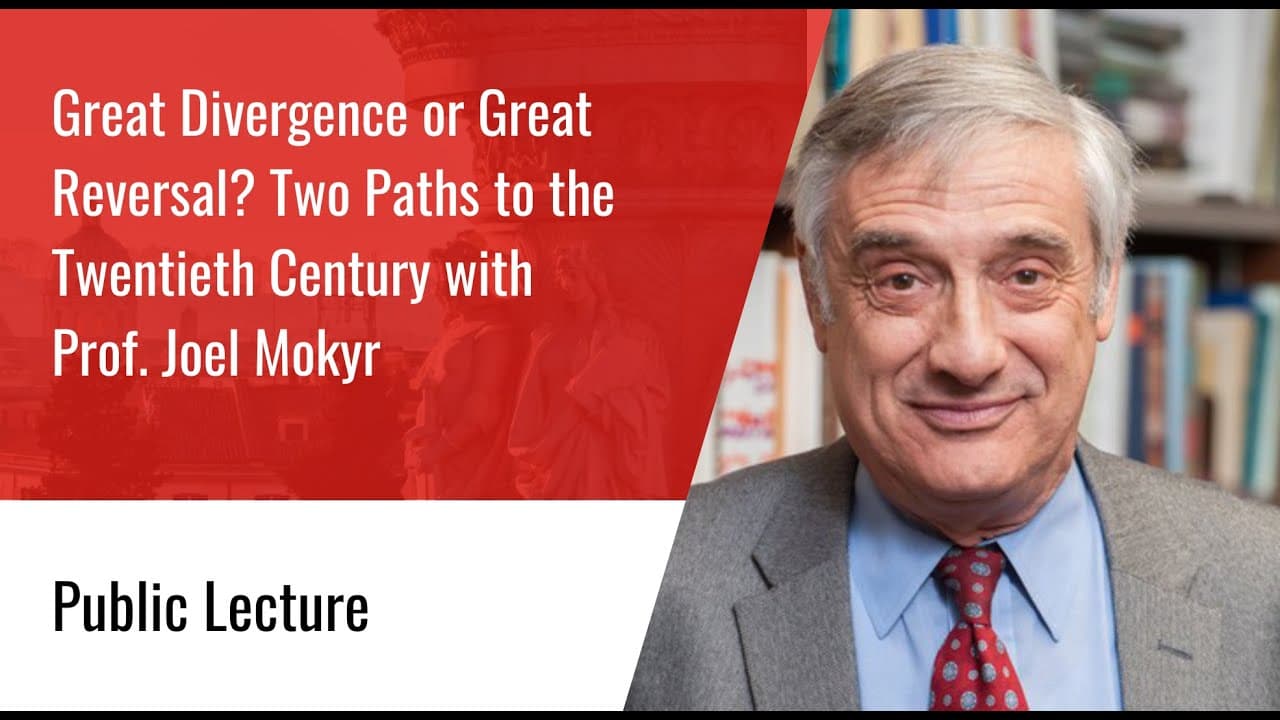
Lecture: Great Divergence or Great Reversal? Two Paths to the Twentieth Century - Prof Joel Mokyr
TL;DR
The talk examines the historical cultural dynamics between Europe and China that shaped modern economic outcomes.
Transcript
it's really good to see so many people here and thank you very much for your patience those of you who are familiar with Kings you may know that um there are sometimes timetabling problems I'm afraid we had one of those today so we are a little bit uh late starting the talk this evening but thank you very much for your patience my name is Mark Penn... Read More
Key Insights
- 🌍 The historical context of the "great divergence" highlights the differences in institutional development between Europe and China.
- 👪 Extended kinship in China contributed to stagnation, whereas the development of nuclear families in Europe encouraged innovation and competition.
- ❓ The impact of cultural values on economic progression underscores the importance of individualism in fostering technological advances.
- 👋 The recognition of corporations and social organizations in Europe provided a framework for cooperation and local public goods delivery.
- 🌍 Warfare in Europe necessitated adaptive state structures, fostering economic development and bureaucratic growth.
- ♻️ The varying degrees of state capacity and political decentralization shaped the institutional environments conducive to economic prosperity.
- 💦 Mokyr's work emphasizes the intertwined relationship between culture, institutions, and economic history, challenging previous economic theories that undervalue cultural perspectives.
Install to Summarize YouTube Videos and Get Transcripts
Explore YouTube Video Summarizer or Get YouTube Transcript Extractor
Questions & Answers
Q: What primary factors contributed to the economic divergence between Europe and China from 1000 to 1900?
Mokyr attributes the economic divergence to various factors, including technological innovation, state capacity, and cultural values. In Europe, a fragmented political landscape fostered competition and innovation, whereas China’s centralized bureaucracy stifled creativity and progress over time, particularly after the decline of the Song Dynasty.
Q: How did the concept of kinship influence social organization in China compared to Europe?
In China, extended kinship systems became increasingly dominant after the fall of the Song Dynasty, resulting in families and clans providing social support. In contrast, Europe transitioned to more nuclear family structures, facilitating the formation of corporations and social organizations that fostered cooperation and public goods provision among unrelated individuals.
Q: What role did wars play in shaping institutions and fostering economic development in Europe?
Mokyr explains that while wars complicated political relationships, they also pressured states to develop bureaucratic systems and foster cooperation to win conflicts. Such competition led to advancements in military and political institutions, which ultimately contributed to economic growth and state capacity evolution in Europe, unlike the more stable and less competitive environment in China.
Q: Can cultural values in Europe be credited with the onset of the Industrial Revolution?
Yes, Mokyr suggests that cultural values, particularly individualism and a focus on innovation, uniquely positioned European societies to embrace and drive the Industrial Revolution. The societal values encouraged cooperation among unrelated individuals, leading to the formation of institutions that facilitated economic growth and technological advancements.
Summary & Key Takeaways
-
Mark Pennington introduces Professor Joel Mokyr, highlighting the significance of culture in economic history and the relationship between formal and informal institutions.
-
Mokyr discusses the concept of "great divergence" and "great reversal," focusing on how Europe surpassed China in economic development from 1000 to 1900.
-
He explores the cultural shifts occurring in Europe and China, emphasizing individualism and extended kinship while linking these trends to institutional development and economic growth.
Read in Other Languages (beta)
Share This Summary 📚
Summarize YouTube Videos and Get Video Transcripts with 1-Click
Try YouTube Summary with ChatGPT & Claude or YouTube Transcript Generator