23.2 Potential Energy of Gravity near the Surface of the Earth
TL;DR
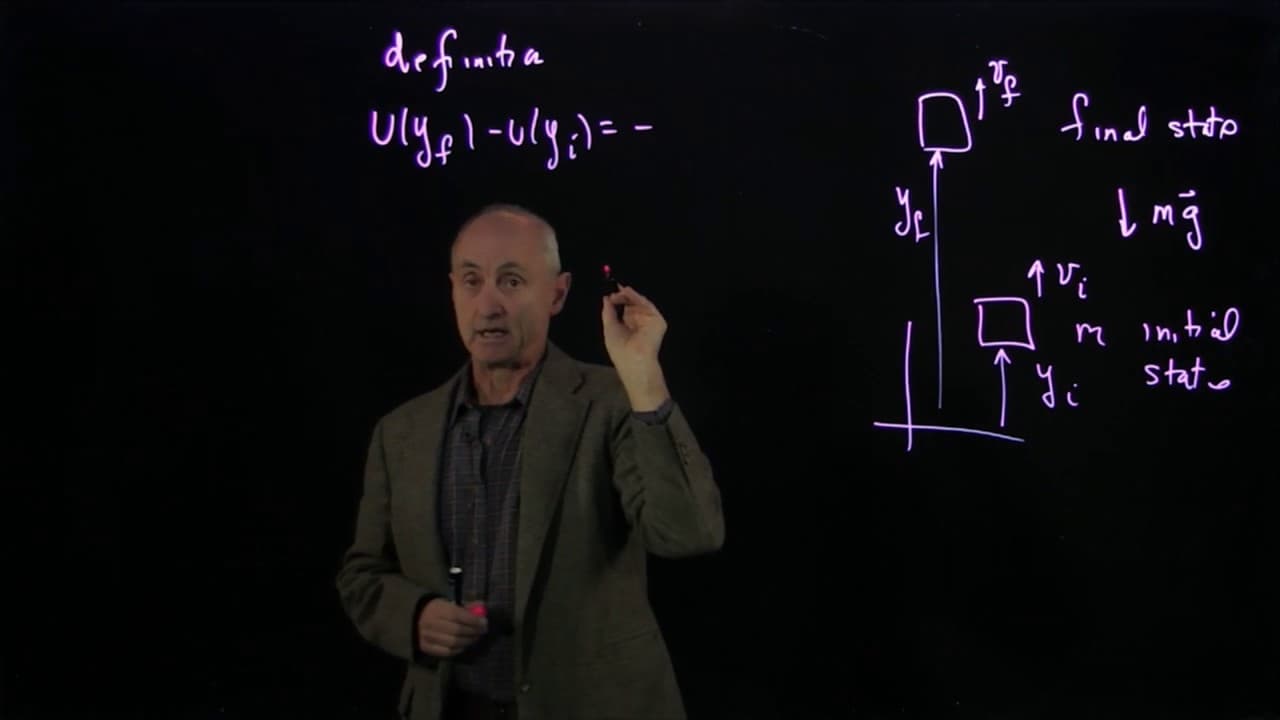
The potential energy difference between two points is defined as the negative of the work done by a conservative force, and it depends on the initial and final heights.
Transcript
We now would like to explore the concept of potential energy difference for a conservative force. Let's consider the following case. Suppose you have an object of mass m and it's located at a certain height y i initial. And so this is our initial state. And we would like to move this object upwards. So it goes up to a height y final. This is our fi... Read More
Key Insights
- 😥 The potential energy difference is determined by the work done by a conservative force in moving an object between two points.
- 🥡 The potential energy difference depends on the initial and final heights, regardless of the path taken.
- 🤨 Raising an object leads to an increase in potential energy, while lowering it results in a decrease.
- 🤘 The definition of potential energy difference includes a negative sign because gravitational force is a conservative force.
- 💱 The change in potential energy is equal to the mass multiplied by the acceleration due to gravity and the change in displacement.
- 💱 The potential energy difference can be positive, negative, or zero depending on the change in height.
- 🔨 The concept of potential energy difference is a useful tool in analyzing the behavior of conservative forces.
Install to Summarize YouTube Videos and Get Transcripts
Explore YouTube Video Summarizer or Get YouTube Transcript Extractor
Questions & Answers
Q: How is the potential energy difference defined?
The potential energy difference between two points is defined as the negative of the work done by the conservative force in moving the object from the initial state to the final state.
Q: What determines the potential energy difference?
The potential energy difference depends on the initial and final heights of the object.
Q: Why is the potential energy increasing when we raise something?
When an object is raised, the gravitational force points downward while the displacement is upward. The negative work done by the force and the extra minus sign in the definition result in a positive change in potential energy.
Q: What happens to the potential energy when an object is lowered?
When an object is lowered, the gravitational force and displacement are both downward. The positive work done by the force and the extra minus sign in the definition result in a negative change in potential energy.
Summary & Key Takeaways
-
The potential energy difference for a conservative force is determined by the work done by the force in moving an object from an initial state to a final state.
-
The potential energy difference is defined as the negative of the work done by the gravitational force.
-
The change in potential energy is equal to the product of the mass, acceleration due to gravity, and the change in displacement.
Read in Other Languages (beta)
Share This Summary 📚
Summarize YouTube Videos and Get Video Transcripts with 1-Click
Try YouTube Summary with ChatGPT & Claude or YouTube Transcript Generator
Explore More Summaries from MIT OpenCourseWare 📚



Summarize YouTube Videos and Get Video Transcripts with 1-Click
Try YouTube Summary with ChatGPT & Claude or YouTube Transcript Generator