What Is the Linearity of Expectations in Probability?
TL;DR
The linearity of expectations states that the expected value of the sum of two or more random variables equals the sum of their expected values. This principle applies to any finite number of random variables and is crucial for calculating the mean of binomial random variables, allowing us to express complex random variables as sums of simpler, easier-to-analyze parts.
Transcript
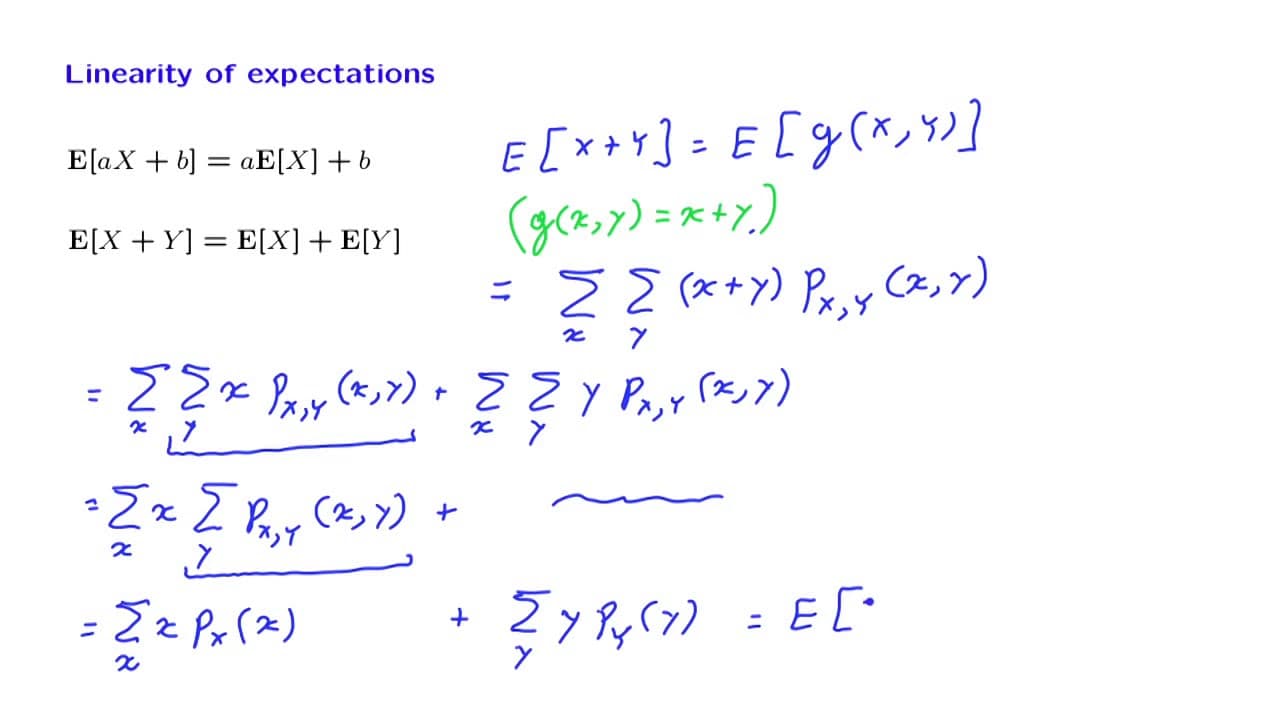
Let us now revisit the subject of expectations and develop an important linearity property for the case where we're dealing with multiple random variables. We already have a linearity property. If we have a linear function of a single random variable, then expectations behave in a linear fashion. But now, if we have multiple random variables, we ha... Read More
Key Insights
- 🍹 The linearity property states that the expected value of the sum of two random variables is equal to the sum of their individual expected values.
- #️⃣ The linearity property can be extended to any finite number of random variables.
- 🍹 The linearity of expectations can be applied to find the expected value of a function of two random variables by summing over all possible values.
- 😑 Indicator variables can be used to express a random variable as a sum of simpler random variables.
- 🍹 The linearity of expectations can be used to find the mean of a binomial random variable by considering it as the sum of indicator variables.
- 🟰 The expected value of each indicator variable representing a binomial trial is equal to the success probability.
- 🤑 The linearity of expectations is a powerful tool for breaking up complicated random variables into simpler ones for analysis.
Install to Summarize YouTube Videos and Get Transcripts
Explore YouTube Video Summarizer or Get YouTube Transcript Extractor
Questions & Answers
Q: What is the linearity property?
The linearity property states that the expected value of the sum of two random variables is equal to the sum of their individual expected values. This property holds for any two random variables.
Q: Can the linearity property be extended to more than two random variables?
Yes, the linearity property can be extended to any finite number of random variables. The expected value of the sum of multiple random variables is equal to the sum of their individual expected values.
Q: How is the linearity property applied to find the expected value of a function of two random variables?
To find the expected value of a function of two random variables, we apply the linearity property by summing over all possible values of the random variables and weighting them according to their joint probability mass function.
Q: How is the linearity property used to find the mean of a binomial random variable?
The linearity property is used to find the mean of a binomial random variable by expressing it as a sum of simpler random variables called indicator variables. Each indicator variable represents the success or failure of an individual trial. The expected value of each indicator variable is equal to the success probability, and the sum of these expected values gives the mean of the binomial random variable.
Summary & Key Takeaways
-
The linearity property states that the expected value of the sum of two random variables is equal to the sum of their individual expected values.
-
This property can be extended to any finite number of random variables.
-
The linearity of expectations can be used to find the mean of a binomial random variable, which represents the number of successes in a fixed number of trials.
Read in Other Languages (beta)
Share This Summary 📚
Summarize YouTube Videos and Get Video Transcripts with 1-Click
Try YouTube Summary with ChatGPT & Claude or YouTube Transcript Generator
Explore More Summaries from MIT OpenCourseWare 📚



Summarize YouTube Videos and Get Video Transcripts with 1-Click
Try YouTube Summary with ChatGPT & Claude or YouTube Transcript Generator