L07.2 Conditional PMFs
TL;DR
The video explains the concept of conditional probability mass function (PMF) and joint PMF, and how they can be used to calculate probabilities for specific values of random variables given certain conditions.
Transcript
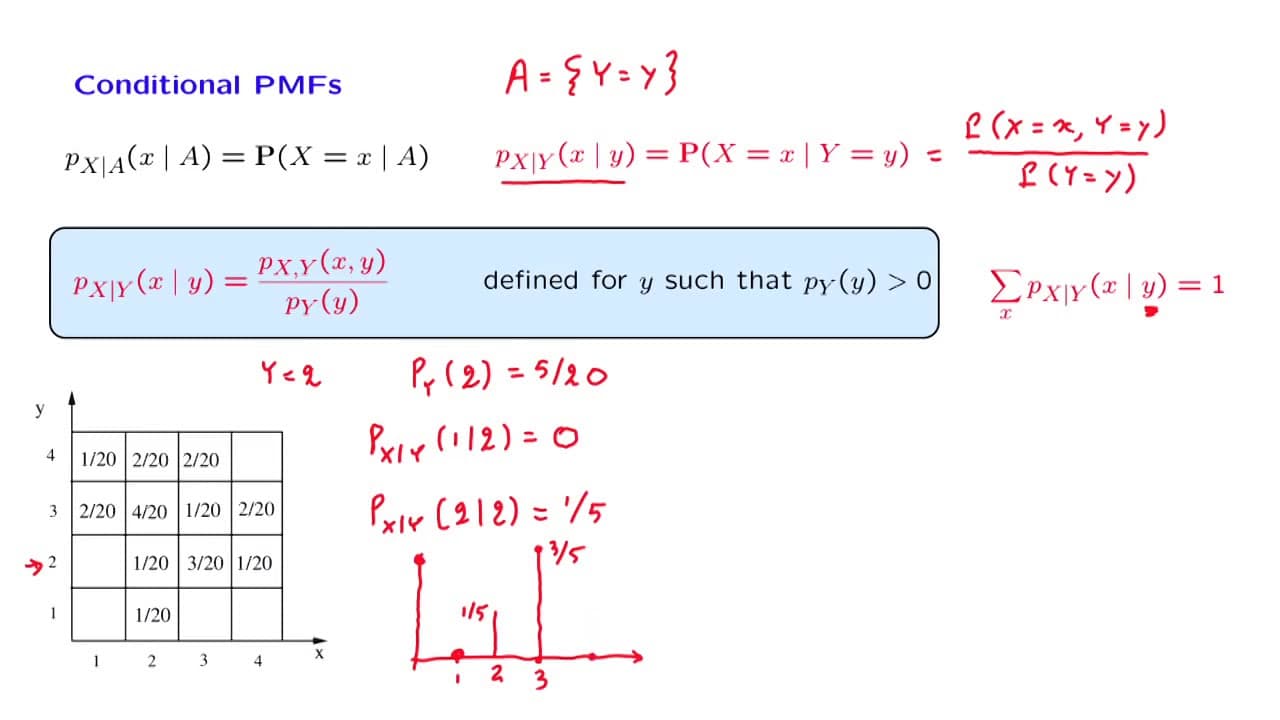
We have already introduced the concept of the conditional PMF of a random variable, X, given an event A. We will now consider the case where we condition on the value of another random variable Y. That is, we let A be the event that some other random variable, Y, takes on a specific value, little y. In this case, we're talking about a conditional p... Read More
Key Insights
- ❓ Conditional PMFs are used to calculate probabilities for specific values of random variables given certain conditions.
- 🥳 The conditional PMF is defined as the ratio of the joint PMF to the corresponding marginal PMF.
- ❓ Conditional PMFs are only defined when the conditioning event has a positive probability.
- ❓ The values of a conditional PMF will vary depending on the value of the conditioning random variable.
- 📏 The multiplication rule can be used to specify probability models for multiple random variables.
- ❓ By specifying the distribution of one random variable and the conditional PMFs of the other variables, a full probability model can be determined.
- ❓ Conditional PMFs can be calculated for more than two random variables using similar principles.
Install to Summarize YouTube Videos and Get Transcripts
Explore YouTube Video Summarizer or Get YouTube Transcript Extractor
Questions & Answers
Q: What is the definition of a conditional PMF?
A conditional PMF is the ratio of the joint PMF to the corresponding marginal PMF. It calculates the probability of a specific value for a random variable, given that another random variable has taken on a specific value.
Q: When are conditional probabilities and conditional PMFs defined?
Conditional probabilities and conditional PMFs are defined when the conditioning event has a positive probability. The conditional probability will only be defined for values of the random variable that have a positive probability of occurring.
Q: How can a conditional PMF be calculated?
To calculate a conditional PMF, you need to know the joint PMF and the marginal PMF. The conditional PMF is obtained by dividing the joint PMF by the corresponding marginal PMF.
Q: Can conditional PMFs be calculated for more than two random variables?
Yes, conditional PMFs can be calculated for more than two random variables. The notation used for expressing conditional PMFs with multiple random variables makes it clear which variables are being conditioned on.
Summary & Key Takeaways
-
Conditional PMF is a probability distribution that calculates the probability of a random variable taking on a specific value, given that another random variable has taken on a specific value.
-
The conditional PMF is defined as the ratio of the joint PMF to the corresponding marginal PMF.
-
Conditional PMFs are only defined when the conditioning event has a positive probability, and will only be defined for values of the random variable that have a positive probability of occurring.
Read in Other Languages (beta)
Share This Summary 📚
Summarize YouTube Videos and Get Video Transcripts with 1-Click
Try YouTube Summary with ChatGPT & Claude or YouTube Transcript Generator
Explore More Summaries from MIT OpenCourseWare 📚



Summarize YouTube Videos and Get Video Transcripts with 1-Click
Try YouTube Summary with ChatGPT & Claude or YouTube Transcript Generator