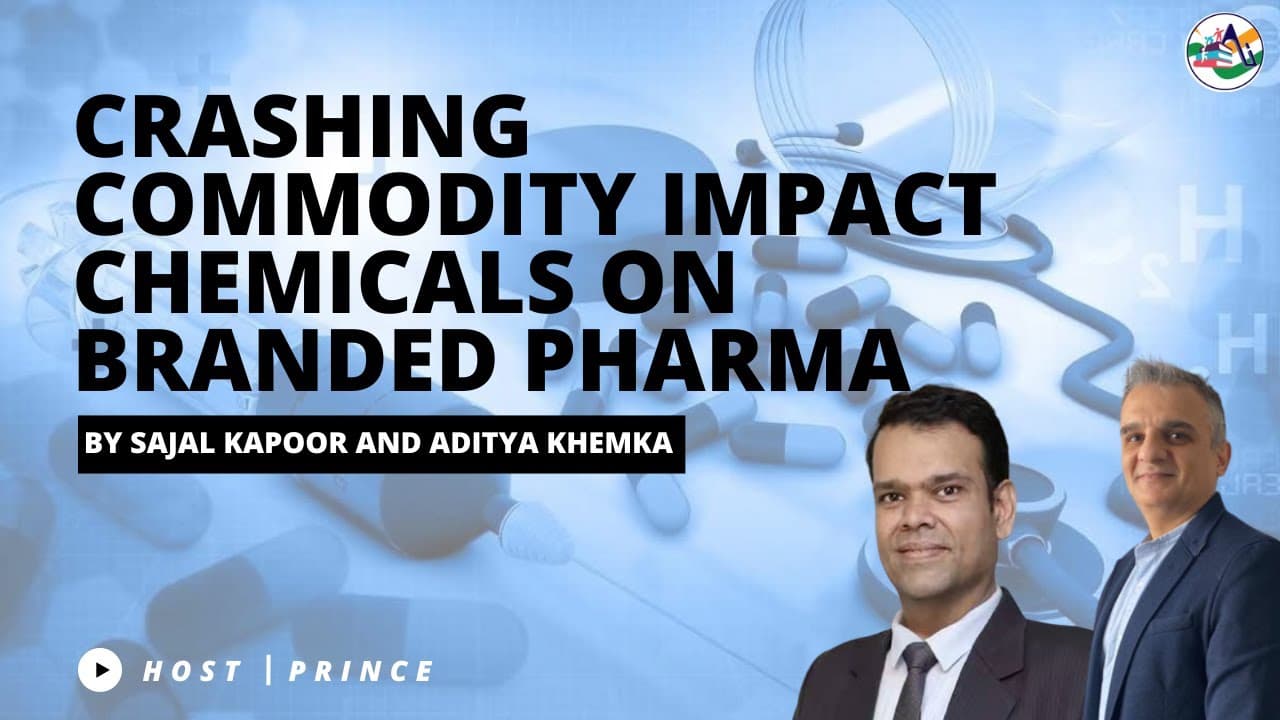
Impact of Crashing Commodity Chemicals on Branded Pharma | Sajal Kapoor | Aditya Khemka
TL;DR
Commodity price corrections could affect branded pharma companies differently due to their pricing power, with API and chemical companies potentially benefiting from cheaper raw materials, while formulators may initially face price erosion.
Transcript
just in terms of disclaimer look whatever we discuss is purely for educational purposes even if I take any company names stock names it is not a buy sell recommendation it is just my view and opinion on the name and is purely shared to you from uh you know education framework construct standpoint do not trade or invest based on these opinions these... Read More
Key Insights
- 🥺 The availability of cheaper raw materials from China could benefit API and chemical companies, potentially leading to higher margins.
- 😀 Branded pharma companies may still face price pressure in the US and European markets, impacting their margins.
- 🧭 The distinction between branded and unbranded pharma companies affects their ability to pass on price increases to consumers.
- 👨💼 The valuation discrepancies between larger branded pharma companies and smaller branded companies may be influenced by liquidity preferences rather than fundamental business quality.
- 🧑🏭 The impact of commodity price corrections on the pharma industry depends on various factors, including competition, input costs, and regulatory frameworks.
- Ⓜ️ Understanding the difference between development (D) and manufacturing (M) in CDMO businesses helps determine their gross margins and growth prospects.
- 💚 The current focus on greener chemical manufacturing methods aligns with evolving global sustainability demands.
- 🔠 El Niño and monsoon seasons in India do not necessarily correlate with the performance of agri-chemical and input companies.
- 😀 Gland Pharma's business model, as an unbanded generics manufacturer, may face challenges with pricing pressure and competition.
Install to Summarize YouTube Videos and Get Transcripts
Explore YouTube Video Summarizer or Get YouTube Transcript Extractor
Questions & Answers
Q: How do branded pharma companies differ from unbranded or API companies?
Branded pharma companies have pricing power, allowing them to pass on price increases to consumers. Unbranded and API companies often face price pressure due to market competition.
Q: How have raw material price increases impacted the pharma industry?
API and chemical companies faced raw material inflation, resulting in higher expenses. However, due to competition, they were unable to fully pass on the price increases to formulators, resulting in reduced margins.
Q: How might the correction in commodity prices affect API and chemical companies?
If raw material prices cool off, API companies could benefit from buying cheaper materials from China, resulting in higher margins. Chemical companies may face price erosion and volume loss due to competition from cheaper Chinese imports.
Q: What impact could this have on formulators in the pharma industry?
Formulators may not immediately see improvements in margins due to continued purchases of higher-priced API inventory. However, they may eventually benefit from lower API costs and request price cuts from API companies to maintain their margins.
Key Insights:
- The availability of cheaper raw materials from China could benefit API and chemical companies, potentially leading to higher margins.
- Branded pharma companies may still face price pressure in the US and European markets, impacting their margins.
- The distinction between branded and unbranded pharma companies affects their ability to pass on price increases to consumers.
- The valuation discrepancies between larger branded pharma companies and smaller branded companies may be influenced by liquidity preferences rather than fundamental business quality.
- The impact of commodity price corrections on the pharma industry depends on various factors, including competition, input costs, and regulatory frameworks.
- Understanding the difference between development (D) and manufacturing (M) in CDMO businesses helps determine their gross margins and growth prospects.
- The current focus on greener chemical manufacturing methods aligns with evolving global sustainability demands.
- El Niño and monsoon seasons in India do not necessarily correlate with the performance of agri-chemical and input companies.
- Gland Pharma's business model, as an unbanded generics manufacturer, may face challenges with pricing pressure and competition.
- Enzymatic routes in manufacturing can benefit companies in terms of sustainability and decarbonization efforts but may require careful scale-up and commercial viability assessments.
Summary & Key Takeaways
-
Branded pharma companies have pricing power, unlike unbranded or API companies, allowing them to pass on price increases to consumers.
-
In the past, API and chemical companies faced raw material inflation, resulting in price increases that were not fully realized due to market competition.
-
Recent data suggests that raw material price increases may begin to cool off, benefiting API and chemical companies with cheaper materials.
-
Formulators may also benefit from lower API costs, as their raw material expenses decrease; however, they may still experience price pressure in the US and European markets.
Read in Other Languages (beta)
Share This Summary 📚
Summarize YouTube Videos and Get Video Transcripts with 1-Click
Try YouTube Summary with ChatGPT & Claude or YouTube Transcript Generator
Explore More Summaries from Accidental Investor Prince 📚


Summarize YouTube Videos and Get Video Transcripts with 1-Click
Try YouTube Summary with ChatGPT & Claude or YouTube Transcript Generator