Parallelism in Python | Guido van Rossum and Lex Fridman
TL;DR
This content discusses the concepts of parallelism, concurrency, threading, and asynchronous IO, and how they relate to Python programming.
Transcript
let me talk to you about parallelism in your post titled reasoning about async IO semaphore you talk about a fast food restaurant Silicon Valley that has only one table is this a real thing I just wanted to ask you about that is that just like a metaphor you're using or is that an actual restaurant in Silicon Valley it was it was a metaphor of cour... Read More
Key Insights
- 😋 The metaphor of a fast food restaurant with one table serves as an engaging introduction to the concepts of parallelism and concurrency.
- 🧵 Python's Global Interpreter Lock (GIL) was initially introduced to make thread management easier but restricts true parallelism. Multiple sub interpreters and a specialized no-GIL interpreter are possible future solutions.
- 🚦 Implementing synchronization primitives like locks and semaphores can be challenging due to the difficulty of managing multiple variables and ordered operations.
- 👻 Async IO in Python provides a way to handle IO-bound operations efficiently by allowing tasks to work concurrently and asynchronously.
- ™️ The trade-off between parallelism and complexity/performance is an ongoing debate in the Python community, with different opinions on whether the GIL is the optimal solution.
Install to Summarize YouTube Videos and Get Transcripts
Explore YouTube Video Summarizer or Get YouTube Transcript Extractor
Questions & Answers
Q: What is the difference between parallelism and concurrency?
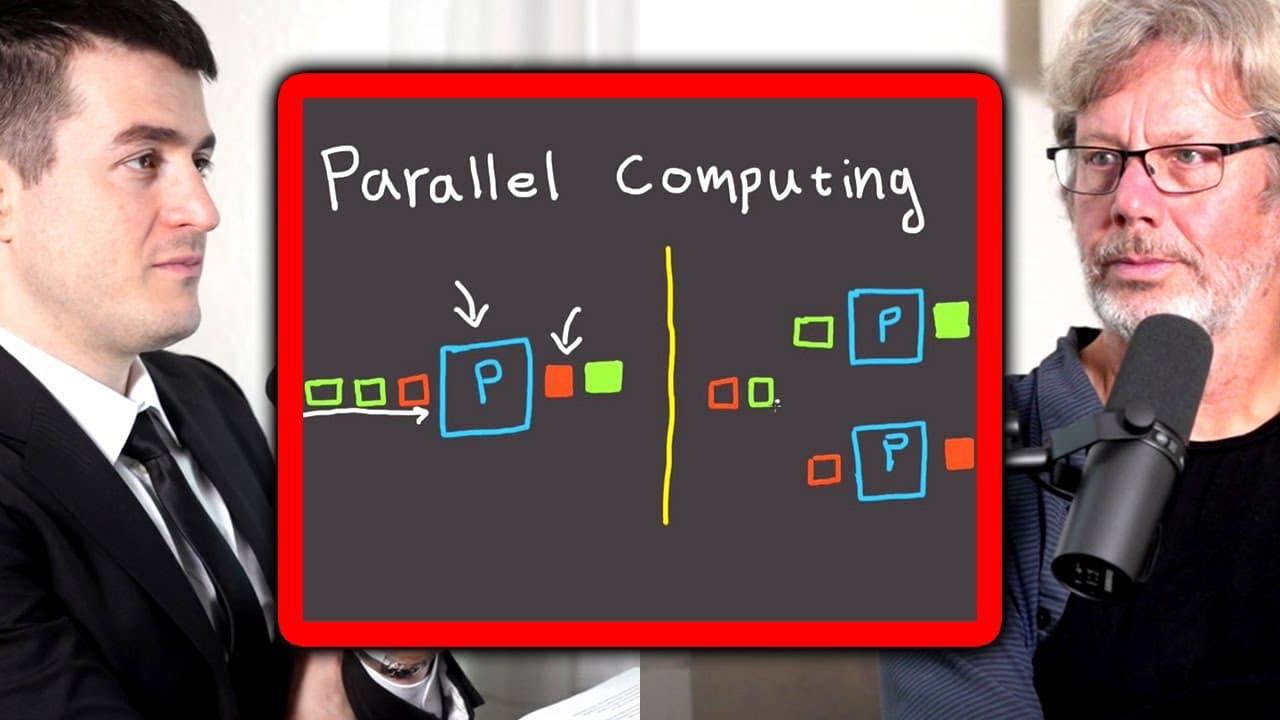
In parallelism, multiple CPUs work together on different tasks simultaneously, while concurrency involves switching between tasks to create the illusion of simultaneous execution.
Q: Why is implementing synchronization primitives hard?
Our brains are not naturally adept at keeping track of multiple things simultaneously. When coding, it becomes challenging to manage the different variables and anticipate all possible orderings of operations.
Q: What are locks and semaphores used for?
Locks ensure that only one process can access a shared resource at a time, while semaphores allow for more complex scenarios with multiple resources and signaling.
Q: How does Python's async IO work?
Async IO is a library that enables concurrent and asynchronous programming in Python. It allows for efficient use of CPU resources by handling IO-bound operations asynchronously.
Summary & Key Takeaways
-
The content begins with a metaphor of a fast food restaurant in Silicon Valley with only one table, which serves as an introduction to the concepts of parallelism and concurrency.
-
The speaker explains that parallelism refers to the use of multiple CPUs to increase productivity, while concurrency involves the illusion of simultaneous execution by switching between different tasks.
-
The difficulties in implementing synchronization primitives, such as locks and semaphores, are discussed, highlighting the challenges of managing multiple variables and ordered operations.
Read in Other Languages (beta)
Share This Summary 📚
Summarize YouTube Videos and Get Video Transcripts with 1-Click
Try YouTube Summary with ChatGPT & Claude or YouTube Transcript Generator
Explore More Summaries from Lex Clips 📚




Summarize YouTube Videos and Get Video Transcripts with 1-Click
Try YouTube Summary with ChatGPT & Claude or YouTube Transcript Generator