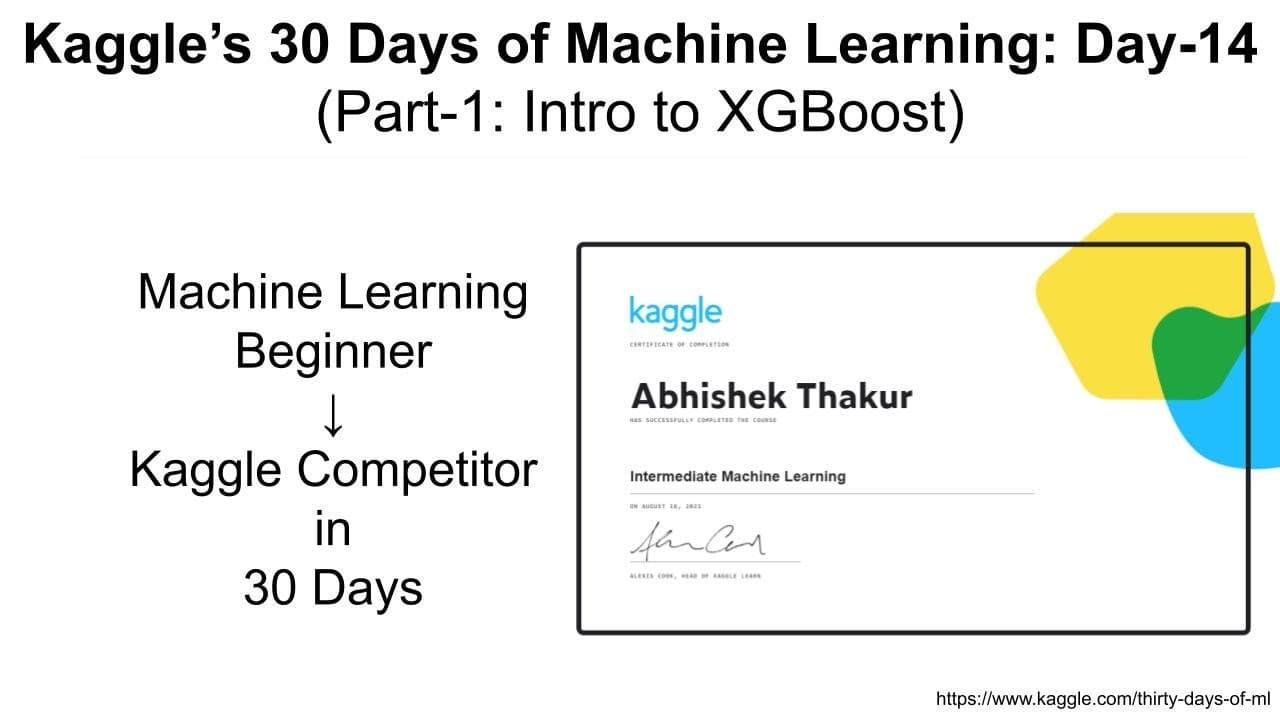
Kaggle's 30 Days Of ML (Day-14 Part-1): Intro to XGBoost
TL;DR
This video provides an overview of gradient boosting, which is an ensemble-based machine learning model used for improving predictions.
Transcript
hello everyone and welcome to my youtube channel this is day 14 of kaggle's 30 days of machine learning challenge and today is the last day for intermediate machine learning today we are going to learn about gradient boosting and data leakage but today is divided into two parts so this is part one and it's about gradient boosting what is gradient b... Read More
Key Insights
- 😒 Gradient boosting is an ensemble-based machine learning model that uses a naive model and iterative training to improve predictions.
- 📚 XGBoost is a popular library for implementing gradient boosting, providing various parameters and functionalities for optimization.
- ☠️ Parameter tuning, such as adjusting the number of estimators and learning rate, is important for optimizing the performance of gradient boosting models.
- 🌸 Understanding the concept of loss, calculating it, and training new models based on the loss are fundamental aspects of gradient boosting.
- 📚 Different gradient boosting libraries, such as CatBoost and LightGBM, offer alternative implementations and functionalities.
- ☠️ The choice of learning rate and the number of estimators requires careful consideration for optimal performance.
- 😅 Aligning columns and performing one-hot encoding are necessary steps to ensure the input data matches the model's requirements.
Install to Summarize YouTube Videos and Get Transcripts
Explore YouTube Video Summarizer or Get YouTube Transcript Extractor
Questions & Answers
Q: What is gradient boosting and how does it work?
Gradient boosting is an ensemble-based machine learning model that uses a naive model to make predictions. It trains new models based on the calculated loss, ultimately reducing the overall loss of the ensemble.
Q: What is the difference between gradient boosting and random forest?
Both gradient boosting and random forest are ensemble-based models, but gradient boosting uses boosting, while random forest uses bagging. Gradient boosting focuses on reducing the loss and improving predictions through iterative training of new models.
Q: How does XGBoost differ from other Gradient Boosting libraries?
XGBoost is a popular library for implementing gradient boosting. It provides various parameters and functionalities for tuning the model. Other gradient boosting libraries, such as CatBoost and LightGBM, have different features and implementations.
Q: Why is parameter tuning necessary in gradient boosting?
Parameter tuning, such as adjusting the number of estimators and learning rate, is crucial in gradient boosting to optimize the model's performance. It helps prevent overfitting and ensures that the model achieves the best results.
Summary & Key Takeaways
-
Gradient boosting is an ensemble-based model that uses a naive model (often decision trees) to make predictions and train new models based on the calculated loss.
-
XGBoost is one of the popular libraries for implementing gradient boosting.
-
Parameter tuning, such as adjusting the number of estimators and learning rate, is important for improving the model's performance.
Read in Other Languages (beta)
Share This Summary 📚
Summarize YouTube Videos and Get Video Transcripts with 1-Click
Try YouTube Summary with ChatGPT & Claude or YouTube Transcript Generator
Explore More Summaries from Abhishek Thakur 📚

Summarize YouTube Videos and Get Video Transcripts with 1-Click
Try YouTube Summary with ChatGPT & Claude or YouTube Transcript Generator