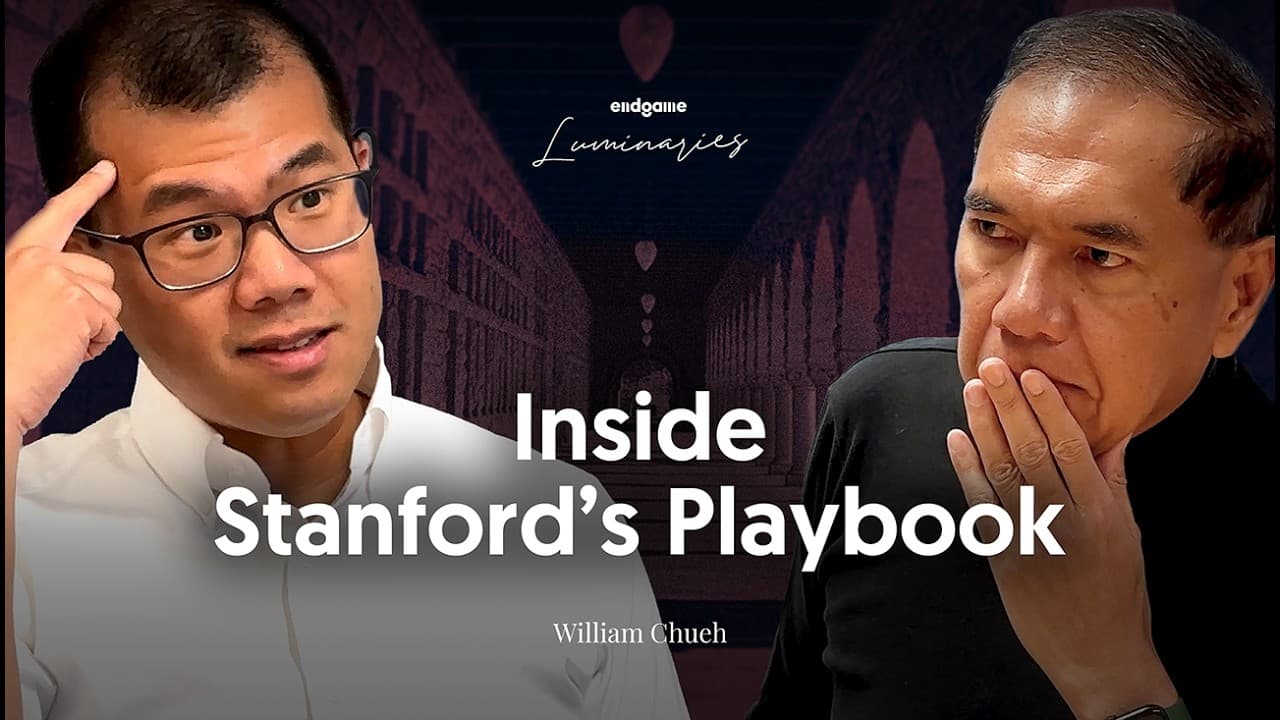
1 Hour of Pure Academic Gold on Energy Transition - William Chueh | Endgame #224 (Luminaries)
TL;DR
Exploring energy transition challenges and Stanford's educational impact.
Transcript
At Stanford, I'm constantly challenged by my students. My students would tell me, "I don't like to learn this way, like this is outdated, or this is not useful. This is not impactful." Stanford realized many decades ago that our superpower is to scale through our students. Most of the students when they leave Stanford, they often don't end up pract... Read More
Key Insights
- Stanford's educational approach emphasizes creativity and entrepreneurial spirit, fostering a mindset to innovate beyond traditional learning.
- William Chueh's journey from Taiwan to the US highlights the importance of educational opportunities and the nurturing of immigrant talent.
- The collaboration between US creativity and Taiwan's industrialization exemplifies how diverse strengths can drive global innovation.
- The energy transition faces challenges in balancing sustainability, affordability, and security, requiring strategic investments and innovation.
- Stanford's role in energy innovation focuses on shaping mindsets and fostering collaboration between academia and entrepreneurship.
- Battery technology evolution mirrors that of semiconductors, with ongoing efforts to improve energy density and reduce costs.
- Solar energy is seen as a key democratizer, but challenges remain in reducing system-level costs and improving installation efficiency.
- The future of energy involves a mix of solutions, including renewables and fuels, with a focus on achieving net-zero emissions.
Install to Summarize YouTube Videos and Get Transcripts
Explore YouTube Video Summarizer or Get YouTube Transcript Extractor
Questions & Answers
Q: What is Stanford's approach to fostering innovation?
Stanford fosters innovation by emphasizing a mindset shift in students, encouraging creativity and entrepreneurial spirit. The university focuses on influencing students' mindsets early in their careers, allowing them to think beyond textbooks and embrace new ideas. This approach has led to a culture of innovation and collaboration with entrepreneurship.
Q: How does William Chueh view the role of education in his personal journey?
William Chueh views education as a pivotal factor in his personal journey, highlighting the opportunities he received as an immigrant in the US. His upbringing in Taiwan and transition to the US education system exemplifies the nurturing of talent and the importance of providing educational opportunities to shape future innovators.
Q: What are the challenges in the energy transition discussed in the video?
The energy transition faces challenges in balancing sustainability, affordability, and security. Strategic investments are needed to unlock capital and drive the transition forward. Chueh emphasizes the importance of co-optimizing these factors to ensure a successful transition to clean energy, highlighting the need for innovative solutions and collaboration.
Q: What is the significance of battery technology in the energy transition?
Battery technology plays a crucial role in the energy transition, with ongoing efforts to improve energy density and reduce costs. The evolution of batteries is compared to semiconductors, with a focus on achieving breakthroughs that offer both high energy density and low cost. This is essential for the widespread adoption of electric vehicles and renewable energy systems.
Q: How does solar energy contribute to democratizing energy?
Solar energy is seen as a key democratizer of energy, with significant cost reductions over the years. However, challenges remain in reducing system-level costs, such as installation and power electronics. Innovating on these fronts can increase solar energy's penetration, making it more accessible and affordable globally.
Q: What is the role of fuels in the future energy system?
Fuels will continue to play a critical role in the energy system due to their high energy density. The challenge lies in achieving a net-zero future while using fuels as an energy carrier. This involves exploring carbon capture, utilization, and storage solutions, as well as developing sustainable fuels to reduce greenhouse gas emissions.
Q: What are the potential impacts of AI and robotics on energy demand?
AI and robotics are expected to significantly increase energy demand due to their data and compute intensity. Chueh emphasizes the importance of improving energy efficiency in AI algorithms and hardware to manage this demand. This will be crucial in ensuring that AI and robotics can be integrated sustainably into the global economy.
Q: How can the existing energy grid adapt to increased renewable penetration?
The existing energy grid faces challenges with increased renewable penetration, as it was designed for unidirectional energy flow. Upgrading the grid to handle bidirectional flow and incorporating advanced power electronics and control systems is essential. This will enable the efficient integration of renewables and improve grid reliability, especially in the face of extreme weather events.
Summary & Key Takeaways
-
William Chueh discusses the role of Stanford in fostering innovation through education, emphasizing the importance of mindset and creativity in students. He highlights the complementary strengths of US creativity and Taiwan's industrial capabilities in driving global innovation.
-
The energy transition is explored, focusing on the need to balance sustainability, affordability, and security. Chueh discusses the challenges in scaling renewables and the role of strategic investments in driving the transition forward.
-
Battery technology and solar energy are identified as key components in democratizing energy. Chueh emphasizes the need for innovation in reducing system-level costs and improving installation efficiency to increase the penetration of renewables.
Read in Other Languages (beta)
Share This Summary 📚
Summarize YouTube Videos and Get Video Transcripts with 1-Click
Try YouTube Summary with ChatGPT & Claude or YouTube Transcript Generator
Explore More Summaries from Gita Wirjawan 📚



Summarize YouTube Videos and Get Video Transcripts with 1-Click
Try YouTube Summary with ChatGPT & Claude or YouTube Transcript Generator