Bode plot | Stability analysis | Example | GM & PM | CS | Control Systems | Lec-89
TL;DR
Discusses methods to determine stability using Bode plots.
Transcript
hello everyone in this session we will discuss some problems here the problem is identify the stability for given body plot so boda plot is given just by using this water plots just identify the given system is stable or not so here the first question is you given db db means what is this this is the magnitude plot first thing that value is it is a... Read More
Key Insights
- ❓ Stability can be assessed using Bode plots through two primary methods, focusing on crossover frequencies and margins.
- 🉐 A system is stable if the gain crossover frequency is less than the phase crossover frequency.
- 🎏 Gain margin reflects the additional gain before instability arises, while phase margin indicates phase lag tolerance.
- 0️⃣ Marginal stability occurs when gain and phase margins are both zero, indicating sensitivity to disturbances.
- 🦻 Bode plots provide visual insights into system performance, aiding in controller design and stability analysis.
- 🎮 System analysis involves identifying specific frequencies that are critical for stability assessment and controller design.
- 👻 Understanding Bode plot characteristics allows for better control system performance optimization.
Install to Summarize YouTube Videos and Get Transcripts
Explore YouTube Video Summarizer or Get YouTube Transcript Extractor
Questions & Answers
Q: What are Bode plots, and why are they important in control systems?
Bode plots are graphical representations of a system's frequency response, displaying the gain (magnitude) and phase shift as functions of frequency. They are crucial for control engineers because they provide insights into system stability, performance, and dynamics. Analyzing the Bode plot helps identify how changes in system parameters affect stability and response.
Q: What are gain and phase crossover frequencies?
Gain crossover frequency is the frequency at which the magnitude of the system's transfer function is 0 dB, indicating unity gain. Phase crossover frequency, on the other hand, is the frequency where the phase shift of the system reaches -180 degrees. These frequencies are key in evaluating system stability and understanding how different frequencies affect the system's behavior.
Q: How do you determine if a system is stable using gain and phase margins?
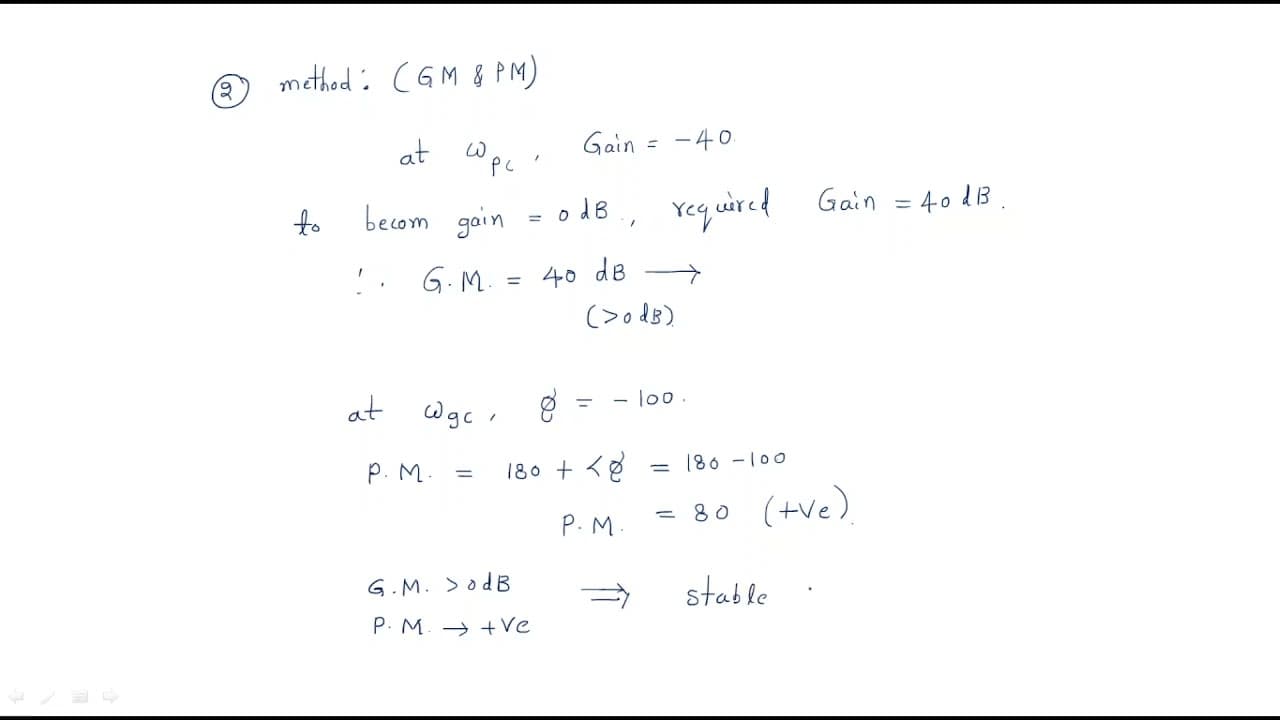
A system is considered stable if its gain margin (the difference in dB between the gain at the phase crossover frequency and 0 dB) is positive and its phase margin (the difference between 180 degrees and the phase at the gain crossover frequency) is also positive. Negative margins indicate instability, while marginal values denote marginal stability.
Q: What does it mean for a system to be marginally stable?
A system is termed marginally stable when its gain margin and phase margin are both zero. This indicates that while the system does not exhibit instability, it is on the verge of oscillatory behavior, and any small disturbance could lead to instability. Such systems require careful tuning to ensure stability.
Q: Can you explain the significance of observing frequency values in Bode plots?
Observing frequency values on Bode plots is critical as they provide the intersection points for gain and phase crossover frequencies, which are essential for evaluating the stability of a system. Analyzing these points helps engineers anticipate how a system will respond to different inputs and disturbances.
Q: What do gain and phase margins indicate about a control system?
Gain margin indicates how much gain can increase before the system becomes unstable, while phase margin indicates how much additional phase lag can be introduced before instability occurs. Both margins provide essential metrics for designing stable systems and assessing robustness against uncertainties and disturbances.
Summary & Key Takeaways
-
The session focuses on identifying the stability of a given system using Bode plots, examining gain and phase crossover frequencies for stability assessment.
-
Two primary methods are described: the first involves determining the gain and phase crossover frequencies, while the second method relies on calculating gain and phase margins to evaluate system stability.
-
Results indicate that a system is stable if the gain crossover frequency is less than the phase crossover frequency, and if both gain margin and phase margin are positive.
Read in Other Languages (beta)
Share This Summary 📚
Summarize YouTube Videos and Get Video Transcripts with 1-Click
Try YouTube Summary with ChatGPT & Claude or YouTube Transcript Generator