The Census and Climate Newsroom AIde
TL;DR
AI tool simplifies complex census and climate data for journalists.
Transcript
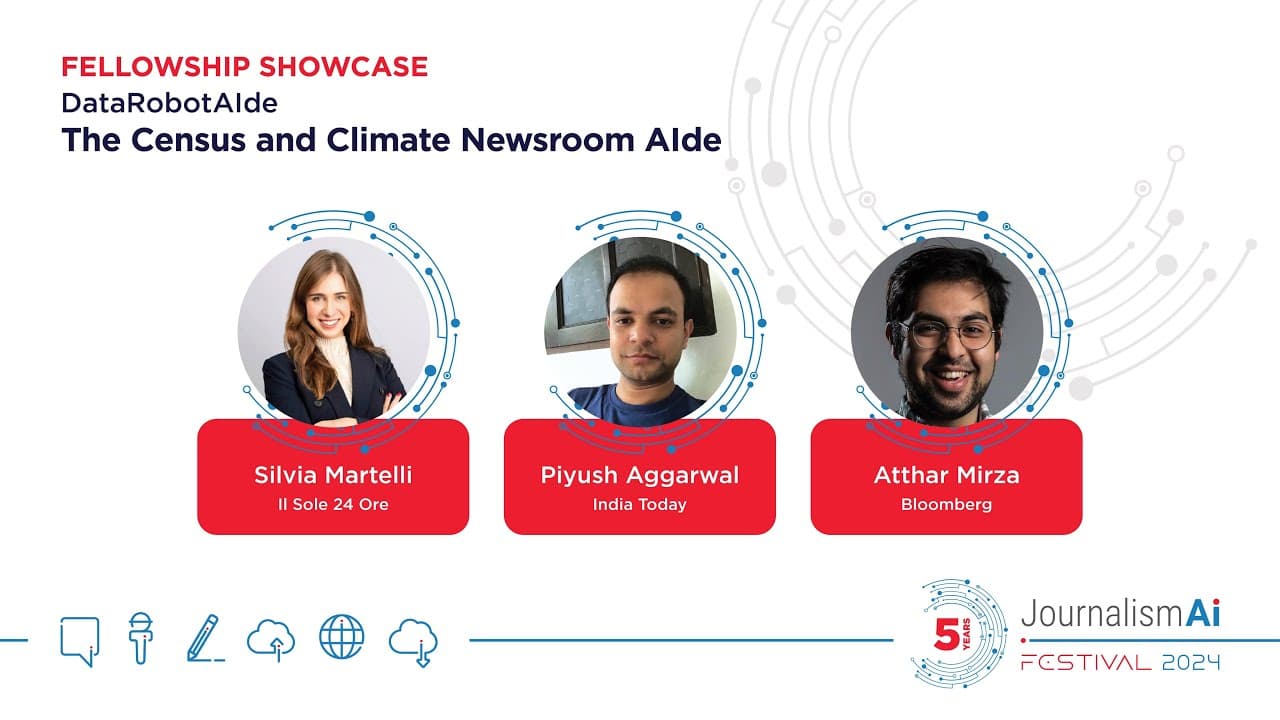
this is a collaboration between journalists and technologists from The Washington Post Bloomberg IL Sol 24 or I'm pretty sure I'm getting that name completely wrong but they're from Italy uh India today from India and they've been developing an AI based tool to navigate complex senses and climate data so uh to speak ... Read More
Key Insights
- The collaboration involves journalists and technologists from major global news organizations, aiming to streamline access to complex census and climate data.
- An AI-based tool has been developed to assist journalists in querying, collecting, and analyzing structured data, addressing two main newsroom needs: quick data access and detailed insights.
- The tool is designed to simplify the overwhelming interfaces of data portals, such as the US Census Bureau, which has over 8,000 demographic variables.
- Challenges with accessing census data vary by country, with India's data being in spreadsheets and Italy's API having similar issues.
- The tool uses generative AI and large language models to allow natural language queries, providing relevant data and enabling advanced analysis.
- The project experimented with different technologies, including open-source language models and various backend solutions, to create a flexible framework.
- The tool's architecture includes features like conversational history and vector databases for semantic checks, enhancing query accuracy.
- Future plans include supporting multiple export formats and improving visualization outputs, making the tool more versatile for journalistic use.
Install to Summarize YouTube Videos and Get Transcripts
Explore YouTube Video Summarizer or Get YouTube Transcript Extractor
Questions & Answers
Q: Can the AI tool be used to fact-check statistical claims?
Yes, the AI tool can be used to fact-check statistical claims by pulling data directly from the Census API. However, while the data retrieval is accurate, the analysis part requires additional checks, which the team addresses by using two different models to compare answers and ensure accuracy.
Q: How does the tool handle complex data access challenges?
The tool simplifies complex data access by using generative AI and large language models, allowing users to make natural language queries. It provides quick access to relevant data and supports advanced analysis, addressing the overwhelming nature of traditional data portals like the US Census Bureau, which has over 8,000 demographic variables.
Q: What technologies were experimented with during the tool's development?
The team experimented with various technologies, including open-source language models like LLaMA, and backend solutions like Google Cloud and AWS. They used frameworks such as Django and FastAPI, and databases like Postgres and ChromaDB, to create a flexible and open framework for the AI tool.
Q: How does the tool ensure accuracy in its responses?
To ensure accuracy, the tool uses two different agents running simultaneously to compare answers. It also incorporates features like conversational history and vector databases for semantic checks, which help in maintaining the accuracy of the responses by referencing similar queries stored in the database.
Q: What are the future plans for the tool's development?
Future plans for the tool include supporting multiple export formats, such as tables and graphics, to enhance visualization outputs. The team is also working on improving the accuracy and usability of the tool, making it more versatile for journalistic use in various data-driven stories.
Q: How does the tool handle different datasets like climate and census data?
The tool is designed to handle different structured datasets by using a flexible architecture that can process any structured data input. It allows users to query datasets like climate and census data using natural language, providing relevant insights and enabling comparisons across different data points.
Q: What challenges did the team face with accessing census data in different countries?
The team faced challenges such as India's census data being in spreadsheets without an API, and Italy's API having similar issues. These challenges were addressed by pivoting to climate data and using generative AI to streamline data access and analysis, making the tool adaptable to different data structures.
Q: How does the tool facilitate journalistic storytelling?
The tool facilitates journalistic storytelling by providing quick access to specific data needed for articles and generating detailed insights into socioeconomic and demographic situations. It simplifies the data retrieval process, allowing journalists to focus on creating stories without the need for specialized data knowledge.
Summary & Key Takeaways
-
The project is a collaboration between journalists and technologists from The Washington Post, Bloomberg, Il Sole 24 Ore, and India Today, aiming to develop an AI tool for navigating complex census and climate data.
-
The tool addresses newsroom challenges by providing quick access to specific data and generating insights into socioeconomic and demographic situations, using generative AI and large language models.
-
The architecture includes features like conversational history and semantic checks, with plans to support multiple export formats and improve visualization outputs, enhancing its utility for journalists.
Read in Other Languages (beta)
Share This Summary 📚
Summarize YouTube Videos and Get Video Transcripts with 1-Click
Try YouTube Summary with ChatGPT & Claude or YouTube Transcript Generator
Explore More Summaries from PolisLSE 📚




Summarize YouTube Videos and Get Video Transcripts with 1-Click
Try YouTube Summary with ChatGPT & Claude or YouTube Transcript Generator