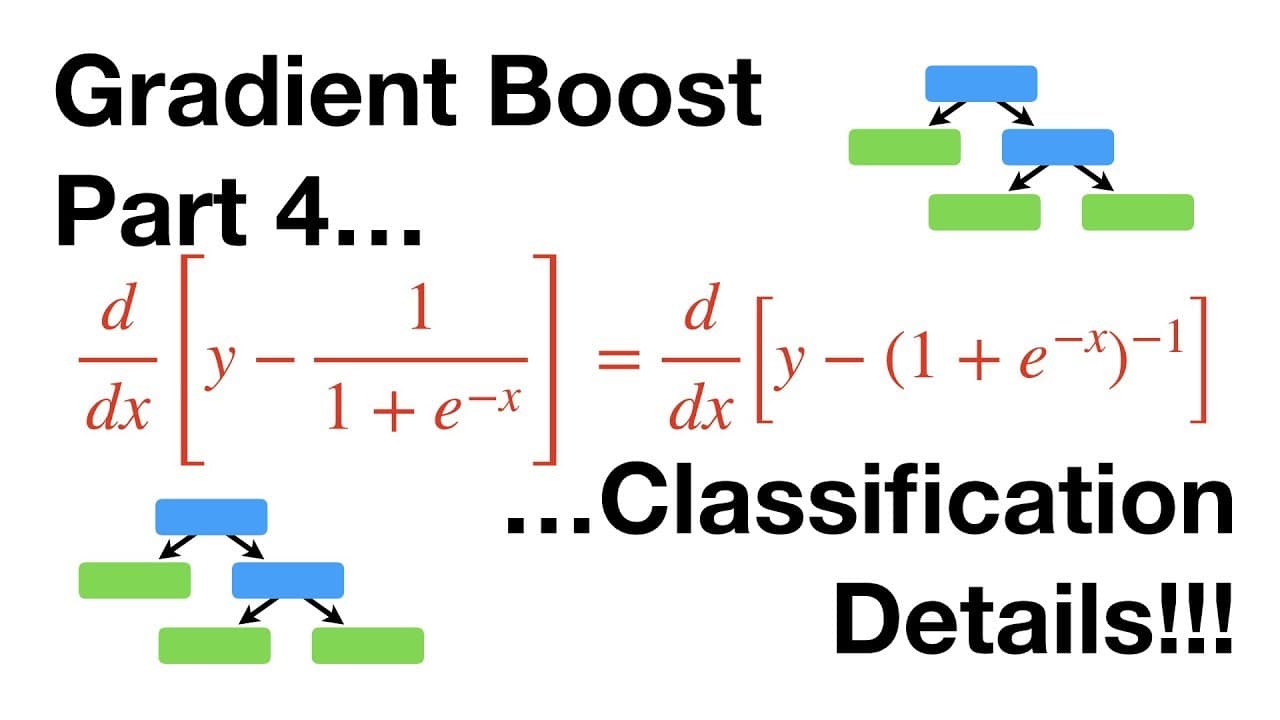
How Does Gradient Boosting Work for Classification?
TL;DR
Gradient boosting for classification optimizes log-odds predictions by incrementally building decision trees based on residual errors. Each iteration updates predictions using a differentiable loss function, allowing the model to refine its accuracy. The approach relies on understanding residuals, learning rates, and the relationships between predicted probabilities and log-odds to enhance classification outcomes.
Transcript
gradient boost for classification seems scary but it's not stat quest hello I'm Josh stormer and welcome to stat quest today we're gonna do gradient boost part 4 we're gonna talk about how gradient boost is used for classification now we're gonna dive deep into the details note this stat quest assumes you've already watched the first three parts in... Read More
Key Insights
- 🧑💻 Gradient boost for classification involves optimizing log-odds predictions through iterative tree-building and prediction adjustments.
- 🌸 Understanding loss functions, residuals, and output values is crucial for implementing the gradient boost algorithm effectively.
- 🎮 The learning rate plays a significant role in controlling the impact of each tree's predictions on the final classification outcomes.
- 🧑💻 Conversion from predicted probabilities to log odds simplifies the process of calculating loss functions in gradient boost for classification.
- 🧑💻 Gradient boost for classification utilizes a step-by-step approach to update predictions based on residuals and optimize log-odds for accurate classification.
- 🤩 Building trees, calculating output values, and making final predictions are key components of the gradient boost algorithm for classification.
- 👻 The algorithm's iterative nature allows for continuous improvement in prediction accuracy for classification tasks.
Install to Summarize YouTube Videos and Get Transcripts
Explore YouTube Video Summarizer or Get YouTube Transcript Extractor
Questions & Answers
Q: What are the key components to consider when using gradient boost for classification?
When using gradient boost for classification, it is crucial to understand log-odds, log likelihood, loss functions, residuals, tree building, output values, and the iterative prediction process.
Q: How does the learning rate impact the gradient boost algorithm for classification?
The learning rate in the gradient boost algorithm for classification controls the rate at which each tree's predictions influence the final outcome, impacting the optimization process and predictive accuracy.
Q: Why is it essential to convert the predicted probabilities to log odds in gradient boost for classification?
Converting predicted probabilities to log odds in gradient boost for classification helps simplify the loss function calculations and makes the optimization process more manageable, leading to better predictions.
Q: How does gradient boost handle the process of updating predictions for classification tasks?
Gradient boost updates predictions in a stepwise manner, iteratively improving log-odds predictions by building trees, computing output values, and adjusting predictions based on residuals to enhance classification accuracy.
Summary & Key Takeaways
-
Explanation of the gradient boost algorithm for classification, diving deep into log-odds and log likelihood.
-
Walkthrough of training data set explanation and loss function calculations for classification.
-
Step-by-step process of building trees, calculating output values, and making predictions for successful classification.
Read in Other Languages (beta)
Share This Summary 📚
Summarize YouTube Videos and Get Video Transcripts with 1-Click
Try YouTube Summary with ChatGPT & Claude or YouTube Transcript Generator
Explore More Summaries from StatQuest with Josh Starmer 📚
Summarize YouTube Videos and Get Video Transcripts with 1-Click
Try YouTube Summary with ChatGPT & Claude or YouTube Transcript Generator