11.2.2 Compiling Expressions
TL;DR
A compiler translates high-level language programs into assembly language by checking for correctness, generating efficient instructions, and optimizing code.
Transcript
A compiler is a program that translates a high-level language program into a functionally equivalent sequence of machine instructions, i.e., an assembly language program. A compiler first checks that the high-level program is correct, i.e., that the statements are well formed, the programmer isn't asking for nonsensical computations, e.g., adding a... Read More
Key Insights
- ✋ A compiler translates high-level language programs into assembly language, ensuring correctness and generating efficient code.
- 🎭 Compilers perform checks on the program and provide warnings for potential issues.
- 😑 Different types of statements and expressions are compiled using specific techniques.
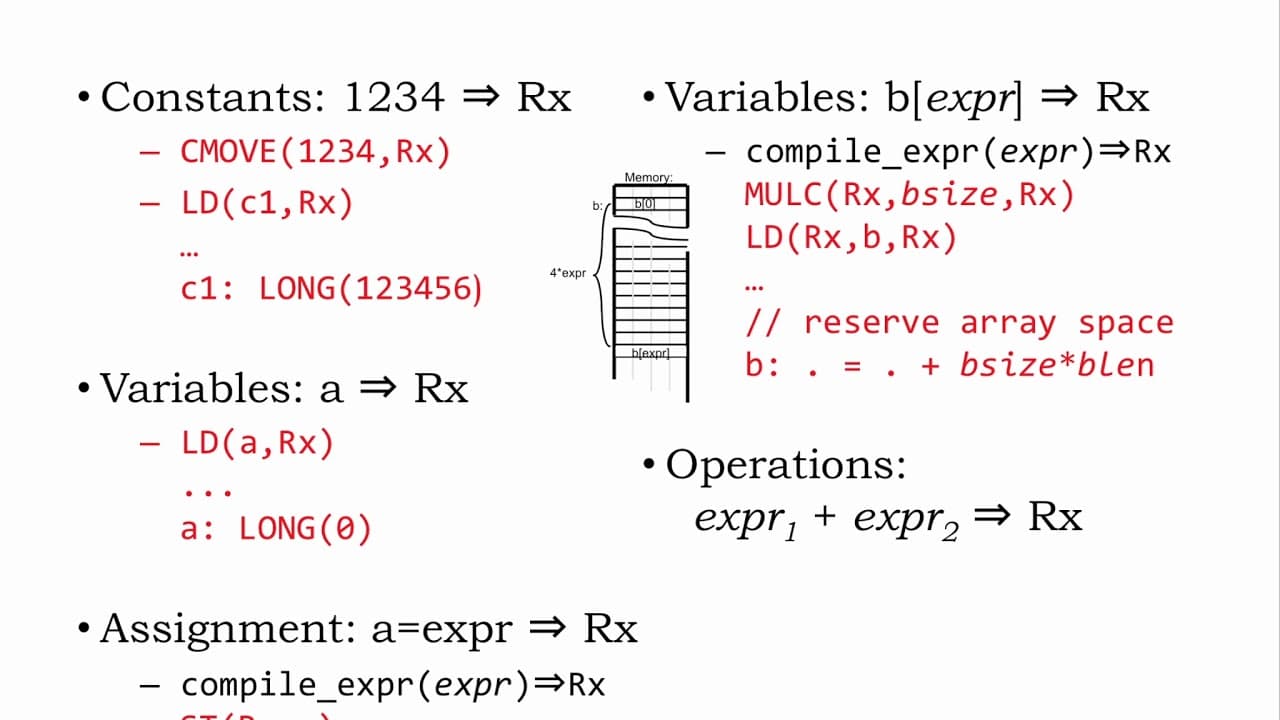
- 🤩 Loading constants and variables, performing array accesses, and handling assignment expressions are key aspects of compilation.
- 😑 Recursive descent is a common technique used in compiling expressions.
Install to Summarize YouTube Videos and Get Transcripts
Explore YouTube Video Summarizer or Get YouTube Transcript Extractor
Questions & Answers
Q: What is the purpose of a compiler?
A compiler translates high-level language programs into machine code, checking for correctness and providing warnings for potential issues. It also optimizes code to generate efficient sequences of instructions.
Q: How does a compiler handle conditional statements?
Conditional statements compute the value of a test expression and execute different statements based on the result. The compiler generates code to evaluate the test expression and conditionally execute the appropriate statements.
Q: How does a compiler handle array access?
Arrays are stored as consecutive locations in memory. The compiler generates code to compute the memory address of the desired array element by evaluating the index expression, multiplying it by the element size, and adding it to the base address of the array.
Q: How does a compiler handle assignment expressions?
To handle assignment expressions, the compiler generates code to evaluate the expression and load the value into a register. It then generates a store instruction to store the value in the specified variable.
Summary & Key Takeaways
-
A compiler translates high-level language programs into machine instructions, checking for correctness and providing warnings for unexpected results.
-
The compiler generates efficient sequences of instructions by rearranging computations.
-
The compilation technique for different types of statements and expressions, including unconditional and conditional statements, iteration statements, and arithmetic expressions, is discussed.
Read in Other Languages (beta)
Share This Summary 📚
Summarize YouTube Videos and Get Video Transcripts with 1-Click
Try YouTube Summary with ChatGPT & Claude or YouTube Transcript Generator
Explore More Summaries from MIT OpenCourseWare 📚



Summarize YouTube Videos and Get Video Transcripts with 1-Click
Try YouTube Summary with ChatGPT & Claude or YouTube Transcript Generator