Classification | Letter - Examples | Part- 08 | Reasoning | Bharath Kumar
TL;DR
Discusses various letter classification problems and their solutions.
Transcript
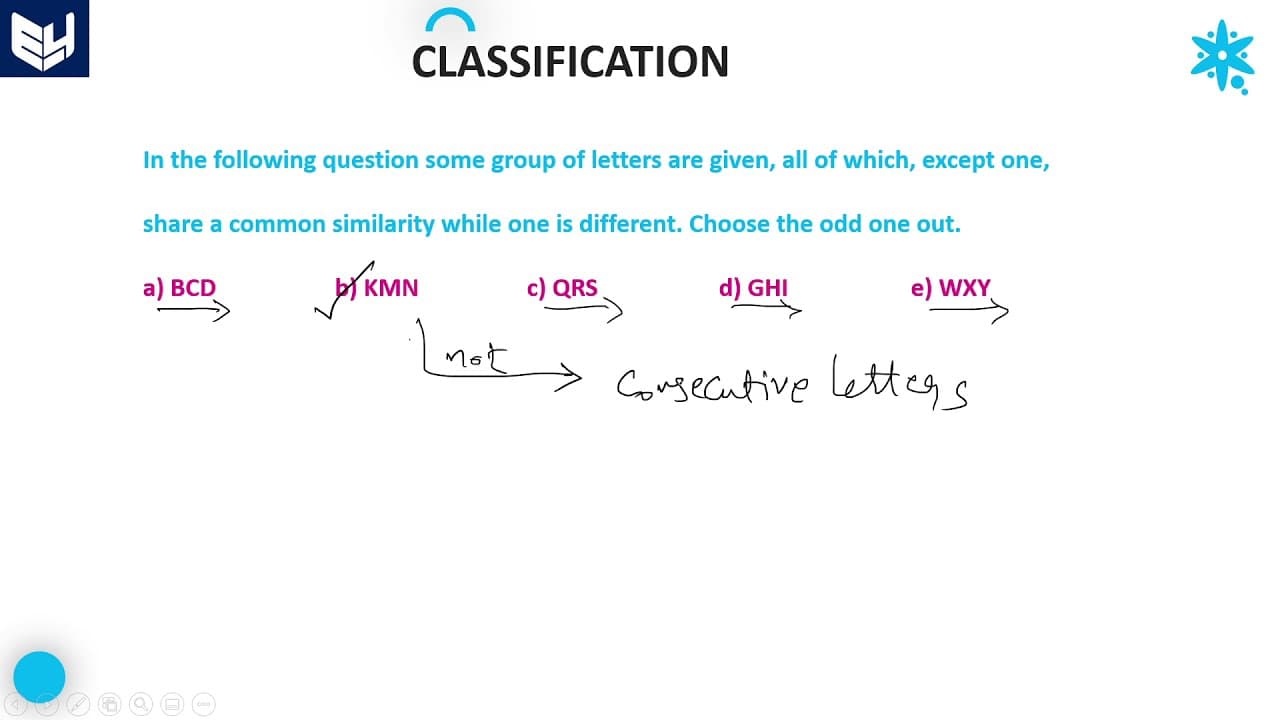
hi everyone welcome back in this session i am going to discussing about letter classification in the last session i already discussed a few problems on letter classification let's continue the letter classification or concept see here here the question is option a that is a b c d and k m n q r s g h i w x y if you observe carefully b c d and q r s ... Read More
Key Insights
- 💌 Breaking down complex letter classifications into numerical values simplifies identification of patterns and anomalies.
- 💌 Recognizing consecutive letters provides a foundational strategy for determining logical sequences in letter classification.
- 😛 Pair relationships among letters can unveil deeper logical structures when assessing options for odd one outs.
- 🎁 Each question presents a unique logical framework, promoting diverse approaches to problem-solving and reasoning.
- 🤩 The instructional style encourages active engagement and interactive learning, key components in educational methodologies.
- 👻 Clear identification of consistent patterns allows for quicker decision-making in classification scenarios.
- 🐝 Distinguishing between types of relationships aids in honing analytical skills necessary for tackling logical puzzles.
Install to Summarize YouTube Videos and Get Transcripts
Explore YouTube Video Summarizer or Get YouTube Transcript Extractor
Questions & Answers
Q: What is the primary method used to determine the odd one out in the letter classification challenges?
The primary method used involves recognizing patterns or logical sequences within the provided options. This may include identifying consecutive letters, analyzing numerical values assigned to each letter, or discerning pairs of letters that follow a specific relational logic, thereby establishing the odd one out through identifiable patterns.
Q: How does the presenter suggest breaking down complex letter classification questions?
The presenter advises writing down letters with their respective numerical values to simplify the analysis. By converting letters to their numerical positions in the alphabet, one can identify sequences or patterns, making it easier to spot anomalies or odd choices among the options presented.
Q: In the classification exercise involving 'k m n', what makes it the odd option?
The odd option 'k m n' does not follow the logic of being consecutive letters like the other choices. While 'k l m' is a consecutive sequence, 'k m n' skips 'l', thereby breaking the established pattern of consecutive lettering and making it the differing choice among the options.
Q: Why is 'g i q' identified as the odd one out in the pairs analysis?
The letters 'g i q' do not form a recognized pairing as the other options do. The pairs are made up of letters that consistently maintain a relational logic, while 'i q' stands alone without any such relationship, thus marking it as the odd one out according to the stated rules.
Q: What logic is followed in the sequence that includes 'p d w' and 'd f'?
The logic for this sequence follows a pattern of adding two to the numerical value of the first letter to arrive at the second. For example, starting from 'p', which is 16, if we add two, we reach 'd', which confirms the consistency of plus two progression evident in subsequent letter pairs.
Q: How do the examples provided help enhance problem-solving skills?
The examples serve as practical applications of logical reasoning, allowing learners to practice and identify patterns through guided analysis. By working through these logical puzzles, participants can develop critical thinking and analytical skills applicable to various contexts, fostering a deeper understanding of classification and organization in problem-solving.
Summary & Key Takeaways
-
The content thoroughly explains letter classification, examining different sets of options to identify odd one out patterns based on various logical rules.
-
Examples of letter classifications include identifying patterns of consecutive letters and establishing relationships based on numerical values representing alphabetical positions.
-
The presenter provides multiple questions and encourages participants to engage in logical reasoning to enhance their understanding and problem-solving skills.
Read in Other Languages (beta)
Share This Summary 📚
Summarize YouTube Videos and Get Video Transcripts with 1-Click
Try YouTube Summary with ChatGPT & Claude or YouTube Transcript Generator