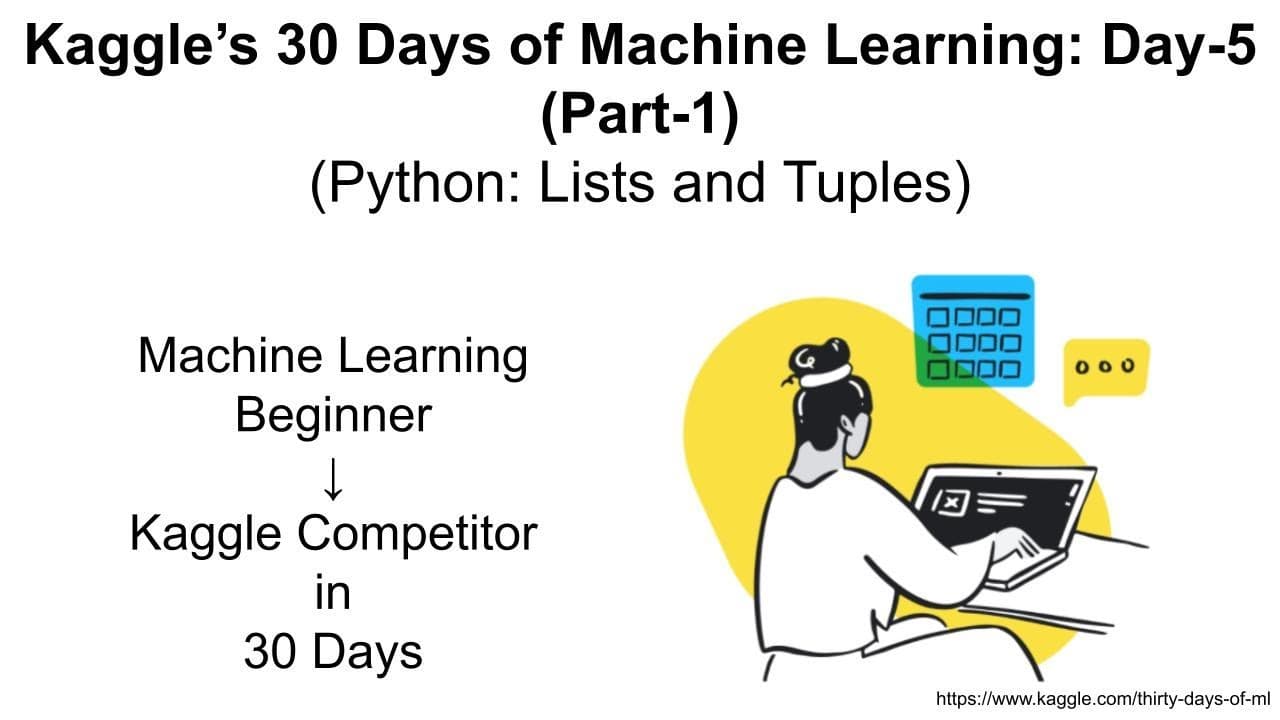
Kaggle's 30 Days Of ML (Day-5, Part-1): Python Lists and Tuples
TL;DR
Learn about the use of lists and tuples in Python, including indexing, slicing, modifying, and accessing elements.
Transcript
hello everyone and welcome to kaggle's 30 days of ml and this is day 5. today we are going to learn about lists day 5 is divided into two parts and i will be uploading another video right after this one so what are lists lists are very very useful and when you when you're working with machine learning you will end up using it like almost every time... Read More
Key Insights
- 👂 Lists are versatile data structures in Python, commonly used for storing and manipulating data in an ordered manner.
- 👂 Tuples provide an immutable alternative to lists, useful for storing data that should not be changed.
- 👻 Indexing and slicing allow for easy access to specific elements or ranges within a list or tuple.
- 🫰 Modifying a list involves assigning new values to specific indices or using methods like append() and pop().
- 👂 The "in" keyword can be used to check if an element is present in a list.
- 👂 Lists can contain any type of Python objects, including other lists, enabling complex data structures such as lists of lists.
- 🤫 The length of a list can be obtained using the len() function.
Install to Summarize YouTube Videos and Get Transcripts
Explore YouTube Video Summarizer or Get YouTube Transcript Extractor
Questions & Answers
Q: What are lists and how are they useful in machine learning?
Lists are ordered sequences of values in Python, which are widely used in machine learning. They can store and manipulate data in a sequential manner, making them useful for tasks such as storing dataset values or model predictions.
Q: How do you create a list in Python?
Lists are created using square brackets, with each element separated by a comma. For example, prime_numbers = [2, 3, 5, 7, 11] creates a list of prime numbers.
Q: What is the difference between lists and tuples in Python?
Lists are mutable, meaning they can be modified after creation, while tuples are immutable and cannot be modified. Lists are created using square brackets, while tuples use parentheses.
Q: How can you access specific elements within a list?
Elements within a list can be accessed using indexing, starting from 0. For example, primes[0] would give you the first element of the list. Negative indices can also be used to access elements from the end of the list, with -1 representing the last element.
Q: How can you modify elements within a list?
Elements within a list can be modified by assigning a new value to the desired index. For example, primes[0] = 2 would change the first element of the list to 2.
Q: How can you add or remove elements from a list?
Elements can be added to the end of a list using the append() method, and removed using the pop() method. The pop() method also returns the removed element.
Q: What is the purpose of tuples in Python?
Tuples are similar to lists in Python, but they are immutable, meaning they cannot be modified after creation. Tuples are often used to store data that should not be changed, such as coordinate pairs.
Q: How can you determine if an element is in a list?
You can use the "in" keyword to check if an element is present in a list. For example, "element in my_list" would return True if the element is in the list, and False otherwise.
Summary & Key Takeaways
-
Lists are ordered sequences of values, while tuples are similar but immutable.
-
Lists can contain any type of Python objects, including other lists, and can be modified.
-
Indexing and slicing can be used to access specific elements or ranges of elements within a list or tuple.
Read in Other Languages (beta)
Share This Summary 📚
Summarize YouTube Videos and Get Video Transcripts with 1-Click
Try YouTube Summary with ChatGPT & Claude or YouTube Transcript Generator
Explore More Summaries from Abhishek Thakur 📚



Summarize YouTube Videos and Get Video Transcripts with 1-Click
Try YouTube Summary with ChatGPT & Claude or YouTube Transcript Generator