2.2.5 Dealing with Noise
TL;DR
Digital signaling specifications for inputs and outputs ensure noise immunity and prevent signaling errors.
Transcript
There's one more issue we need to deal with before finalizing our signaling specification. Consider the following combinational system where the upstream combinational device on the left is trying to send a digital 0 to the downstream combinational device on right. The upstream device is generating an output voltage just slightly below V_L, which, ... Read More
Key Insights
- 🧑🏭 Electrical noise poses a challenge in digital signaling systems due to variations in voltage values and other factors.
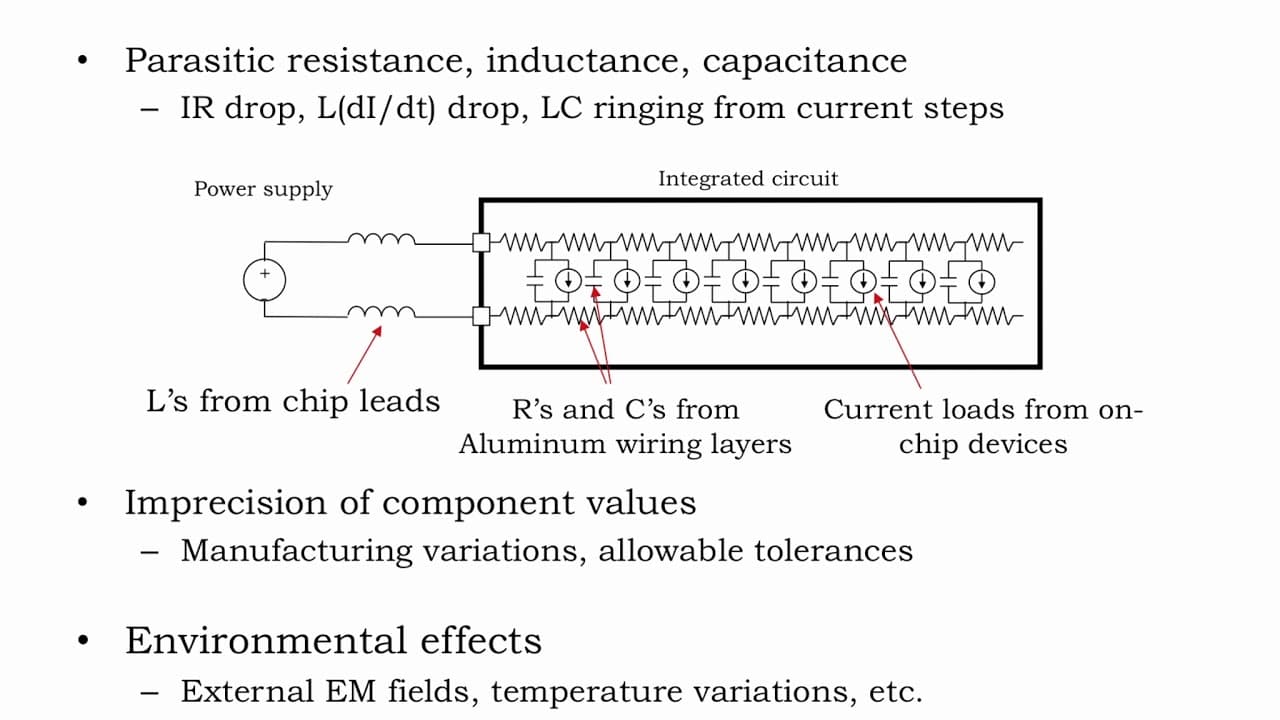
- 🧑🏭 Noise can arise from normal circuit operation, material/process properties, and environmental factors.
- 📡 Separate signaling specifications for inputs and outputs help maintain noise immunity.
- 🪜 The noise margins indicate the tolerance for added noise in valid signaling.
- ✋ Designing signaling specifications with higher noise immunity is a goal for digital engineers.
- 📡 Combinational devices in digital systems remove input noise before it accumulates, preventing signaling errors.
- 📡 Digital signaling is more robust than analog signaling in terms of noise immunity.
Install to Summarize YouTube Videos and Get Transcripts
Explore YouTube Video Summarizer or Get YouTube Transcript Extractor
Questions & Answers
Q: What happens when electrical noise affects the voltage on a wire in a digital signaling system?
When electrical noise slightly changes the voltage on the wire, the received signal may no longer qualify as a valid digital input. This can cause combinational behavior in downstream devices to be inconsistent and incorrect.
Q: Can noise be completely avoided in digital systems?
Noise cannot be entirely eliminated in digital systems that use electrical components. Voltage noise arises from various sources such as IR drops, capacitance coupling, inductance effects, manufacturing variations, and environmental factors.
Q: How can the problem of signaling errors caused by noise be addressed?
The signaling specification can be adjusted so that outputs have tighter bounds than inputs. This ensures that valid output signals can tolerate noise without becoming invalid inputs.
Q: What is the purpose of separate signaling specifications for digital inputs and outputs?
Separate signaling specifications help provide noise immunity. Digital outputs must produce voltages within specified ranges for 0 and 1, while digital inputs have their own thresholds for interpreting 0 and 1.
Summary & Key Takeaways
-
Electrical noise can disrupt digital signaling and cause incorrect behavior in combinational devices.
-
Voltage noise is caused by various factors such as manufacturing variations, environmental effects, and electrical properties of circuits.
-
Separate signaling specifications for inputs and outputs, with defined voltage thresholds, provide noise immunity and prevent signaling errors.
Read in Other Languages (beta)
Share This Summary 📚
Summarize YouTube Videos and Get Video Transcripts with 1-Click
Try YouTube Summary with ChatGPT & Claude or YouTube Transcript Generator
Explore More Summaries from MIT OpenCourseWare 📚



Summarize YouTube Videos and Get Video Transcripts with 1-Click
Try YouTube Summary with ChatGPT & Claude or YouTube Transcript Generator