What Is Bromine and How Does It React?
TL;DR
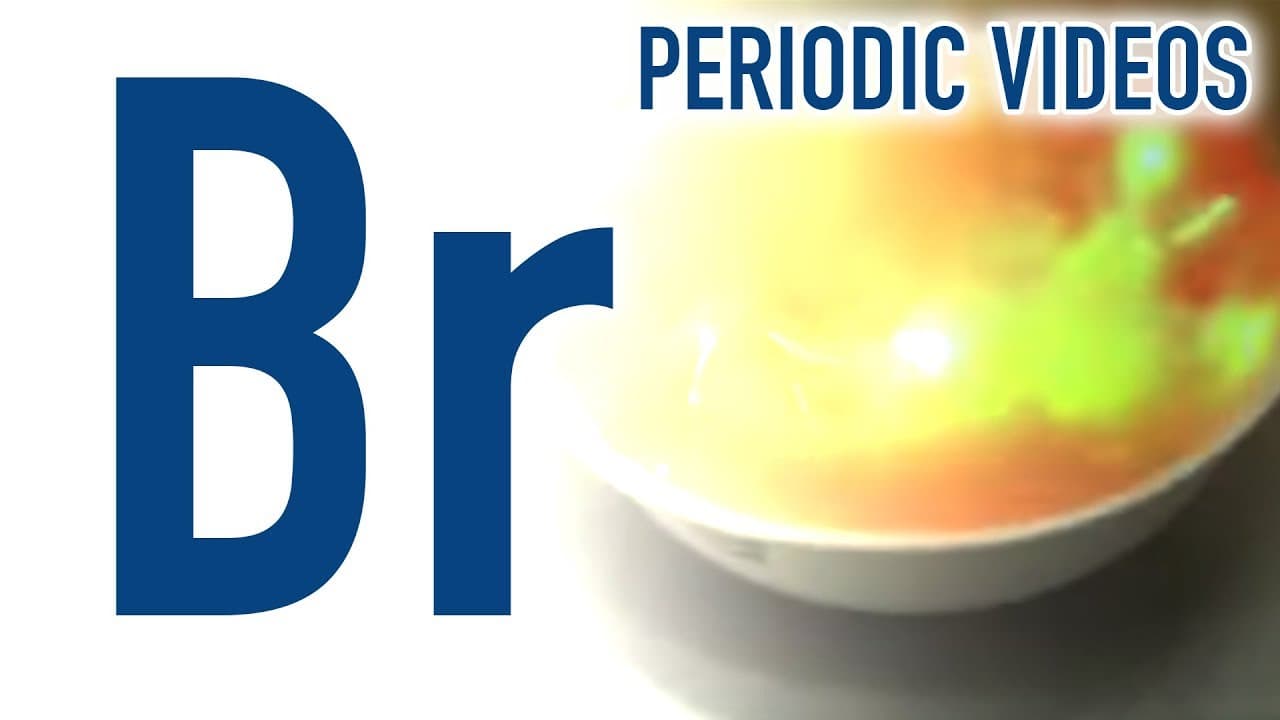
Bromine is a volatile red liquid with a strong odor, found in sea water and the Dead Sea. It is commonly used in plastics to reduce flammability and reacts exothermically with aluminum to produce aluminum tribromide. Notably, bromine has two isotopes, 79 and 81, present in nearly equal amounts, making it a unique element.
Transcript
So today we’re going to look at bromine. So this is bromine, it’s a small sample, about 2 or 3 grammes. Bromine is a red liquid. There are not many elements that are actually liquid: caesium, mercury, gallium and bromine. It’s this beautiful red colour and it has an unpleasant smell. Bromine comes from the Greek word bromos which means stench, a re... Read More
Key Insights
- 😪 Bromine, a red liquid element, is known for its unpleasant smell, derived from the Greek word "bromos."
- 🌊 Commonly found in sea water and the Dead Sea, bromine is used in plastics to reduce flammability.
- 💁 Reacts exothermically with aluminum to form aluminum tribromide, showcasing its unique properties.
- 💄 Has two isotopes, 79 and 81, in almost equal quantities, making it an unusual element.
- ❓ Experiences an exothermic oxidation reaction, releasing energy and vapors.
- 💁 Bromine is less dangerous than chlorine due to its liquid form at room temperature.
- 💦 Reacts readily with water and is widely used in various industries.
Install to Summarize YouTube Videos and Get Transcripts
Explore YouTube Video Summarizer or Get YouTube Transcript Extractor
Questions & Answers
Q: What is the origin of the name "bromine" and why does it have an unpleasant smell?
The name "bromine" originates from the Greek word "bromos," meaning stench, due to its foul odor.
Q: How is bromine obtained from Dead Sea water, and why is it commonly used in plastics?
Bromine is obtained by bubbling chlorine into a bromide solution, and it is used in plastics to reduce flammability.
Q: What reaction occurs when aluminum reacts with bromine, and why is it considered exothermic?
Aluminum reacts with bromine to form aluminum tribromide in an exothermic reaction, releasing energy and vapors.
Q: What sets bromine apart from other elements like chlorine in terms of safety and behavior?
Bromine is less dangerous than chlorine due to its liquid form at room temperature, allowing for slower dispersion in case of a spill.
Summary & Key Takeaways
-
Bromine is a red liquid element with an unpleasant smell, derived from the Greek word for "stench."
-
Commonly found in sea water and the Dead Sea, bromine is used in plastics to reduce flammability.
-
Reacts exothermically with aluminum to form aluminum tribromide, showcasing its unique properties.
Read in Other Languages (beta)
Share This Summary 📚
Summarize YouTube Videos and Get Video Transcripts with 1-Click
Try YouTube Summary with ChatGPT & Claude or YouTube Transcript Generator
Explore More Summaries from Periodic Videos 📚

Summarize YouTube Videos and Get Video Transcripts with 1-Click
Try YouTube Summary with ChatGPT & Claude or YouTube Transcript Generator