The Iron Logic of Diminishing Returns (Solow Model Explained)
TL;DR
Explains diminishing returns and capital's role in economic growth.
Transcript
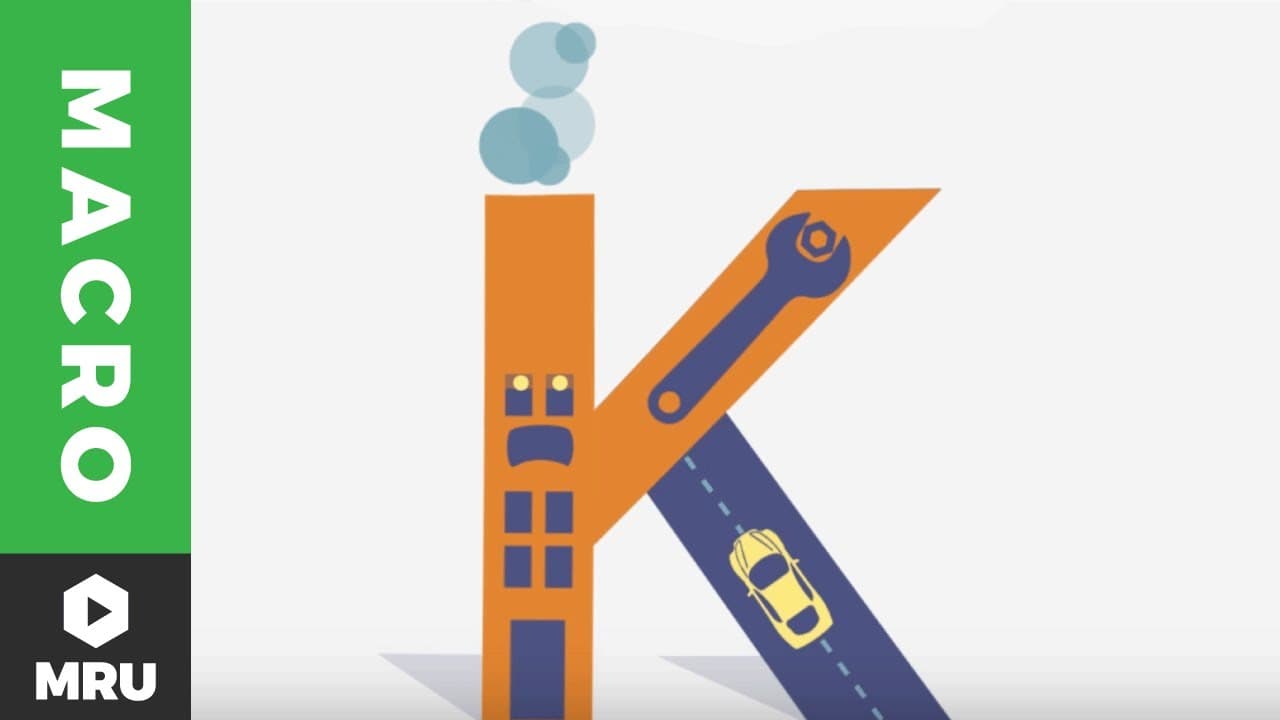
♪ [music] ♪ - [Alex] In our last video, we introduced the variables in our Super Simple Solow Model. We have physical capital, represented by "K," human capital, represented by "e" times "L," and ideas, represented by "A." In this video, we're going to hold human capital and ideas constant. That will let us focus in on K so we can show what hap... Read More
Key Insights
- The Solow model focuses on physical capital, human capital, and ideas, but this video isolates physical capital to explore its impact on output.
- Output increases with more capital, but the rate of increase diminishes with each additional unit due to the iron logic of diminishing returns.
- The production function used is the square root function, illustrating how output grows with capital but at a decreasing rate.
- Marginal product of capital is high with initial units but decreases as capital stock increases, explaining rapid post-war growth in Germany and Japan.
- Post-war Germany and Japan had high growth due to a low capital base, where initial investments yielded high returns.
- While rapid growth is possible from a low base, a larger base with slower growth is generally preferable in the long run.
- The video hints at further complexities and challenges associated with capital, to be explored in subsequent videos.
- Understanding diminishing returns and marginal product of capital is crucial for grasping economic growth dynamics.
Install to Summarize YouTube Videos and Get Transcripts
Explore YouTube Video Summarizer or Get YouTube Transcript Extractor
Questions & Answers
Q: What does the Solow model focus on in this video?
In this video, the Solow model focuses specifically on physical capital, isolating it from human capital and ideas to explore its impact on economic output. The video aims to explain how changes in the amount of physical capital influence output, highlighting key concepts like diminishing returns and the marginal product of capital.
Q: What is the 'iron logic of diminishing returns'?
The 'iron logic of diminishing returns' refers to the principle that while more capital increases output, each additional unit of capital contributes less to output than the previous one. This diminishing rate of return is exemplified by the decreasing productivity of additional capital investments, as seen in the example of a farmer using multiple tractors.
Q: How does the production function illustrate diminishing returns?
The production function used in the video is a square root function, which illustrates diminishing returns by showing that output grows with capital but at a decreasing rate. As more units of capital are added, the increase in output becomes smaller, demonstrating the diminishing marginal returns of additional capital.
Q: What historical examples are used to explain the concepts?
The video uses post-World War II Germany and Japan as historical examples to explain the concepts of diminishing returns and marginal product of capital. These countries experienced rapid economic growth due to their low capital base, where initial investments in capital had a significant impact on output and growth rates.
Q: Why did Germany and Japan grow rapidly post-World War II?
Germany and Japan grew rapidly post-World War II because they started with a low capital base, meaning that initial investments in capital yielded high returns. The first units of capital, such as roads and factories, were extremely productive, leading to significant increases in output and economic growth during the reconstruction period.
Q: What is the marginal product of capital?
The marginal product of capital refers to the additional output produced by each new unit of capital. Initially, the marginal product is high, meaning that the first few units of capital significantly boost output. However, as more capital is added, the marginal product decreases, illustrating the concept of diminishing returns.
Q: What preference is discussed regarding economic growth?
The video discusses the preference for having a larger economic base with slower growth compared to rapid growth from a low base. While rapid growth is possible when starting from a low capital base, a larger base with consistent, slower growth is generally more desirable for long-term economic stability and prosperity.
Q: What future topics are hinted at in the video?
The video hints at further complexities and challenges associated with physical capital, which will be explored in subsequent videos. It suggests that there are additional nuances to consider when analyzing capital's role in economic growth, beyond the concepts of diminishing returns and marginal product of capital discussed in this video.
Summary & Key Takeaways
-
The video explains the Solow model's focus on physical capital and its impact on economic output. It highlights the concept of diminishing returns, where additional capital yields progressively less output. The video uses historical examples like post-war Germany and Japan to illustrate the model's principles.
-
The production function in the Solow model is described using a square root function, showing how output grows with capital but at a decreasing rate. The concept of marginal product of capital is introduced, emphasizing its initial high value and subsequent decline as capital stock increases.
-
The video provides insights into why countries like Germany and Japan experienced rapid growth post-World War II due to a low capital base. It also discusses the preference for a larger economic base with slower growth and hints at further challenges related to capital in future discussions.
Read in Other Languages (beta)
Share This Summary 📚
Summarize YouTube Videos and Get Video Transcripts with 1-Click
Try YouTube Summary with ChatGPT & Claude or YouTube Transcript Generator
Explore More Summaries from Marginal Revolution University 📚

Summarize YouTube Videos and Get Video Transcripts with 1-Click
Try YouTube Summary with ChatGPT & Claude or YouTube Transcript Generator