3…2…1…Takeoff! Activity Demo
TL;DR
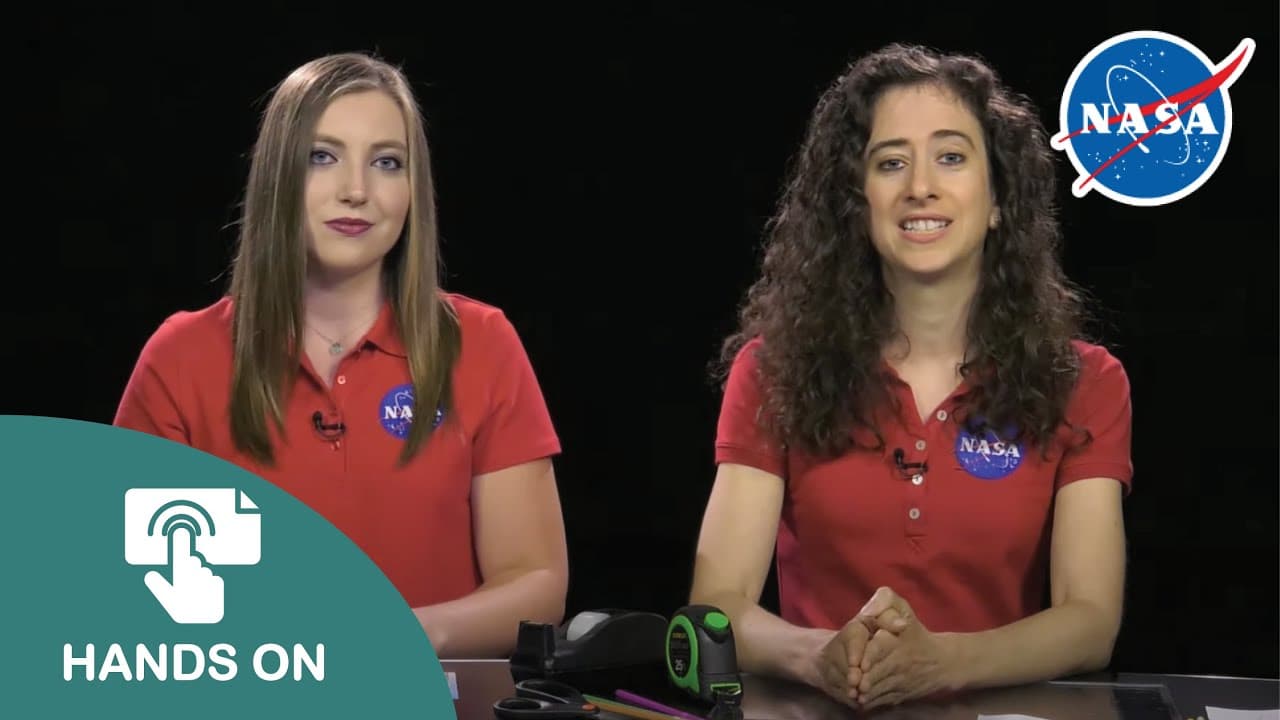
This NASA video demonstrates two versions of the 3... 2... 1... Takeoff activity, allowing students to explore the four forces of flight and Newton's third law of motion by constructing and flying paper X-planes.
Transcript
Hello my name is Adaline Dinehart and I'm Lindsey Thornton and we are both education specialists here at NASA Langley Research Center. Today, we'll be demonstrating both the complex and simple versions of the 3... 2... 1... Takeoff activities. In this activity students will explore the four forces of flight and Newton's third law of motion when we ... Read More
Key Insights
- 🤗 The activity allows students to explore the principles of flight and Newton's third law of motion in a hands-on way.
- ✈️ By constructing and flying paper X-planes, students learn about the four forces of flight and how they interact.
- 🧑🎓 The simple version provides a template for students to build a basic X-plane, while the complex version encourages students to design their own planes and test different variables.
- 🧑🎓 Students are encouraged to make observations, measure distances flown, and record their data in a table.
- ✈️ The activity promotes critical thinking and problem-solving as students make adjustments to their planes to improve flight performance.
- 🤭 The video highlights the importance of understanding the forces of flight and Newton's laws in aircraft design, using NASA's X-59 Quiet Supersonic Technology Aircraft as an example.
- 🤔 Discussion questions provided in the video prompt students to think about the real-world applications of the principles learned in the activity.
Install to Summarize YouTube Videos and Get Transcripts
Explore YouTube Video Summarizer or Get YouTube Transcript Extractor
Questions & Answers
Q: What are the four forces of flight?
The four forces of flight are lift, weight, thrust, and drag. Lift is the force that allows an aircraft to move upward, weight is the force due to gravity pulling the aircraft downward, thrust is the force that propels the aircraft forward, and drag is the resistance encountered by the aircraft as it moves through the air.
Q: How do the principles of Newton's third law of motion apply to flying a paper X-plane?
Newton's third law states that for every action, there is an equal and opposite reaction. In the context of flying a paper X-plane, when students blow into the straw and produce thrust, the plane experiences an equal and opposite force that propels it forward.
Q: What adjustments can students make to improve the flight of their paper X-planes?
Students can adjust the angle at which they blow into the straw to change the direction of thrust. They can also experiment with the shape of the wings or the length of the body of the plane to affect its aerodynamics and increase the distance it travels.
Q: How does the complex version of the activity differ from the simple version?
In the complex version, students are tasked with designing and building their own X-plane using a printed template. They have the option to change one variable, such as the length of the body or the shape of the wings, to see if it improves the distance traveled.
Summary & Key Takeaways
-
The video introduces two versions of the 3... 2... 1... Takeoff activity, where students learn about the four forces of flight and Newton's third law of motion.
-
In the simple version, students cut out and build a paper X-plane, while the complex version requires students to design and build their own X-plane.
-
Students test the planes by flying them with the help of straws, measure the distance flown, and make adjustments to improve the flight.
Read in Other Languages (beta)
Share This Summary 📚
Summarize YouTube Videos and Get Video Transcripts with 1-Click
Try YouTube Summary with ChatGPT & Claude or YouTube Transcript Generator
Explore More Summaries from NASA STEM 📚



Summarize YouTube Videos and Get Video Transcripts with 1-Click
Try YouTube Summary with ChatGPT & Claude or YouTube Transcript Generator