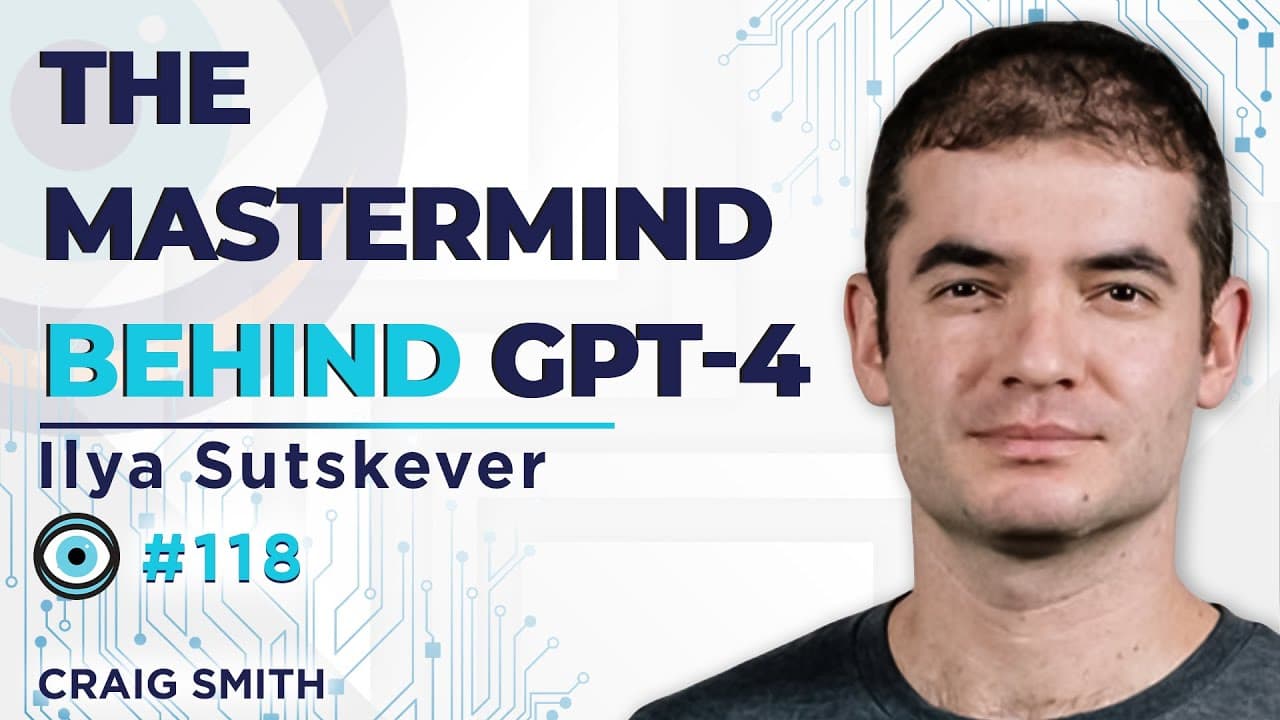
The Mastermind Behind GPT-4 and the Future of AI | Ilya Sutskever | Eye on AI #118
TL;DR
Large language models are changing the world and raising questions about their limitations and potential impact on society.
Transcript
yeah I'm Craig Smith and this is I on AI this week I talked to Ilya switzerberger a co-founder and chief scientist of open Ai and one of the primary Minds behind the large language model gpt3 and its public progeny chat GPT which I don't think it's an exaggeration to say is changing the world this isn't the first time Elia has changed the world Jef... Read More
Key Insights
- 🌥️ Large language models have the potential to transform various aspects of society and have already demonstrated impressive capabilities in language processing and generation.
- 🧑🏭 Scalability is an essential factor in the success of large models, but it requires specific models and training methods that can benefit from increased scale.
- 📺 Multimodal understanding, combining language with other modalities like vision, is desirable for AI systems but not necessarily critical for their effectiveness.
- 😒 The use of reinforcement learning from human feedback shows promise in improving the quality and reliability of large language models' outputs.
- 👻 The understanding of the world by large language models is based on statistical regularities in the language they are trained on, allowing them to capture a significant amount of knowledge about human thoughts, feelings, and interactions.
- 🖐️ Large language models can potentially play a role in democratic processes, where citizens provide input to shape the behavior and decision-making of AI systems.
- 👨🔬 The future of AI research aims to make models more reliable, controllable, and efficient in learning from less data and instructions.
- ❓ Although AI systems may never fully comprehend all variables and complexities of a situation, they can still provide valuable insights and assistance for decision-making in complex scenarios.
Install to Summarize YouTube Videos and Get Transcripts
Explore YouTube Video Summarizer or Get YouTube Transcript Extractor
Questions & Answers
Q: What motivated you to start working in the field of AI and how did you become involved with Jeff Hinton?
Ilya Switzerberger was interested in AI from an early age and was motivated by a curiosity about consciousness. After moving to Canada, he joined the University of Toronto and had the opportunity to work with Jeff Hinton, who was a professor there.
Q: How did the breakthroughs in convolutional neural networks lead to the application for the ImageNet competition?
Switzerberger had the realization that training a large and deep neural network on a big enough dataset related to a specific task could lead to successful results. This understanding, combined with Alex's coding skills for training the network, led to their success in the ImageNet competition.
Q: How did the development of Transformers and self-attention impact the GPT project?
Switzerberger and his team at OpenAI were already exploring the idea of predicting the next thing as a means of unsupervised learning. When the Transformer paper was released, they quickly realized that Transformers addressed the limitations of recurrent neural networks and the learning of long-term dependencies.
Q: How does reinforcement learning from human feedback improve the output quality of large language models?
Large language models, like GPT, can sometimes produce outputs that don't make sense or hallucinate information. Reinforcement learning from human feedback allows the model to learn from its mistakes and improve its output by receiving feedback on inappropriate or nonsensical responses.
Q: Can large language models be trained to develop a better understanding of reality beyond just linguistic knowledge?
Switzerberger believes that large language models already have a deep understanding of the world based on the statistical regularities they learn from text data. Although there are limitations and improvements to be made, he is hopeful that better reinforcement learning processes can address these limitations and reduce hallucinations.
Key Insights:
- Large language models have the potential to transform various aspects of society and have already demonstrated impressive capabilities in language processing and generation.
- Scalability is an essential factor in the success of large models, but it requires specific models and training methods that can benefit from increased scale.
- Multimodal understanding, combining language with other modalities like vision, is desirable for AI systems but not necessarily critical for their effectiveness.
- The use of reinforcement learning from human feedback shows promise in improving the quality and reliability of large language models' outputs.
- The understanding of the world by large language models is based on statistical regularities in the language they are trained on, allowing them to capture a significant amount of knowledge about human thoughts, feelings, and interactions.
- Large language models can potentially play a role in democratic processes, where citizens provide input to shape the behavior and decision-making of AI systems.
- The future of AI research aims to make models more reliable, controllable, and efficient in learning from less data and instructions.
- Although AI systems may never fully comprehend all variables and complexities of a situation, they can still provide valuable insights and assistance for decision-making in complex scenarios.
Overall, large language models have the potential to revolutionize AI and society, but there are still challenges to overcome in terms of output quality, hallucinations, and understanding of the underlying reality. Continued research and development are necessary to harness the full potential of these models while addressing their limitations.
Summary & Key Takeaways
-
Ilya Switzerberger, co-founder and chief scientist of OpenAI, discusses the development of large language models like GPT-3 and the transformative potential they possess.
-
Switzerberger explains his early interest in AI and how he began working with Jeff Hinton at the University of Toronto to understand artificial intelligence and intelligence in general.
-
The interview covers topics such as the limitations of large language models, the use of reinforcement learning to improve output quality, and the possibility of automating the teaching process.
-
Switzerberger also comments on the relationship between language models and the understanding of reality, as well as the role of multimodal understanding in AI research.
Read in Other Languages (beta)
Share This Summary 📚
Summarize YouTube Videos and Get Video Transcripts with 1-Click
Try YouTube Summary with ChatGPT & Claude or YouTube Transcript Generator
Explore More Summaries from Eye on AI 📚

Summarize YouTube Videos and Get Video Transcripts with 1-Click
Try YouTube Summary with ChatGPT & Claude or YouTube Transcript Generator