blood relation reasoning tricks | Reasoning | Part-10 | Pratik Shrivastava
TL;DR
This content explains how to establish family relations using symbols in blood relation questions.
Transcript
hello friends welcome back our today's topic is blood relation as you know bloody lesson is one of the very important topic for all kind of competitive exams let it be Bank sec UPSC railways and placement trainings in all the exams remember two to three questions we can expect from blood relation our today's question is one of the very important qu... Read More
Key Insights
- 🍉 Blood relation questions are common in various competitive exams, requiring clear understanding of familial terms.
- 🤬 The provided symbols have unique meanings that must be correctly interpreted to solve problems effectively.
- 🌲 Visualization through a blood relation tree is essential for understanding complex relationships.
- 🤬 The logic behind establishing relationships is based on generational understanding and specific symbol usage.
- ⁉️ The content highlights the importance of methodical reasoning in solving relational questions.
- 🤬 Understanding potential outcomes from symbol placement can drastically impact answer accuracy.
- 🩸 Recognizing patterns in blood relations assists in quicker problem resolution during exams.
Install to Summarize YouTube Videos and Get Transcripts
Explore YouTube Video Summarizer or Get YouTube Transcript Extractor
Questions & Answers
Q: What do the symbols in the blood relation context represent?
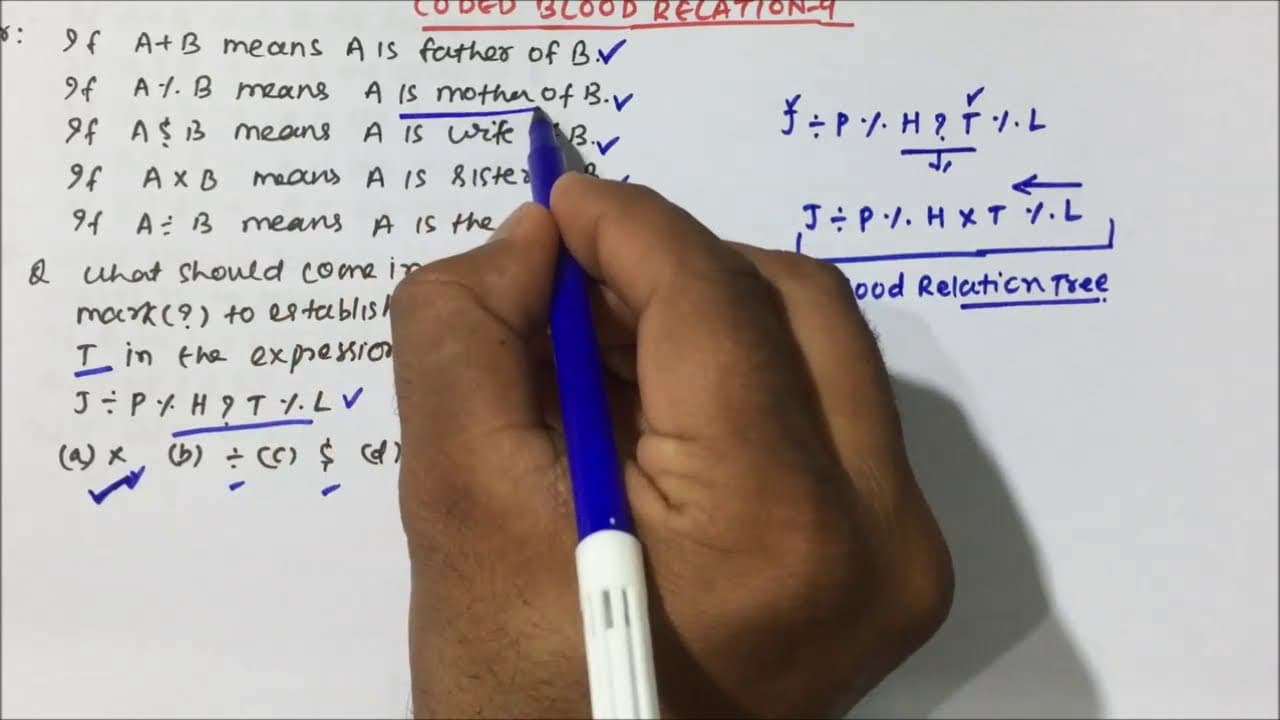
Each symbol has a specific meaning: "+" indicates father, "%" signifies mother, "$" represents wife, "×" denotes sister, and "÷" means son. Understanding these symbols is critical to establishing relationships accurately in blood relation scenarios.
Q: How can we determine if J is the brother of T from the provided expression?
To determine J's relation to T, we analyze the expression and attempt different symbols. The correct configuration allows us to visualize a family tree, where J being the son and T being a sister confirms their brother-sister relationship effectively using the multiplication symbol.
Q: What key factors do we need to consider when identifying sister-in-law relationships?
Sister-in-law relationships can arise in two scenarios: a wife's sister or a husband's sister. The symbols must indicate either a wife or husband to create this relationship. Therefore, identifying the correct symbol is crucial for establishing such familial ties in the given expressions.
Q: Why does using options A and D in the examples lead to different outcomes?
Option A (multiplication) allows J to become T's brother directly. However, option D (involving division) presents an issue as it introduces a generation gap, which negates the brother-sister relationship since siblings must be from the same generation.
Q: How is the blood relation tree utilized in the examples?
The blood relation tree is used to represent relationships visually. By placing individuals according to the established rules (father, mother, etc.), it becomes clearer to see familial connections, thus validating the options presented in solving the problem.
Q: What is the significance of this content for exam preparation?
This content is crucial as blood relation questions commonly appear in competitive exams like banking, UPSC, and railways. Understanding the foundational principles and practicing with examples ensures candidates are well-prepared to tackle these problems efficiently.
Summary & Key Takeaways
-
The content provides an in-depth explanation of how to solve blood relation problems typical in competitive exams by using specific symbols to denote family roles.
-
It emphasizes the importance of understanding the relationships, including parentage and sibling connections, to identify correct options in given expressions.
-
Two example questions demonstrate the application of different symbols to establish familial links, helping viewers understand the logical reasoning process involved in solving such questions.
Read in Other Languages (beta)
Share This Summary 📚
Summarize YouTube Videos and Get Video Transcripts with 1-Click
Try YouTube Summary with ChatGPT & Claude or YouTube Transcript Generator