How to Calculate Variance of a Sum of Random Variables
TL;DR
To calculate the variance of a sum of independent random variables, use the law of total variance, which combines the variance of the conditional expectation and the unconditional variance of the sum. This approach distinguishes between randomness from spending amounts and randomness in the number of variables, giving a comprehensive measure of total variance.
Transcript
We now continue the study of the sum of a random number of independent random variables. We already figured out what is the expected value of this sum, and we found a fairly simple answer. When it comes to the variance, however, it's pretty hard to guess what the answer will be, and it turns out that the answer is not as simple. So this is what we ... Read More
Key Insights
- 👮 The law of total variance is an important concept when calculating the variance of a sum of random variables.
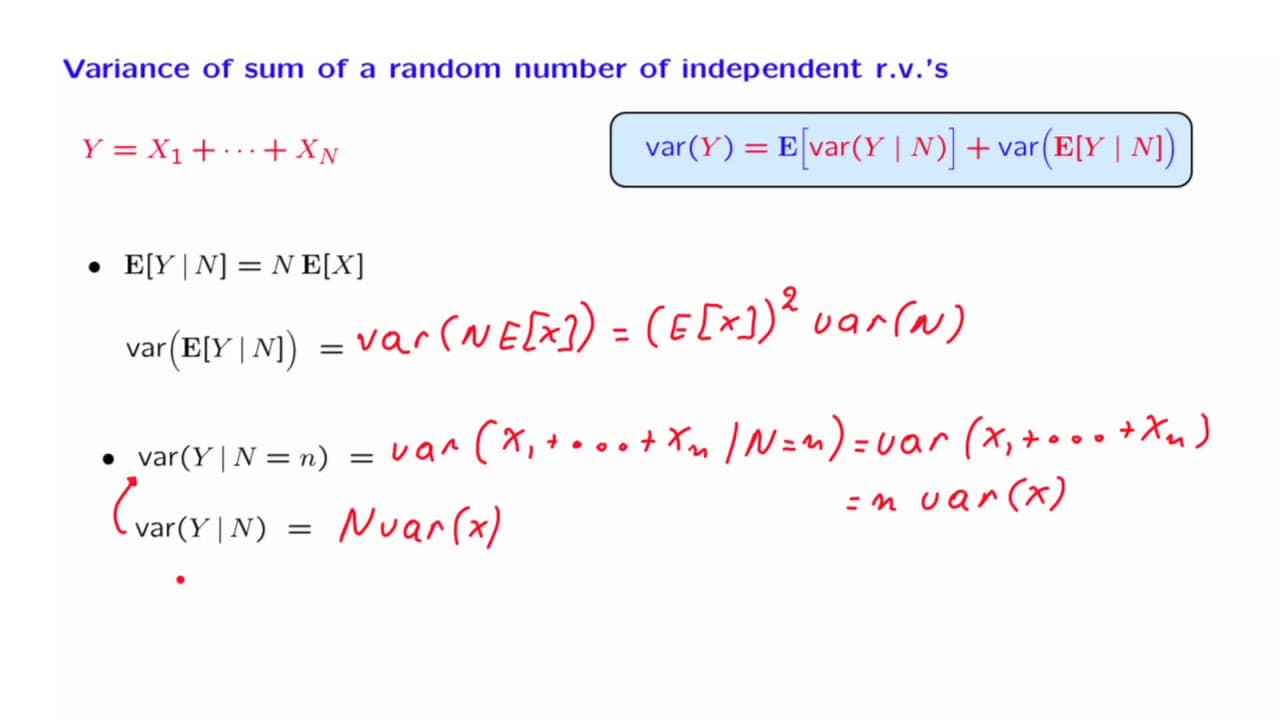
- 🏪 The variance of the conditional expectation is obtained by multiplying the variance of the number of stores with the square of the expected value of the amount spent.
- 🍹 The unconditional variance of a sum of random variables is equal to n times the variance of each individual variable.
Install to Summarize YouTube Videos and Get Transcripts
Explore YouTube Video Summarizer or Get YouTube Transcript Extractor
Questions & Answers
Q: What is the purpose of using the law of total variance when calculating the variance of a sum of random variables?
The law of total variance breaks down the problem by considering the value of the random variable capital N, allowing us to calculate the conditional expectation variance and the unconditional variance separately.
Q: How is the variance of the conditional expectation calculated?
The variance of the conditional expectation is calculated by multiplying the variance of capital N (number of stores) with the square of the expected value of X (amount spent in each store).
Q: How is the unconditional variance of a sum of random variables determined?
The unconditional variance of a sum of n random variables is obtained by multiplying n with the variance of each individual random variable.
Q: What does the law of total variance reveal about the overall variance of a random variable?
The law of total variance shows that the overall variance of a random variable is influenced by two sources of randomness: the variance of X (amount spent in a store) and the contribution from the randomness of the number of stores.
Summary & Key Takeaways
-
The content introduces the problem of calculating the variance of a sum of random variables and highlights the importance of using the law of total variance.
-
It provides the formula for calculating the variance of the conditional expectation and explains how the variance of a sum of independent random variables can be calculated.
-
The content concludes by emphasizing the power of the law of total variance in determining the overall variance of a random variable.
Read in Other Languages (beta)
Share This Summary 📚
Summarize YouTube Videos and Get Video Transcripts with 1-Click
Try YouTube Summary with ChatGPT & Claude or YouTube Transcript Generator
Explore More Summaries from MIT OpenCourseWare 📚



Summarize YouTube Videos and Get Video Transcripts with 1-Click
Try YouTube Summary with ChatGPT & Claude or YouTube Transcript Generator