The fundamentals of space-time: Part 1 - Andrew Pontzen and Tom Whyntie
TL;DR
Space and time are interconnected in physics, represented as four-dimensional space-time.
Transcript
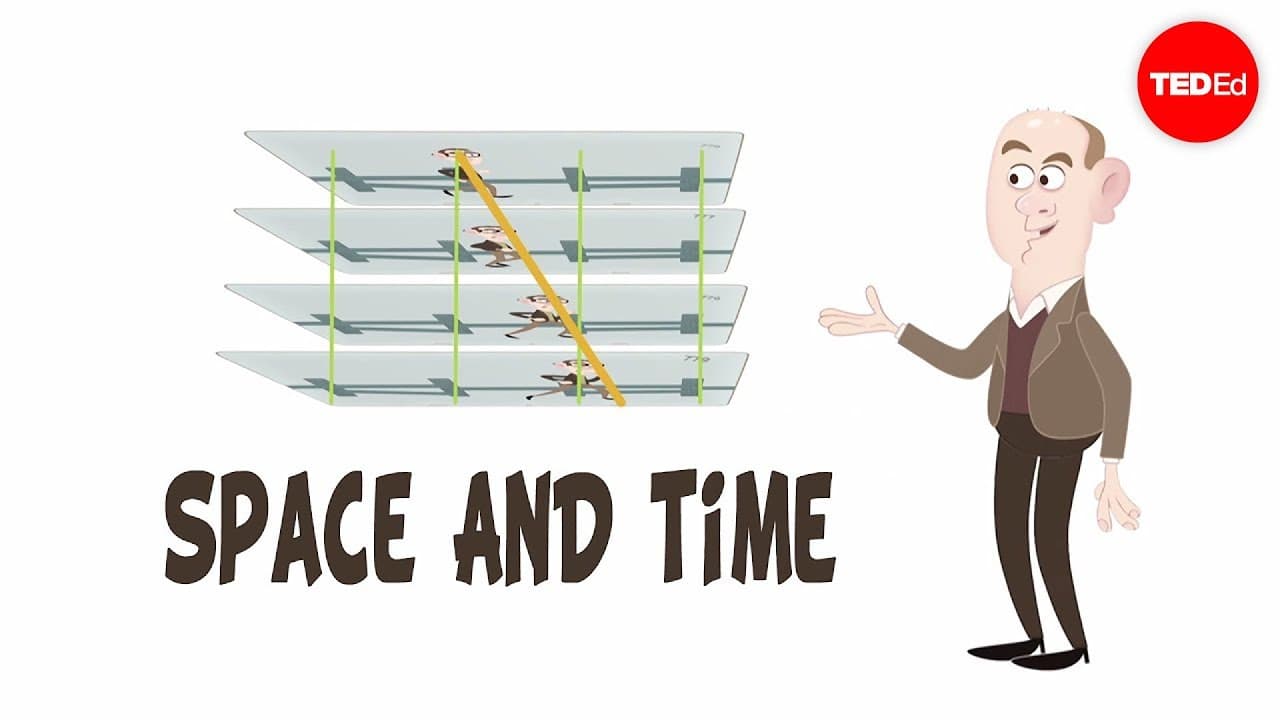
Space: it's where things happen. Time: it's when things happen. We can measure where things are and when things take place, but in modern physics, we realize when and where are actually part of the same question. Because when it comes to understanding the universe, we need to replace three-dimensional space plus time with a single concept: four-dim... Read More
Key Insights
- 👾 Space and time are interconnected in modern physics, forming four-dimensional space-time.
- 👾 Animation, like a flip book, is used to visually represent space-time and movement through spatial dimensions.
- 👾 Different perspectives and speeds can alter the perception of space-time in physics.
- 🫥 The concept of world lines represents an object's path through space and time.
- 👻 A Galilean transformation allows for the analysis of physics from different observer perspectives.
- 🫵 Viewing physics from various speeds and perspectives aids in understanding phenomena.
- 🚄 The concept of space-time becomes more complex at high speeds, such as the speed of light.
Install to Summarize YouTube Videos and Get Transcripts
Explore YouTube Video Summarizer or Get YouTube Transcript Extractor
Questions & Answers
Q: How is space linked to time in modern physics?
Space and time are no longer separate entities in modern physics; they are interconnected as four-dimensional space-time, where events are described in both spatial and temporal terms.
Q: How is animation used to explain space-time?
Animation, like a flip book, is used to visually represent space-time where different panels show an object's position at various moments, allowing us to understand movement through space and time.
Q: What is a world line in the context of space-time?
A world line represents an object's path through space and time, with different slopes indicating different velocities or speeds of motion of the object.
Q: How does a Galilean transformation help analyze physics from different perspectives?
The Galilean transformation enables us to view physics from different perspectives by rearranging panels, allowing for analysis from another observer's point of view, such as changing speeds.
Summary & Key Takeaways
-
Space and time are linked as part of modern physics, forming four-dimensional space-time.
-
Animation is used to illustrate how space-time can be visualized through a series of panels in a flip book.
-
Different perspectives and speeds can alter the perception of space-time in physics.
Read in Other Languages (beta)
Share This Summary 📚
Summarize YouTube Videos and Get Video Transcripts with 1-Click
Try YouTube Summary with ChatGPT & Claude or YouTube Transcript Generator
Explore More Summaries from TED-Ed 📚






Summarize YouTube Videos and Get Video Transcripts with 1-Click
Try YouTube Summary with ChatGPT & Claude or YouTube Transcript Generator