The continents are moving. When will they collide? - Jean-Baptiste P. Koehl
TL;DR
Earth's shifting plates will create a new supercontinent in 50-250 million years with potential environmental consequences.
Transcript
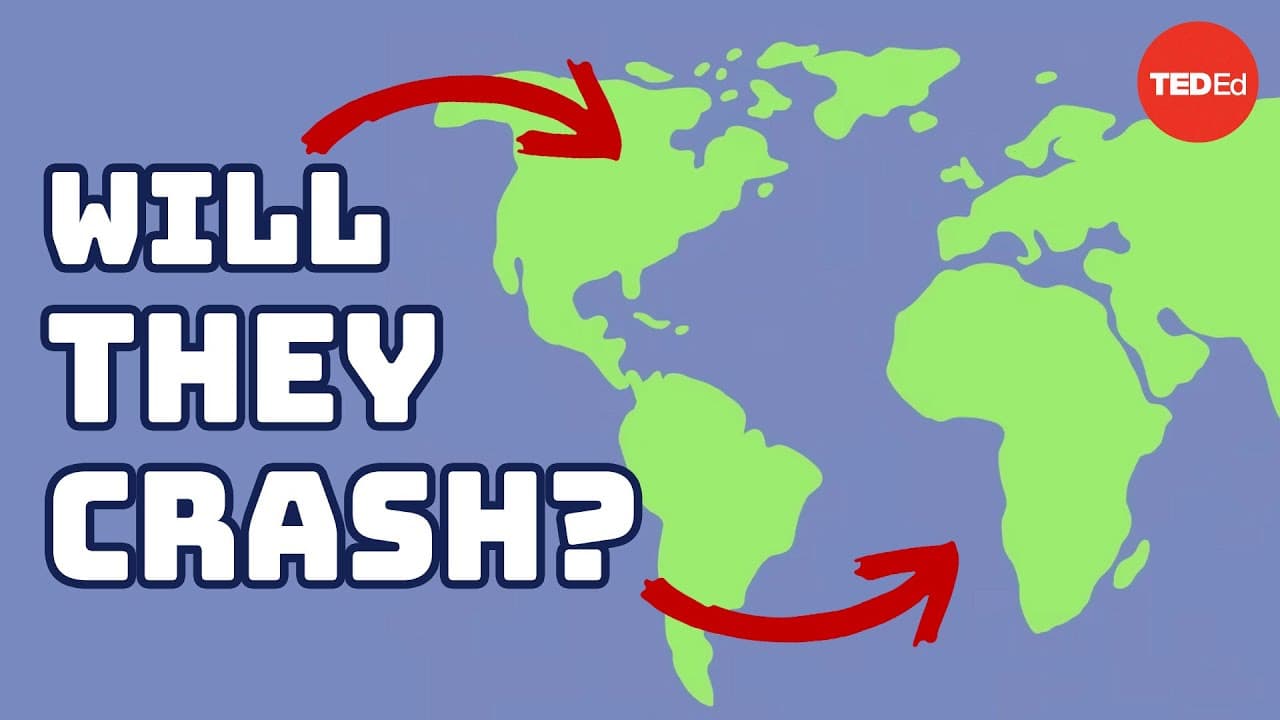
In the early 20th century, a meteorologist named Alfred Wegener noticed striking similarities between the coasts of Africa and South America. These observations led him to propose a controversial new theory: perhaps these and many other continents had once been connected in a single, gigantic landmass. Wegener’s Theory of Continental Drift direct... Read More
Key Insights
- ❓ Alfred Wegener introduced the theory of continental drift.
- 🍽️ Plate tectonics theory explains Earth's crust as shifting plates.
- 😒 Geologists use various methods to predict the next supercontinent.
- ❓ The Wilson Cycle predicts how continents diverge and reassemble.
- 💁 The next supercontinent is predicted to form in 50-250 million years.
- 🫢 Environmental consequences of a new supercontinent include the release of greenhouse gases.
- 🏪 Solutions like storing carbon in basalt could help mitigate emissions.
Install to Summarize YouTube Videos and Get Transcripts
Explore YouTube Video Summarizer or Get YouTube Transcript Extractor
Questions & Answers
Q: What was Alfred Wegener's contribution to the understanding of continents?
Alfred Wegener introduced the theory of continental drift, suggesting that continents were once connected.
Q: How do plate tectonics shape the planet's surface?
Plate tectonics theory explains that Earth's crust is made of shifting plates over molten rock, shaping the planet's surface.
Q: How do geologists predict the future supercontinent?
Geologists use methods like tracing plate movements and the Wilson Cycle to predict the future supercontinent.
Q: What environmental consequences could arise from the formation of a new supercontinent?
The formation of a new supercontinent could lead to the release of vast amounts of carbon and methane, potentially triggering a mass extinction.
Summary & Key Takeaways
-
Alfred Wegener introduced the theory of continental drift in the 20th century, suggesting that continents were once connected.
-
Plate tectonics theory explains Earth's crust as shifting vast plates over molten rock, shaping the planet.
-
Geologists use various methods to predict the future supercontinent, including tracing plate movements and Wilson Cycle.
Read in Other Languages (beta)
Share This Summary 📚
Summarize YouTube Videos and Get Video Transcripts with 1-Click
Try YouTube Summary with ChatGPT & Claude or YouTube Transcript Generator
Explore More Summaries from TED-Ed 📚





Summarize YouTube Videos and Get Video Transcripts with 1-Click
Try YouTube Summary with ChatGPT & Claude or YouTube Transcript Generator