video1017972420 1
TL;DR
Discussion on research strategies and challenges in business case analysis.
Transcript
then I will need to find this recording where it will be yeah that will be next quest for me anyway uh so um thank you for sharing um am I right that the the the you had a a a business case to solve right and you discuss it with Natalia yes cool so can you like briefly discuss from your end I saw the results but I want like uh well not like pitch b... Read More
Key Insights
- The discussion focuses on solving a business case related to increasing new student enrollment and improving student retention and satisfaction.
- A two-stage research approach is proposed: leveraging ongoing research and conducting preliminary research with secondary sources.
- The importance of stakeholder input is emphasized in defining research questions and goals.
- Secondary sources such as existing research documents, Google Scholar, and ethnographic studies are valuable for understanding user context and competitor analysis.
- The discussion highlights the challenges of balancing structured frameworks like 'Jobs to be Done' with the need for flexibility to meet business needs.
- Qualitative research is preferred for understanding user motivations and attitudes, while quantitative methods are used for behavioral analysis.
- The importance of continuous research and adapting strategies based on new insights is emphasized.
- The conversation touches on practical challenges such as tight timelines for updating sales presentations and the need for effective segmentation in email communication.
Install to Summarize YouTube Videos and Get Transcripts
Explore YouTube Video Summarizer or Get YouTube Transcript Extractor
Questions & Answers
Q: What are the main goals of the business case discussed?
The main goals of the business case discussed are to increase the number of new student enrollments and to improve student retention and satisfaction. The discussion focuses on understanding the stages of the user journey, from awareness and attraction to retention, and designing research strategies to meet these objectives.
Q: What is the proposed research strategy?
The proposed research strategy involves a two-stage approach. The first stage leverages ongoing research to avoid disruption and gathers rich information efficiently. The second stage involves preliminary research using secondary sources to understand user context and competitor analysis. Stakeholder input is crucial in defining research questions and goals for both stages.
Q: What are the challenges of using structured frameworks like 'Jobs to be Done'?
One challenge of using structured frameworks like 'Jobs to be Done' is their rigidity, which may not always align with specific business needs. These frameworks often follow a set structure and timeline, which can limit flexibility. The discussion highlights the need to adapt these frameworks to incorporate business goals and user needs effectively.
Q: How is qualitative research used in the discussion?
Qualitative research is used to understand user motivations, attitudes, and deeper insights that cannot be captured through quantitative methods alone. The discussion emphasizes the importance of speaking with users to uncover their motivations and attitudes, which are crucial for developing effective strategies and solutions.
Q: What are the practical challenges mentioned in the discussion?
Practical challenges mentioned include tight timelines for updating sales presentations and the need for effective segmentation in email communication. The discussion explores strategies to gather user feedback quickly and efficiently, such as post-call surveys and tracking user interactions, to improve presentation content and email engagement.
Q: What role do secondary sources play in the research strategy?
Secondary sources play a crucial role in the research strategy by providing valuable context and insights. These sources include existing research documents, Google Scholar, ethnographic studies, and competitor analysis. They help understand the user environment, cultural factors, and competitor offerings, which are essential for informed decision-making.
Q: How is stakeholder input integrated into the research process?
Stakeholder input is integrated into the research process by involving them in defining research questions and goals. Stakeholders provide valuable perspectives on what is important for the business and help identify the resources and timelines available for research. Their input ensures that the research aligns with business objectives and priorities.
Q: What are the benefits of continuous research as discussed?
Continuous research is beneficial as it allows for ongoing discovery of new insights and triggers further research questions. It helps maintain a deep understanding of user needs and market dynamics, enabling the business to adapt strategies proactively. Continuous research fosters a culture of curiosity and learning, which is essential for long-term success.
Summary & Key Takeaways
-
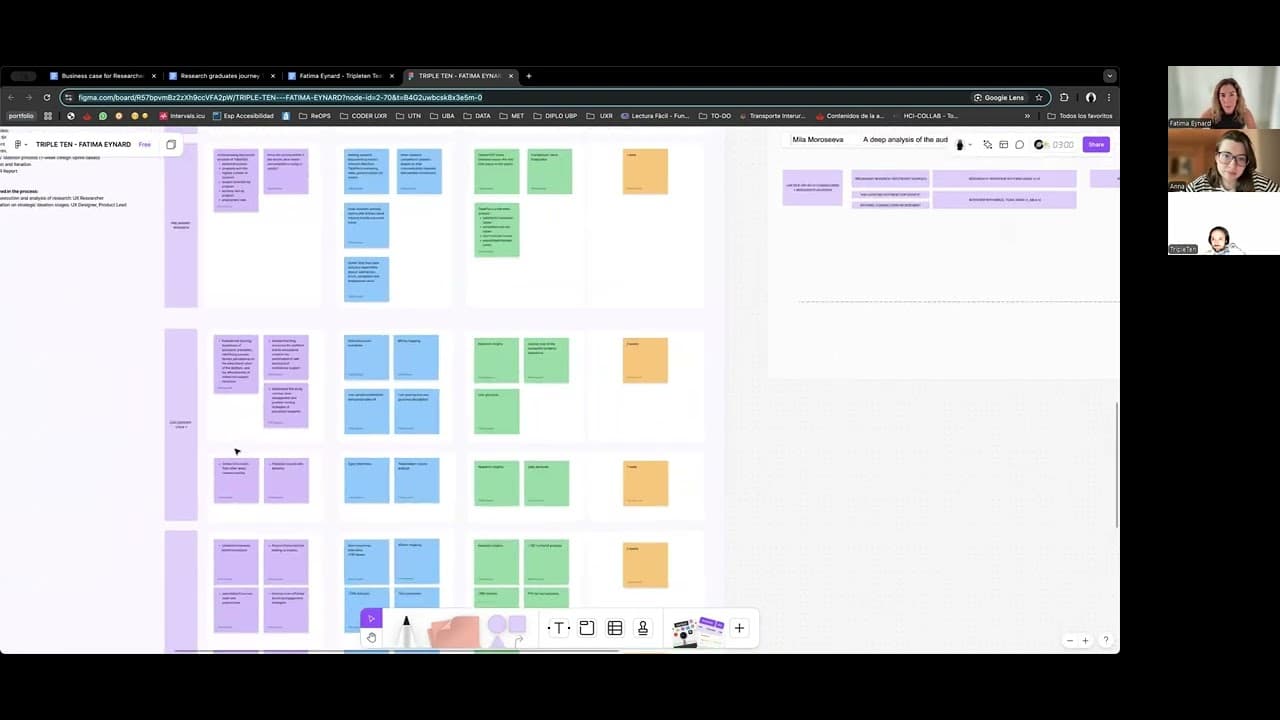
The conversation revolves around a business case aiming to grow student numbers and improve retention. A two-stage research strategy is proposed, starting with leveraging ongoing research and followed by preliminary research using secondary sources. Stakeholder input is crucial for defining research questions and goals.
-
Secondary research sources include existing documents, Google Scholar, and ethnographic studies, which help understand user context and competitor offerings. The conversation also explores the challenges of using structured frameworks like 'Jobs to be Done' and the need for a flexible approach to meet business objectives.
-
Qualitative research is favored for understanding user motivations, while quantitative methods are used for behavioral analysis. The discussion also addresses practical challenges like updating sales presentations within tight timelines and the need for effective segmentation in email communication to improve user engagement.
Read in Other Languages (beta)
Share This Summary 📚
Summarize YouTube Videos and Get Video Transcripts with 1-Click
Try YouTube Summary with ChatGPT & Claude or YouTube Transcript Generator