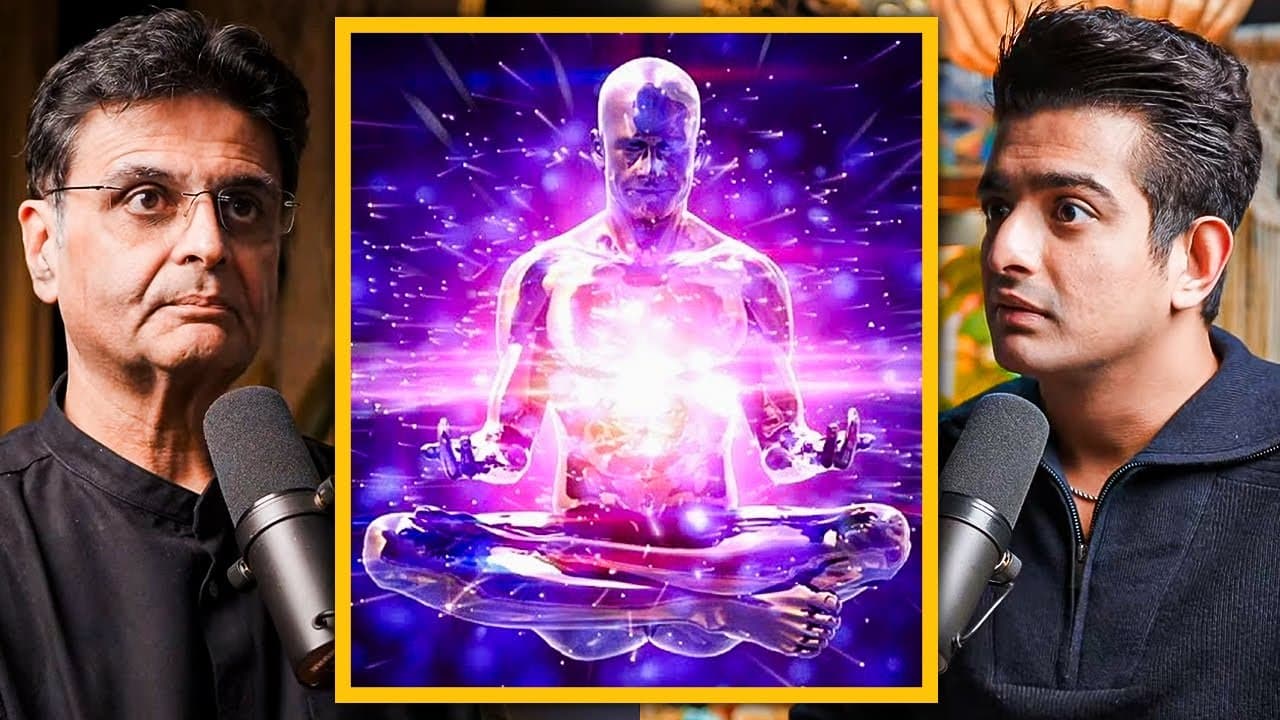
Mind-Blowing Connection Between Your Spine And Nirvana - Spine Surgeon Dr. Ram Chadda Reveals
TL;DR
The conversation delves into the intersection of samadhi, yoga philosophy, and scientific understanding.
Transcript
welcome to TRS Clips where you'll find happiness through your own curiosity actually I want to just go a little bit deeper into the samadhi angle uh because it's from the world of yoga and philosophy uh you know what else is from the world of yoga and philosophy the spine it's actually a very very very important aspect of yoga uh so I knew that wit... Read More
Key Insights
- ✋ Samadhi is a central concept in yoga philosophy, denoting higher consciousness and introspection.
- ❓ Ancient wisdom offers essential insights that complement scientific paradigms, enhancing overall human understanding.
- 🌉 The spine serves as a symbolic and physiological bridge between physical reality and spiritual enlightenment in yoga.
- ❓ Personal growth from ignorance to wisdom (buddhu to Buddha) is a transformative journey reliant on cultivating awareness.
- 🫚 The discussion critiques the skepticism in scientific communities towards practices rooted in ancient cultures like yoga.
- 👻 The neocortex represents a significant evolution in cognitive capabilities, allowing complexity in thought and social interactions.
- 💦 The dialogue emphasizes that science and philosophy can work together to unravel the mysteries of human consciousness.
Install to Summarize YouTube Videos and Get Transcripts
Explore YouTube Video Summarizer or Get YouTube Transcript Extractor
Questions & Answers
Q: What does samadhi signify in yoga philosophy?
Samadhi represents a profound state of consciousness attained through meditation and spiritual practice. It involves both an equanimous intellect and a deep connection to the self, highlighting the potential for transcending ordinary perception of time and space.
Q: How does the speaker view the relationship between science and ancient culture?
The speaker posits that while science is essential in understanding the physical world, it is limited to empirical evidence and may not encompass the depth of insights found in ancient cultures. They argue that philosophies and practices like yoga provide essential hints for the advancement of human understanding that science is still catching up to.
Q: What is the significance of the spine in this discussion?
The spine is framed as a vital component in yoga, serving as a metaphorical highway to higher states of consciousness. It represents the connection between physical existence and spiritual enlightenment, reflecting the journey toward self-realization.
Q: How is the concept of buddhi related to samadhi?
Buddhi, or wisdom, is seen as a crucial element on the path from ignorance (buddhu) to enlightenment (Buddha). It underscores the personal journey of knowledge and self-discovery necessary to achieve higher states of being, such as samadhi.
Q: What parallels are drawn between ancient philosophies and modern science?
The speaker draws parallels between ancient philosophical teachings—like those in the Bhagavad Gita and Buddhism—and the evolving understanding of consciousness in modern science. Both realms eventually converge on similar existential truths, despite their differing methodologies.
Q: What critique is mentioned regarding the reception of yoga in scientific circles?
The speaker mentions a prevailing skepticism towards yoga and ancient philosophies among some scientists, labeling them as "yoga haters." This criticism stems from a lack of scientific evidence supporting these practices, yet the speaker argues for an open-minded approach that allows future research to validate these ancient insights.
Q: Can you explain the concept of the neocortex in relation to human evolution?
The neocortex is described as a distinguishing feature of human evolution, allowing advanced reasoning and moral judgment—qualities that set humans apart from other species. This cognitive ability is foundational for progress and the social structures that characterize human societies.
Q: What is the ultimate objective mentioned in the context of achieving bliss?
The ultimate objective is depicted as reaching a state of bliss beyond existence, achievable through the practice of meditation and a deep understanding of impermanence. This aligns with both yogic teachings and philosophical doctrines that suggest true enlightenment comes from within.
Summary & Key Takeaways
-
The discussion focuses on the concept of samadhi, a higher state of consciousness, as framed by yoga philosophy and its implications on understanding the human experience.
-
The dialogue contrasts science's evidence-based approach with the esoteric insight offered by ancient philosophies, emphasizing the need to respect both dimensions for a fuller understanding of human existence.
-
The spine is highlighted as a significant element in yoga, symbolizing the pathway to higher consciousness while also reflecting the complex journey from ignorance to enlightenment.
Read in Other Languages (beta)
Share This Summary 📚
Summarize YouTube Videos and Get Video Transcripts with 1-Click
Try YouTube Summary with ChatGPT & Claude or YouTube Transcript Generator
Explore More Summaries from TRS Clips 📚





Summarize YouTube Videos and Get Video Transcripts with 1-Click
Try YouTube Summary with ChatGPT & Claude or YouTube Transcript Generator