Clock Synchronisation | Different Types | Distributed Systems | Lec-50 | Bhanu Priya
TL;DR
Overview of clock synchronization methods for distributed systems, including physical and logical techniques.
Transcript
hi students Oh welcome back let's continue the clock synchronization so in the previous video I explained what exactly the clock synchronization is clock synchronization is so in this video I want to tell you a different techniques or different properties that we are using to maintain de to maintain the clock synchronization in the distributed envi... Read More
Key Insights
- ❓ Clock synchronization is vital for maintaining operational consistency in distributed systems, enhancing data integrity and process coordination.
- ⏲️ Physical clock synchronization techniques involve real-time systems that require external time references, such as UTC, to align their operations effectively.
- ⏰ Logical clock synchronization allows for coordination of events without direct reliance on physical clocks, with methods like Lamport's clocks paving the way for effective event ordering.
- 🈸 Mutual exclusion techniques address challenges in resource sharing among processes, ensuring compliance with critical section protocols in distributed applications.
- 📼 The video sets the foundation for more in-depth discussions on specific algorithms in future content, indicating a structured learning approach.
- 🗯️ Different algorithms are suitable for various scenarios, emphasizing the necessity of choosing the right synchronization method based on system requirements.
- 👤 Understanding the intricacies of clock synchronization can enhance system performance, reduce errors, and improve user experiences in technology applications.
Install to Summarize YouTube Videos and Get Transcripts
Explore YouTube Video Summarizer or Get YouTube Transcript Extractor
Questions & Answers
Q: What is clock synchronization and why is it important in distributed systems?
Clock synchronization is the process of aligning the time of different devices in a distributed system to ensure they operate cohesively. It is crucial because distributed systems rely on accurate time for tasks such as event ordering, coordination, and consistency, preventing errors in data processing or transmission.
Q: What are the main types of clock synchronization mentioned in the video?
The video highlights three primary types of clock synchronization: physical clock synchronization, which addresses real-time alignment; logical clock synchronization, which refers to computational timing mechanisms; and mutual exclusion clock synchronization, which ensures that processes do not conflict in accessing shared resources.
Q: Can you explain the UTC and its role in physical clock synchronization?
UTC, or Universal Coordinated Time, acts as a global time standard that helps synchronize clocks in distributed systems. It provides a baseline temporal reference that different systems can adhere to, ensuring that they operate on the same time frame, which is essential for coordination and event timing across various geographical locations.
Q: What are Lamport's clocks, and how do they contribute to logical clock synchronization?
Lamport's clocks are a method for establishing a logical ordering of events in distributed systems. By assigning a sequence number to events based on their occurrence, they enable systems to determine the causality of events, allowing for proper coordination without relying on the physical timing of clocks.
Q: What algorithms are used for mutual exclusion in clock synchronization?
The video highlights several algorithms for mutual exclusion clock synchronization, including centralized algorithms, which rely on a single coordinating process, distributed algorithms that allow for peer coordination without a central authority, and token-based algorithms that control access to resources through passing tokens among processes.
Summary & Key Takeaways
-
The video discusses various techniques for clock synchronization in distributed environments, emphasizing the importance of maintaining accurate time among different systems.
-
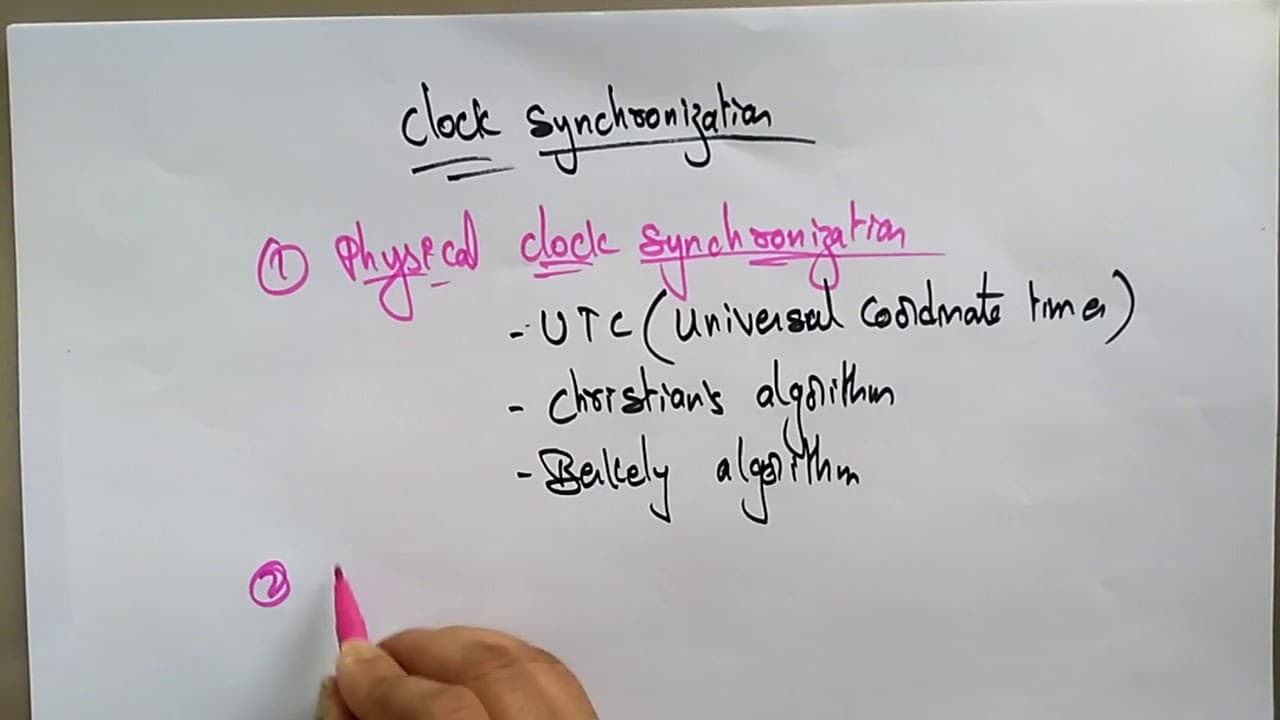
Key techniques include physical clock synchronization methods such as UTC, Christian's algorithm, and the Berkeley algorithm, which help in aligning real-time clocks across systems.
-
Logical clock synchronization is also covered, focusing on methods like Lamport's clocks and mutual exclusion algorithms that manage time without relying on physical clocks.
Read in Other Languages (beta)
Share This Summary 📚
Summarize YouTube Videos and Get Video Transcripts with 1-Click
Try YouTube Summary with ChatGPT & Claude or YouTube Transcript Generator