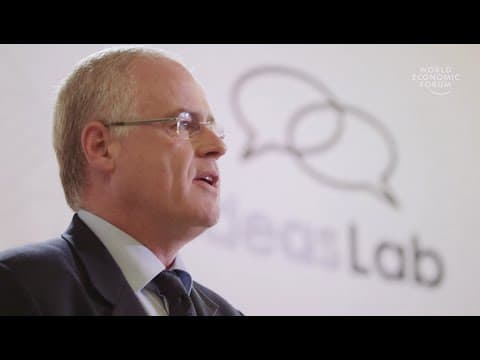
Ideas @Davos | Brian Arthur | Complexity Economics

TL;DR
Standard economics lacks accounting for complexity and feedback loops, urging a shift towards a dynamic perspective.
Transcript
the way I was taught to look at the economy in a gradual school years ago was as a very perfect machine everything well-oiled and balanced and then when everything melted down and crashed in 2008 economics is kind of scratching its head and saying well we're looking for new approaches many scientists like to view the world as orderly and then there... Read More
Key Insights
- ❓ The 2008 economic crash revealed the inadequacies of traditional economic models.
- 🛩️ Complexity economics emphasizes the importance of small interactions in shaping economic systems.
- ❓ Recognizing cultural and institutional influences is crucial in understanding complex economic phenomena.
- 🥺 Positive feedback loops can lead to destabilizing forces in the economy.
- 🥺 Embracing imperfection and dynamism in economic systems can lead to better management and resilience.
- ❓ Traditional economics often overlooks events that propagate through systems.
- 🫵 Complexity economics offers a new perspective on viewing the economy as a living and evolving entity.
Install to Summarize YouTube Videos and Get Transcripts
Explore YouTube Video Summarizer or Get YouTube Transcript Extractor
Questions & Answers
Q: Why did the 2008 economic crash challenge the traditional view of economics?
The crash exposed flaws in the belief of a perfectly balanced economy and the failure to account for complex interactions and feedback loops.
Q: How does complexity economics differ from standard economics?
Complexity economics considers the economy as a dynamic system influenced by small interactions, challenging the static equilibrium perspective of standard economics.
Q: What role do culture and institutions play in complexity economics?
Complexity economics acknowledges the impact of culture and institutions on economic systems, recognizing their importance in shaping behaviors and outcomes.
Q: How can shifting towards complexity economics benefit our understanding of crises like the eurozone crisis?
By embracing complexity economics, we can better recognize positive feedback loops that contribute to crises and work towards managing and mitigating their effects more effectively.
Summary & Key Takeaways
-
Traditional economics views the economy as a perfect machine, but the 2008 crash revealed imperfections.
-
Complexity economics explores how small interactions create larger systems.
-
Embracing imperfection and feedback loops can lead to a better understanding and management of the economy.
Read in Other Languages (beta)
Share This Summary 📚
Summarize YouTube Videos and Get Video Transcripts with 1-Click
Try YouTube Summary with ChatGPT & Claude or YouTube Transcript Generator
Explore More Summaries from World Economic Forum 📚
Summarize YouTube Videos and Get Video Transcripts with 1-Click
Try YouTube Summary with ChatGPT & Claude or YouTube Transcript Generator