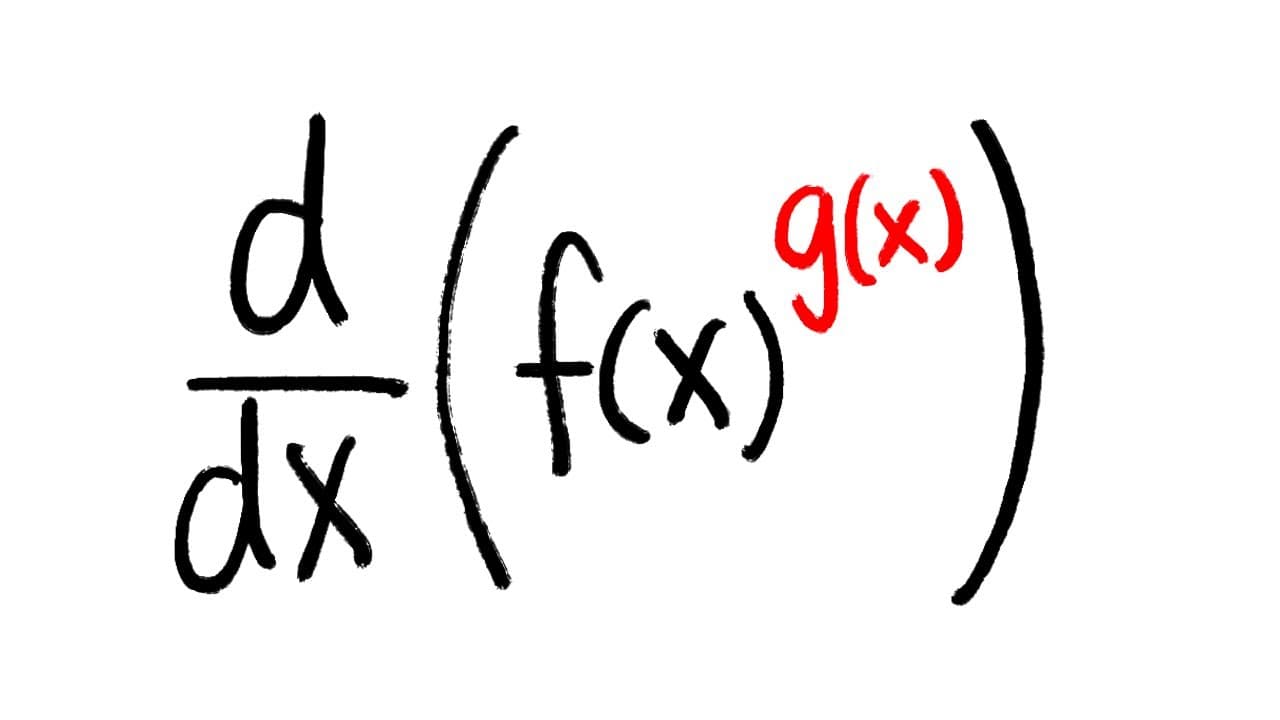
the untaught differentiation formula, the derivative of (f(x))^g(x), calculus 1 tutorial
TL;DR
When differentiating a function to a function power, there are two approaches: using the natural logarithm or rewriting the base as e to the Ln.
Transcript
okay as we all know when we differentiate we have the power we have the product we have the quotient and we also have the chain rules right but we also have another special situation when we have a function to a function power this right here it's not power rule situation this right here is not exponential situation you have to do the following I w... Read More
Key Insights
- ✊ Differentiating a function to a function power can be approached using the natural logarithm or by rewriting the base as e to the Ln.
- 💦 Working with the base as e is often favorable in calculus.
- 🥡 The first approach involves taking the natural logarithm of the function and differentiating implicitly.
- ⚾ The second approach involves rewriting the base as e to the Ln and differentiating using the product rule.
- 🇬🇫 The formula for differentiating a function to a function power is dy/dx = G * F' / F + G' * ln(F).
- ❎ Negative bases do not make sense in this context.
- 😄 The choice of approach depends on personal preference and ease of application.
Install to Summarize YouTube Videos and Get Transcripts
Explore YouTube Video Summarizer or Get YouTube Transcript Extractor
Questions & Answers
Q: What is the first approach to differentiate a function to a function power?
The first approach involves rewriting the function as y = F to the G's power, taking the natural logarithm, and applying the chain rule to differentiate implicitly.
Q: How is the second approach different from the first one?
In the second approach, we rewrite the base as e to the Ln F and differentiate using the product rule.
Q: Can the base of the function be negative?
No, the base of the function cannot be negative as negative to a function does not make sense.
Q: What is the formula to differentiate a function to a function power?
The formula is dy/dx = G * F' / F + G' * ln(F).
Summary & Key Takeaways
-
The video explains two approaches to differentiate a function to a function power: using the natural logarithm or rewriting the base as e to the Ln.
-
In the first approach, we rewrite the function as y = F to the G's power, take the natural logarithm, and apply the chain rule to differentiate implicitly.
-
In the second approach, we rewrite the base as e to the Ln F and differentiate using the product rule.
Read in Other Languages (beta)
Share This Summary 📚
Summarize YouTube Videos and Get Video Transcripts with 1-Click
Try YouTube Summary with ChatGPT & Claude or YouTube Transcript Generator
Explore More Summaries from blackpenredpen 📚
Summarize YouTube Videos and Get Video Transcripts with 1-Click
Try YouTube Summary with ChatGPT & Claude or YouTube Transcript Generator