Ch 1: Public Speaking (Part 4 of 6)
TL;DR
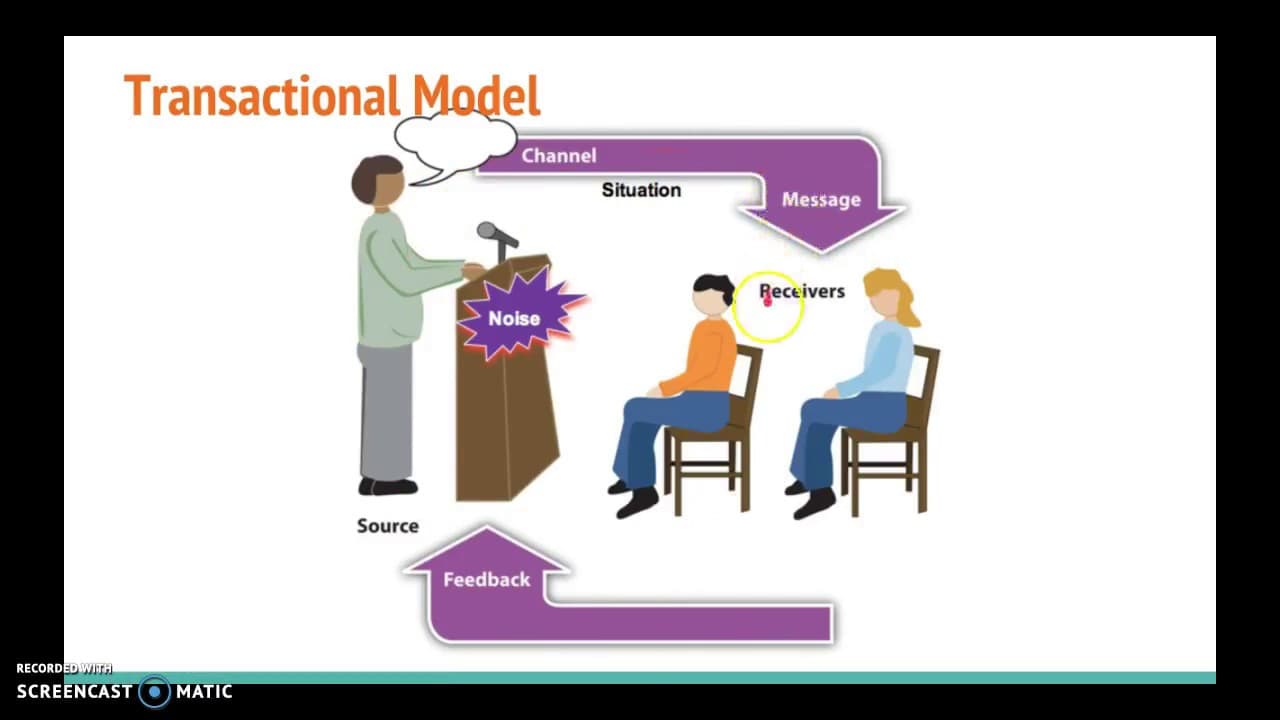
The transactional model co-creates meaning through simultaneous message exchange.
Transcript
So over the years, Communication scholars have come up with many different models to try to explain what is happening in a communication setting; what's happening when public speaking is taking place. And your book talks about a few of these different models: they talk about the linear model and the interactional model. But today, I want t... Read More
Key Insights
- The transactional model of communication involves simultaneous sending and receiving of messages, emphasizing the co-creation of meaning between participants.
- The source, or speaker, is responsible for delivering a message to the listener, ensuring the intended message is accurately received.
- Channels are the mediums through which messages are communicated, including audio-visual, mediated, and in-person methods.
- Receivers interpret messages through their unique frames of reference, influenced by culture, experience, and heredity.
- Feedback from receivers, often nonverbal, provides the source with information about message reception and understanding.
- Noise, both internal and external, can interfere with message transmission, affecting communication effectiveness.
- The situational context, including time and place, significantly impacts the communication process and message delivery.
- Understanding the transactional model offers a comprehensive view of the public speaking process, highlighting the dynamic nature of communication.
Install to Summarize YouTube Videos and Get Transcripts
Explore YouTube Video Summarizer or Get YouTube Transcript Extractor
Questions & Answers
Q: What is the transactional model of communication?
The transactional model of communication is a comprehensive framework that explains the process of public speaking. It involves simultaneous sending and receiving of messages, emphasizing the co-creation of meaning between participants. This model includes elements such as the source, message, channel, receiver, feedback, noise, and situational context, highlighting the dynamic nature of communication.
Q: How does the source ensure the message is accurately received?
The source, or speaker, ensures the message is accurately received by considering the audience's frame of reference and using clear communication channels. This involves aligning verbal and nonverbal cues, adapting the message to the audience's cultural and experiential background, and providing opportunities for feedback to confirm understanding.
Q: What role do channels play in communication?
Channels are the mediums through which messages are communicated from the source to the receiver. They can be audio-visual, mediated, or in-person methods. The choice of channel affects how the message is perceived and interpreted, making it crucial for effective communication to select an appropriate channel that suits the context and audience.
Q: How do receivers interpret messages?
Receivers interpret messages through their unique frames of reference, which are shaped by their culture, experiences, and hereditary factors. This frame of reference influences how they perceive and understand the message, requiring the source to consider these factors to ensure accurate communication and minimize misunderstandings.
Q: What is the significance of feedback in communication?
Feedback is crucial in communication as it provides the source with information about how the message is received and understood by the audience. Often nonverbal, feedback can include nodding, facial expressions, or gestures that indicate comprehension or confusion, allowing the speaker to adjust their message accordingly to enhance understanding.
Q: What types of noise can interfere with communication?
Noise can be both internal and external, interfering with message transmission and affecting communication effectiveness. External noise includes physical disruptions like faulty microphones, while internal noise involves mental distractions such as wandering thoughts or closed-mindedness. Both types of noise can hinder the accurate reception of messages.
Q: How does the situational context impact communication?
The situational context, including the time and place of interaction, significantly impacts communication. Different settings require different communication approaches, such as adjusting volume at a football game versus a church. Understanding the context helps tailor the message and delivery to suit the environment, enhancing communication effectiveness.
Q: Why is the transactional model considered comprehensive?
The transactional model is considered comprehensive because it encompasses all aspects of the communication process, including the simultaneous exchange of messages, feedback, noise, and situational context. It highlights the dynamic and interactive nature of communication, providing a detailed framework for understanding the complexities of public speaking and message co-creation.
Summary & Key Takeaways
-
The transactional model of communication is considered the most inclusive and effective in explaining public speaking. It involves simultaneous message exchange, where meaning is co-created by the interacting individuals. The model includes elements such as the source, message, channel, receiver, feedback, noise, and situational context.
-
In this model, the source sends a message through a channel to the receiver, who interprets it based on their frame of reference. Feedback is provided, often nonverbally, to indicate understanding or confusion. Noise, both internal and external, can impede message transmission, affecting communication.
-
Communication is influenced by the situational context, including the time and place of the interaction. Different settings require different communication approaches, highlighting the importance of adapting to the environment. The transactional model provides a comprehensive framework for understanding the complexities of public speaking.
Read in Other Languages (beta)
Share This Summary 📚
Summarize YouTube Videos and Get Video Transcripts with 1-Click
Try YouTube Summary with ChatGPT & Claude or YouTube Transcript Generator