Lecture 5: TCC and FOR MontiVision Demos, Vanishing Point, Use of VPs in Camera Calibration
TL;DR
Perspective projection, vanishing points, and surface orientation can be used to calibrate cameras, measure brightness, and reconstruct surfaces from images.
Transcript
[SQUEAKING] [RUSTLING] [CLICKING] BERTHOLD HORN: Have another go at this demonstration using a direct HDMI connection. And let's see what happens. Can't play graph. OK, so let's first go back up here. Just make-- So that's what we've seen before. And now let's try-- OK, that's a bit bitter. So this is a webcam looking down at the keyboard. And when... Read More
Key Insights
- 🎥 Vanishing points play a crucial role in camera calibration, allowing for the estimation of internal camera parameters.
- 🔅 Surface orientation can be estimated by measuring brightness and using mathematical models to relate it to the surface's normal vector.
- 🔸 Orthographic projection can be used as a simplified form of perspective projection in certain cases where the depth range is small compared to the object's depth.
Install to Summarize YouTube Videos and Get Transcripts
Explore YouTube Video Summarizer or Get YouTube Transcript Extractor
Questions & Answers
Q: How can vanishing points be used for camera calibration?
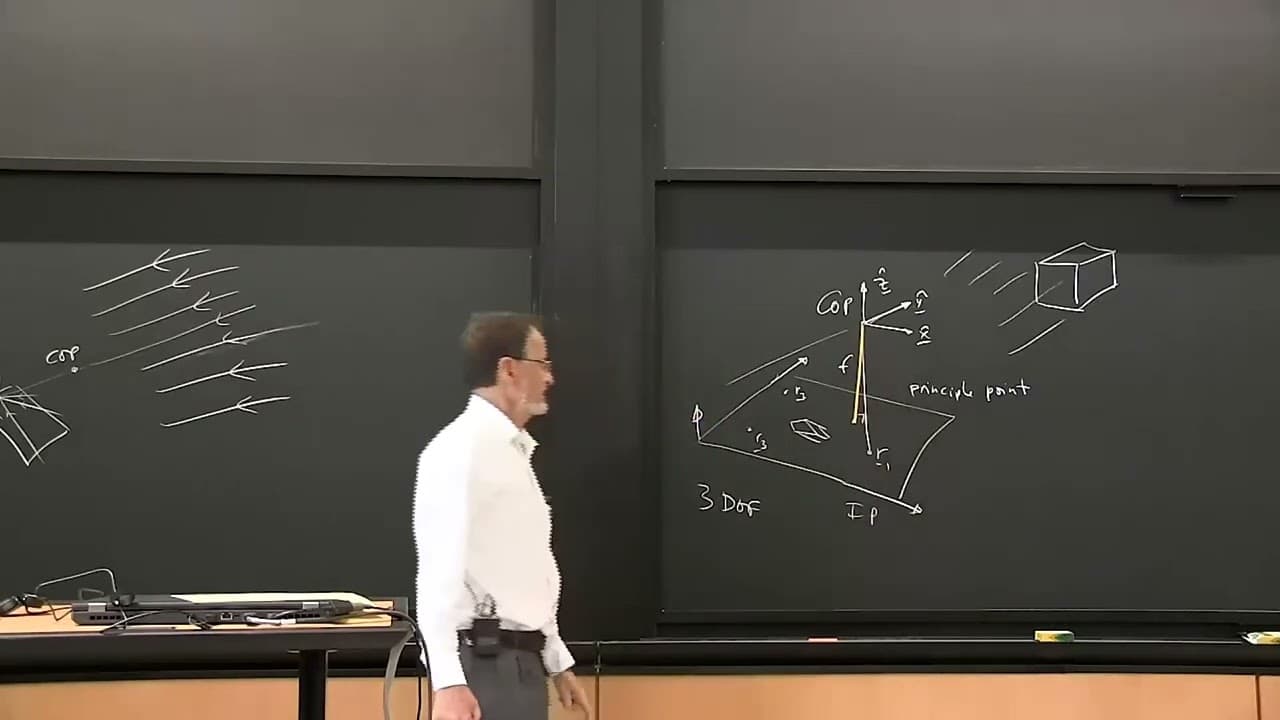
Vanishing points can be used to determine the orientation of surfaces in an image, which is an essential step in camera calibration. By measuring the position of the vanishing points and their relationship to the camera, it is possible to calculate the camera's internal parameters, such as the focal length and principal point.
Q: What is the relationship between brightness and surface orientation?
The brightness of an object in an image is influenced by the orientation of its surface relative to the light source. By measuring the brightness of an object from different lighting directions, it is possible to estimate the surface's normal vector and thus determine its orientation.
Q: Can orthographic projection be used instead of perspective projection?
Orthographic projection is a simplified form of perspective projection that can be used when the range in depth is small compared to the object's depth. In orthographic projection, the depth is assumed to be constant, and the image generated has a constant magnification factor. This simplification is useful for certain applications, such as reconstructing surfaces from images.
Q: How can brightness measurements be used to estimate surface orientation?
By measuring the brightness of an object from different lighting directions and using appropriate mathematical models, it is possible to estimate the surface's normal vector, which can then be used to determine its orientation.
Summary & Key Takeaways
-
Perspective projection is the method used by cameras to generate an image, based on the position and orientation of the objects in the scene.
-
Vanishing points can be used to determine the orientation of surfaces and objects in an image, and they are vital for camera calibration.
-
Surface orientation can be estimated by measuring the brightness of an object in different lighting conditions and using this information to calculate the surface's normal vector.
Read in Other Languages (beta)
Share This Summary 📚
Summarize YouTube Videos and Get Video Transcripts with 1-Click
Try YouTube Summary with ChatGPT & Claude or YouTube Transcript Generator
Explore More Summaries from MIT OpenCourseWare 📚



Summarize YouTube Videos and Get Video Transcripts with 1-Click
Try YouTube Summary with ChatGPT & Claude or YouTube Transcript Generator