4. Classical Wave Equation and Separation of Variables
TL;DR
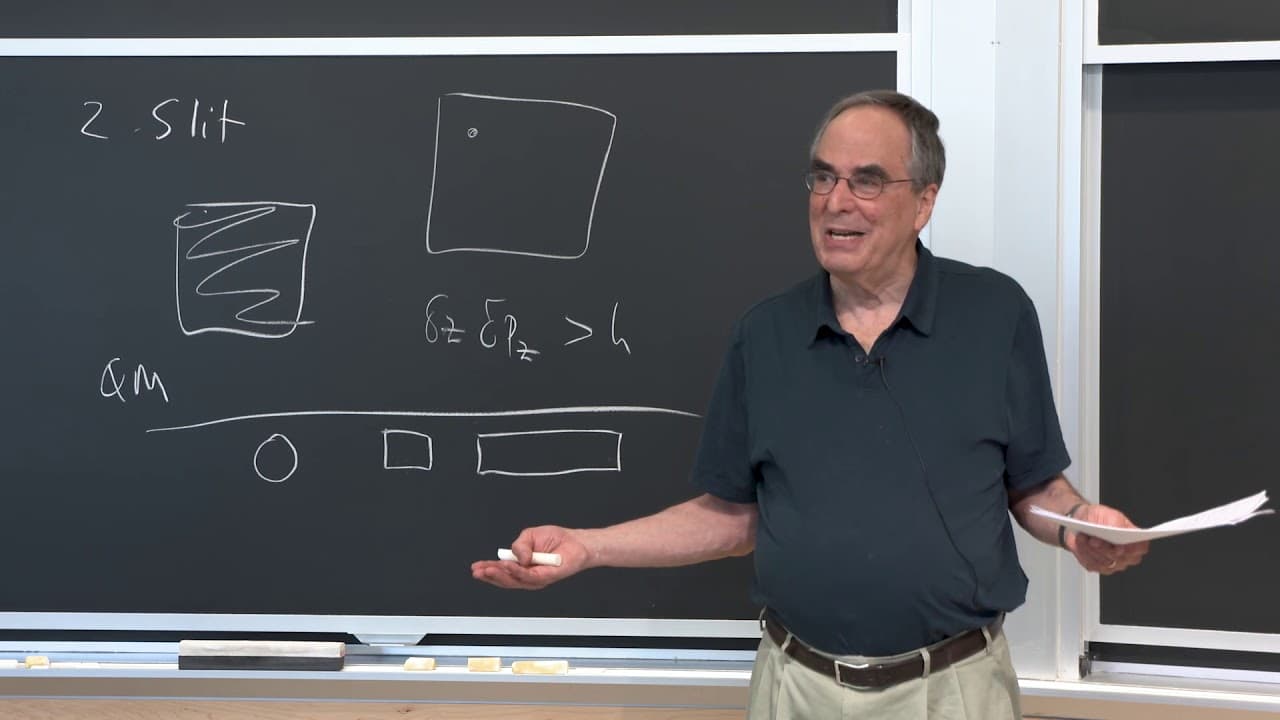
The video discusses the classical wave equation and its solutions, focusing on the properties of eigenfunctions and superpositions. It also highlights the importance of drawing pictures and using classical mechanics to gain insights into quantum mechanical systems.
Transcript
The following content is provided under a Creative Commons license. Your support will help MIT Open Courseware continue to offer high quality educational resources for free. To make a donation or to view additional materials from hundreds of MIT courses, visit MIT Open Courseware at ocw.mit.edu. ROBERT FIELD: That's the outline of what we're going ... Read More
Key Insights
- 😌 The classical wave equation and its solutions lay the foundation for understanding quantum mechanics, as they involve eigenfunctions and superpositions.
- 🥺 The behavior of a string tied down at two points depends on the normal modes and their superpositions, leading to various types of motion.
- 👋 Sines, cosines, and exponentials are valid solutions for the wave equation, depending on the sign of the constant.
- 🦾 Drawing pictures and using classical mechanics aid in understanding and predicting the behavior of quantum mechanical systems.
Install to Summarize YouTube Videos and Get Transcripts
Explore YouTube Video Summarizer or Get YouTube Transcript Extractor
Questions & Answers
Q: What are the two surprising aspects of the two-slit experiment mentioned in the video?
The two surprises are the interference of a single particle with itself and the collapse of the particle's state to a single point when observed.
Q: What are the valid solutions for the classical wave equation for a string tied down at two points?
Only solutions with negative constants (sines, cosines) are valid.
Q: How do superpositions of normal modes affect the motion of a string?
Superpositions of even n modes result in breathing motion, while superpositions involving both even and odd n modes cause left-right motion.
Q: What is the importance of drawing pictures and using classical mechanics in understanding quantum mechanical systems?
Drawing pictures helps visualize the behavior of eigenfunctions and superpositions, while classical mechanics provides insights into the motion and properties of quantum systems.
Summary & Key Takeaways
-
The video starts by exploring the two surprises of the two-slit experiment: the interference of a single particle with itself and the collapse of the particle's state to a single point when observed.
-
The classical wave equation (second derivative of a function with respect to x equals a constant times the function) is introduced, along with its solutions involving sines and cosines for negative constants and exponentials for positive constants.
-
Boundary conditions are discussed, and it is shown that only solutions with negative constants are valid for a string tied down at two points.
-
The video then explains the concept of normal modes and their superposition, allowing for various types of motion (standing, breathing, left-right) in a string.
-
The time-dependent solutions for the wave equation are presented and simplified.
-
The importance of drawing pictures and using classical mechanics to understand and predict the behavior of quantum mechanical systems is emphasized.
Read in Other Languages (beta)
Share This Summary 📚
Summarize YouTube Videos and Get Video Transcripts with 1-Click
Try YouTube Summary with ChatGPT & Claude or YouTube Transcript Generator
Explore More Summaries from MIT OpenCourseWare 📚


Summarize YouTube Videos and Get Video Transcripts with 1-Click
Try YouTube Summary with ChatGPT & Claude or YouTube Transcript Generator