2^(a+bi), ln(a+bi), and sin(a+bi)
TL;DR
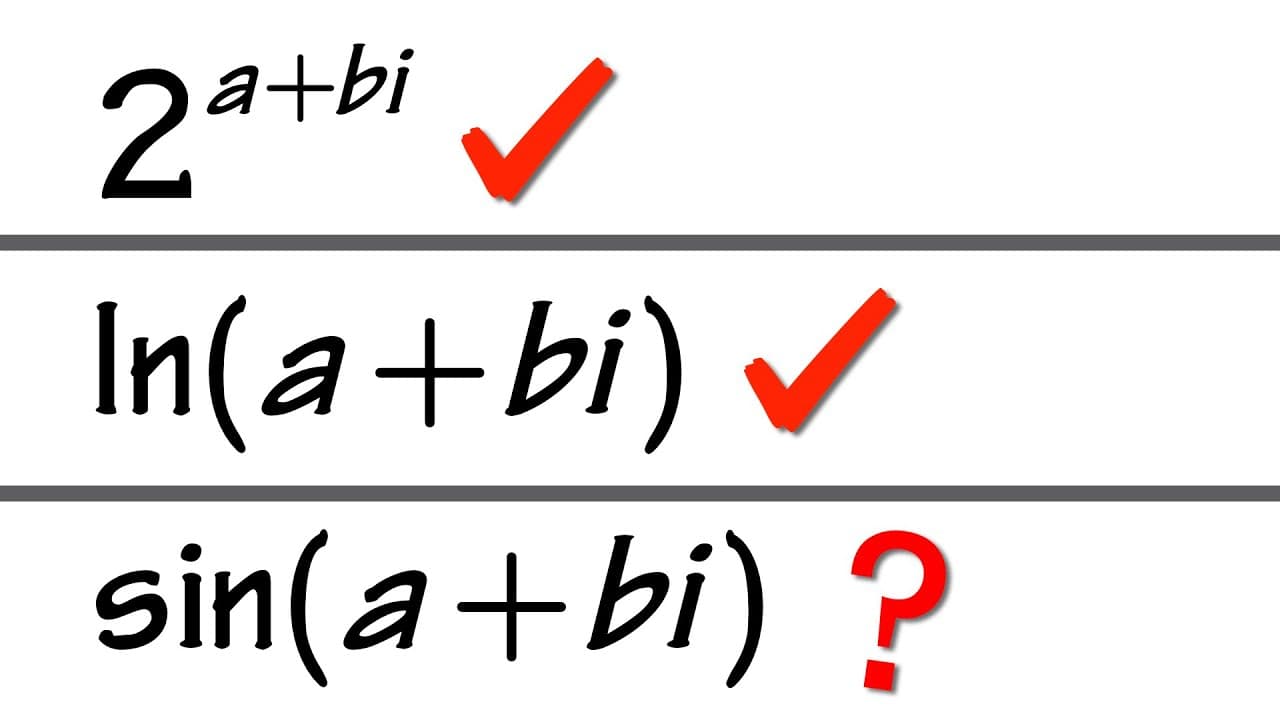
Learn three unique ways to represent complex numbers using algebraic equations, Euler's formula, and trigonometric functions.
Transcript
as we all know this right here is a complex number and people have different preference some people like to put a complex number instead of a square and they get this some people like to put it on the bottom and they will have this and some people also like to put inside the square root and see a description my question for you guys is that where d... Read More
Key Insights
- #️⃣ Complex numbers can be represented using different mathematical frameworks, such as algebraic equations, Euler's formula, and trigonometric functions.
- ✊ Euler's formula provides a powerful way to express complex numbers by using the base of e raised to the power of a complex exponent, allowing for versatile mathematical operations.
- #️⃣ Natural logarithms can be used to simplify the representation of complex numbers and facilitate mathematical manipulations.
Install to Summarize YouTube Videos and Get Transcripts
Explore YouTube Video Summarizer or Get YouTube Transcript Extractor
Questions & Answers
Q: What are the three different ways to represent complex numbers discussed in the video?
The three methods are using algebraic equations, Euler's formula, and trigonometric functions like sine and cosine.
Q: How can complex numbers be written as a base raised to the power of a complex exponent?
By applying Euler's formula, complex numbers can be expressed as a base raised to the power of a complex exponent, where the base is a real number and the exponent includes both real and imaginary components.
Q: How does putting complex numbers inside natural logarithms simplify their representation?
By utilizing natural logarithms, complex numbers can be expressed as the product of the natural logarithm of the modulus (r) and the complex exponent (iθ), effectively simplifying their notation.
Q: What are hyperbolic trigonometric functions, and how are they related to complex numbers?
Hyperbolic trigonometric functions, such as cosh (hyperbolic cosine) and sinh (hyperbolic sine), can be used to represent complex numbers when they are put inside trigonometric functions, delivering a different way to express complex numbers.
Summary & Key Takeaways
-
Complex numbers can be represented in different forms, such as using algebraic equations, Euler's formula, and trigonometric functions.
-
By utilizing Euler's formula, complex numbers can be written as a base raised to the power of a complex exponent.
-
Complex numbers can also be expressed using natural logarithms, which simplifies their representation and allows for additional mathematical operations.
-
Another approach is to put complex numbers within trigonometric functions, such as sine and cosine, resulting in hyperbolic trigonometric functions.
Read in Other Languages (beta)
Share This Summary 📚
Summarize YouTube Videos and Get Video Transcripts with 1-Click
Try YouTube Summary with ChatGPT & Claude or YouTube Transcript Generator
Explore More Summaries from blackpenredpen 📚
Summarize YouTube Videos and Get Video Transcripts with 1-Click
Try YouTube Summary with ChatGPT & Claude or YouTube Transcript Generator