Cancellers | Block Diagram | Delay line | Radar Systems | Lec-35
TL;DR
Delay line cancellers convert bipolar video patterns into unipolar for radar displays.
Transcript
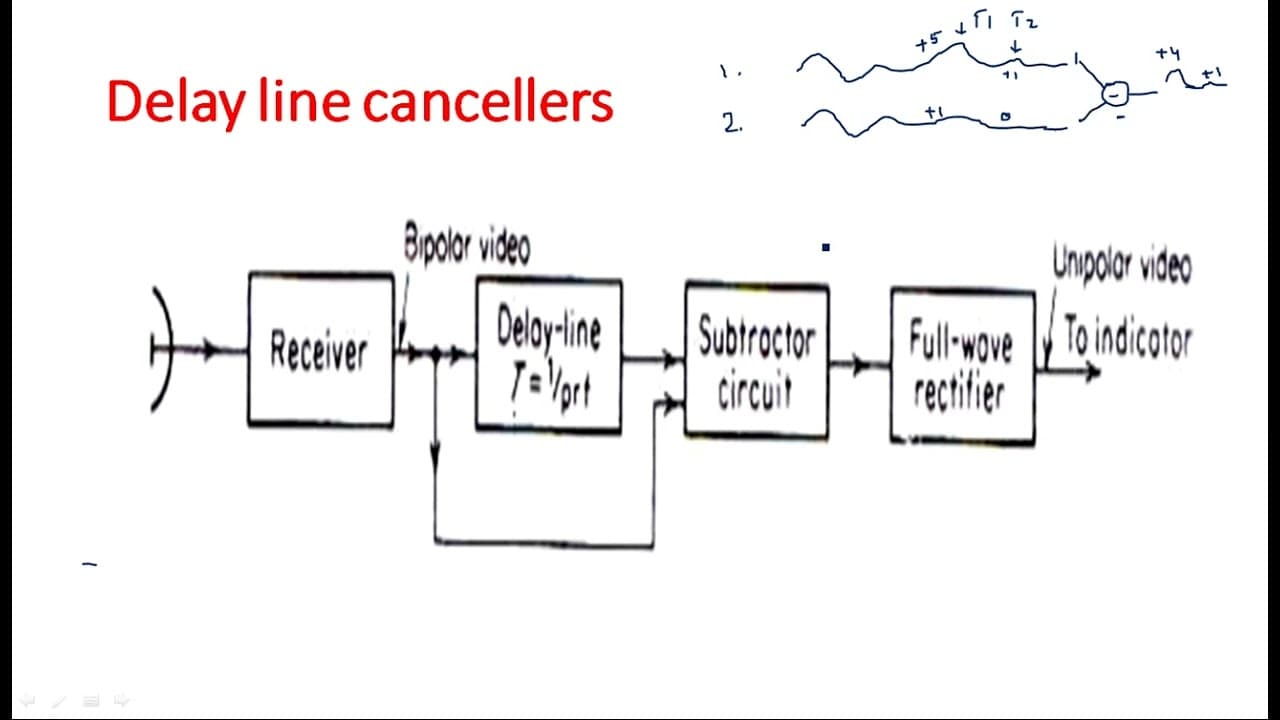
hi everyone in this video I am going to explain about delay line cancellers in the case of MTI and pulse Doppler radar the output of the receiver is given to delay line cancer If You observe the block diagrams of empty radar and pulse Doppler radar the output is connected to delay to delay line cancer it shows like a two delay line cancer from the ... Read More
Key Insights
- 🫥 Delay line cancellers are essential for converting radar output signals from bipolar to unipolar patterns for effective display on PPI systems.
- 🎯 Bipolar video patterns originate from the radar’s receivers and must be processed to eliminate stationary target signals for clearer moving target detection.
- 📡 The method of converting EM signals to acoustic signals before applying delays is vital for managing high-speed radar signals.
- 🎯 Subtractor circuits in delay line cancellers are foundational for focusing on transient signals indicative of moving targets while minimizing interference from stationary targets.
- 📡 Understanding the principle behind the butterfly effect can enhance radar signal analysis by highlighting the impact of minimal changes in target signals.
- ❓ The inability of PPI displays to represent bipolar waveforms underscores the necessity of unipolar conversion for effective visualizations of radar data.
- 🫥 Practical applications of delay line cancellers extend to various sectors including aviation, marine navigation, and defense, improving radar monitoring capabilities.
Install to Summarize YouTube Videos and Get Transcripts
Explore YouTube Video Summarizer or Get YouTube Transcript Extractor
Questions & Answers
Q: What is the primary purpose of a delay line canceler in radar systems?
The primary purpose of a delay line canceler is to convert the bipolar video patterns generated by MTI and pulse Doppler radars into unipolar video patterns. This conversion is essential for displaying accurate target information on plan position indicator (PPI) displays, which cannot handle bipolar signals. By processing the signals correctly, these cancellers improve the system's accuracy in identifying moving targets amidst stationary clutter.
Q: How do delay line cancellers eliminate stationary target signals?
Delay line cancellers use a subtractor circuit which accepts two successive received signals. This subtractor compares the two signals: one is the current signal and the other is a delayed version of the previous signal. By subtracting these signals, the constant amplitudes associated with stationary targets are eliminated, allowing the fluctuating amplitudes from moving targets to remain. The resulting signal highlights only the moving targets, enhancing the radar's ability to focus on relevant data.
Q: Why is it necessary to convert the received signals from EM to acoustic signals?
The conversion from electromagnetic (EM) signals to acoustic signals is necessary because applying millisecond-level delays directly to high-speed EM signals is nearly impossible due to their rapid propagation speed. Acoustic signals, which travel much slower, allow for more manageable delays to be applied. This process involves converting the EM signal into an acoustic signal, applying the necessary delay, and then converting it back to EM format for further processing.
Q: What challenges are associated with displaying bipolar video patterns on PPI screens?
Plan position indicator (PPI) screens can only display unipolar video patterns, which makes it challenging to directly present the bipolar video patterns generated by radar systems. Since PPI displays represent target information as blips in concentric circles without peaks or troughs, the bipolar signals must be converted into a form that PPI can correctly interpret to provide clear target ranging and positioning information.
Q: Can you explain the role of the subtractor circuit in detail?
The subtractor circuit plays a critical role in the operation of delay line cancellers. It takes two versions of the signal: the current and the delayed signal. By performing a subtraction, the circuit removes the common components that represent stationary targets, which show up as consistent amplitudes on both signals. This allows the variable components that signify moving targets to pass through, resulting in a cleaner signal for the radar system to analyze and display.
Q: What is the butterfly effect mentioned in the video?
The butterfly effect refers to a concept in which small changes can lead to significant differences in outcomes, often depicted through an analogy in radar signal waves. In this context, the changing signals as targets move represent how slight alterations in signal amplitude can provide insights into target movement and location. More importantly, this effect emphasizes the need to closely analyze multiple waveforms to accurately discriminate between stationary and moving targets, which is critical for radar functionality.
Q: How does the conversion process from AC to DC occur within delay line cancellers?
The conversion from alternating current (AC) signals to direct current (DC) in delay line cancellers is typically achieved using a rectifier. The bipolar video pattern, initially represented in AC form with both positive and negative amplitudes, needs to be converted to a pure DC signal for proper display on PPI screens. This rectification process eliminates the alternating aspects of the signal, allowing for the generation of a unipolar signal suitable for indicator displays that only process DC components.
Q: What are some practical applications of delay line cancellers in radar technology?
Delay line cancellers are used in various applications within radar technology, including air traffic control, weather monitoring, and military target tracking. They allow for precise detection of moving objects, improving situational awareness in airspace and maritime contexts. Additionally, they enhance the ability of radar systems to filter out noise and clutter, focusing solely on relevant signal targets, which is crucial in environments with multiple objects. Detecting and tracking moving targets effectively ensures improved safety and accuracy in radar operations across numerous fields.
Summary & Key Takeaways
-
Delay line cancellers are crucial for converting bipolar video patterns from MTI and pulse Doppler radars into unipolar video patterns for better display on PPI screens.
-
The conversion process involves utilizing a subtractor circuit, which eliminates stationary target signals, allowing radar systems to focus on moving targets effectively.
-
Understanding the function of delay line cancellers helps in grasping radar signal processing, especially in differentiating between moving and stationary targets.
Read in Other Languages (beta)
Share This Summary 📚
Summarize YouTube Videos and Get Video Transcripts with 1-Click
Try YouTube Summary with ChatGPT & Claude or YouTube Transcript Generator