What Are the Risks of Malicious Code in Compilers?
TL;DR
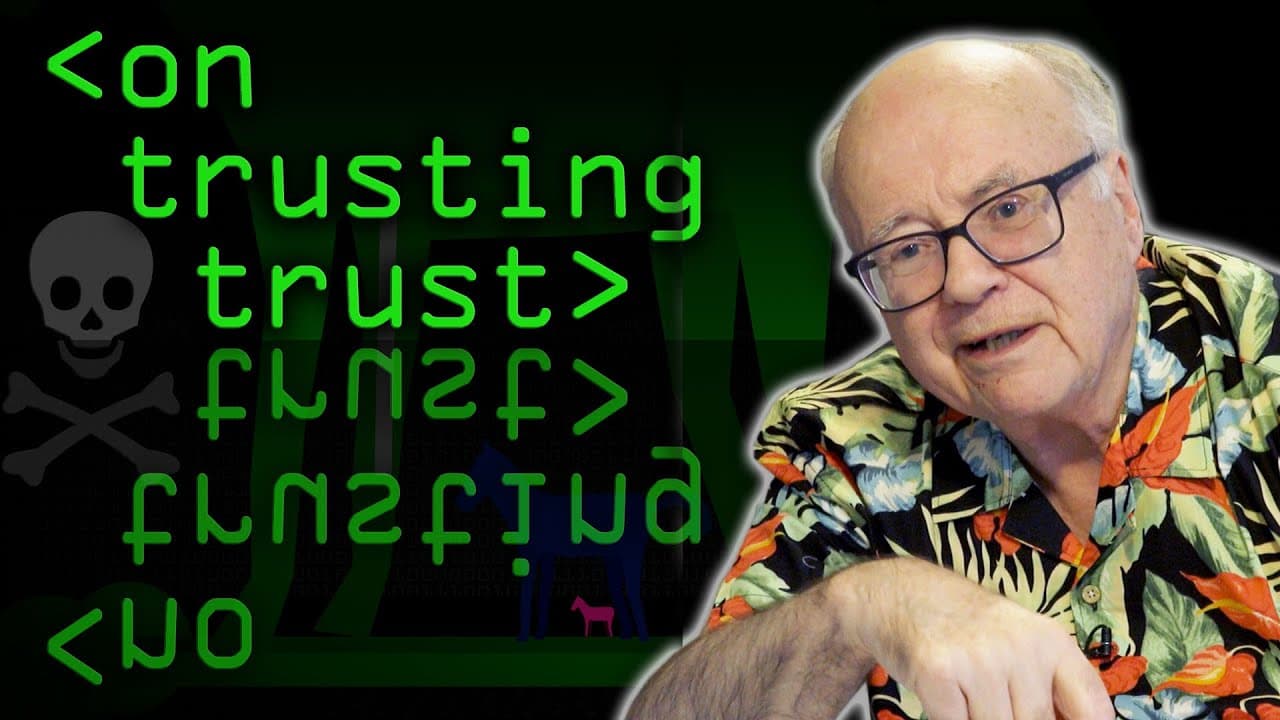
Hidden malicious code in compilers poses significant risks to computer security. Ken Thompson highlights how a rogue compiler could manipulate a system without detection, raising questions about trust in software integrity. This issue, first discussed in 1984, remains a critical concern today.
Transcript
once units got real traction from the mid 70s onwards i thought well it's only a matter of time they've got to give them the turing award and it happened i think in late 83 they were given the during award jointly i think that um the formal presentation which required a sort of little accompanying paper to go with it uh didn't happen until 1984 but... Read More
Key Insights
- 😑 The Turing Award, given for outstanding achievements in computer science, was awarded to individuals who made theoretical contributions like regular expressions and turing machines, but there was hope that the authors of Unix, Dennis Ritchie and Ken Thompson, would be jointly honored for their practical achievement.
- 🤨 Ken Thompson's paper, "Reflections on Trusting Trust," raised concerns about the potential dangers of hidden malicious code in compilers and the ability to compromise the security of computer systems.
- 👻 The concept of a rogue compiler inserting code that allows unauthorized access and manipulation of the system has significant implications for computer security and software integrity.
- 🧡 The presence of hidden malicious code in compilers creates the potential for abuse by bad actors, with examples ranging from disabling printer functions to restricting the copying of CDs.
- 👨💻 This issue of hidden malicious code in compilers, as described by Ken Thompson in 1984, continues to be a concern in modern computer security.
- 👨💻 The ability to include hidden code in compilers demonstrates the need for thorough examination and verification of software sources to ensure their integrity.
- 👨💻 The propagation of hidden malicious code through the compilation process raises challenges in detecting and removing the code from subsequent versions of the compiler.
Install to Summarize YouTube Videos and Get Transcripts
Explore YouTube Video Summarizer or Get YouTube Transcript Extractor
Questions & Answers
Q: How did Ken Thompson and Dennis Ritchie contribute to the development of computing?
Ken Thompson and Dennis Ritchie developed the C programming language and wrote the Unix operating system in C, which had a significant impact on the field of computer science.
Q: What is the potential danger associated with compilers?
Ken Thompson suggests that compilers could be engineered to include hidden malicious code, allowing unauthorized access and manipulation of the system, raising concerns about computer security.
Q: How could a rogue compiler propagate its malicious code?
Ken Thompson explains that a rogue compiler could embed its code deep within the binary, making it difficult to detect and remove. Compiling the compiler with itself would propagate the code to subsequent versions.
Q: What are the implications of hidden malicious code in compilers?
The presence of hidden malicious code in compilers raises concerns about the integrity of software and the potential for abuse by bad actors, compromising the security of computer systems and allowing for unauthorized access and manipulation.
Summary & Key Takeaways
-
Ken Thompson and Dennis Ritchie developed the C programming language and wrote the entire Unix operating system in C.
-
Ken raises the concern that compilers could contain hidden malicious code that could compromise the security of the operating system.
-
He discusses the possibility of a rogue compiler inserting code that allows unauthorized access and manipulation of the system.
-
This raises concerns about the integrity of software and the potential for abuse by bad actors.
Read in Other Languages (beta)
Share This Summary 📚
Summarize YouTube Videos and Get Video Transcripts with 1-Click
Try YouTube Summary with ChatGPT & Claude or YouTube Transcript Generator
Explore More Summaries from Computerphile 📚

Summarize YouTube Videos and Get Video Transcripts with 1-Click
Try YouTube Summary with ChatGPT & Claude or YouTube Transcript Generator