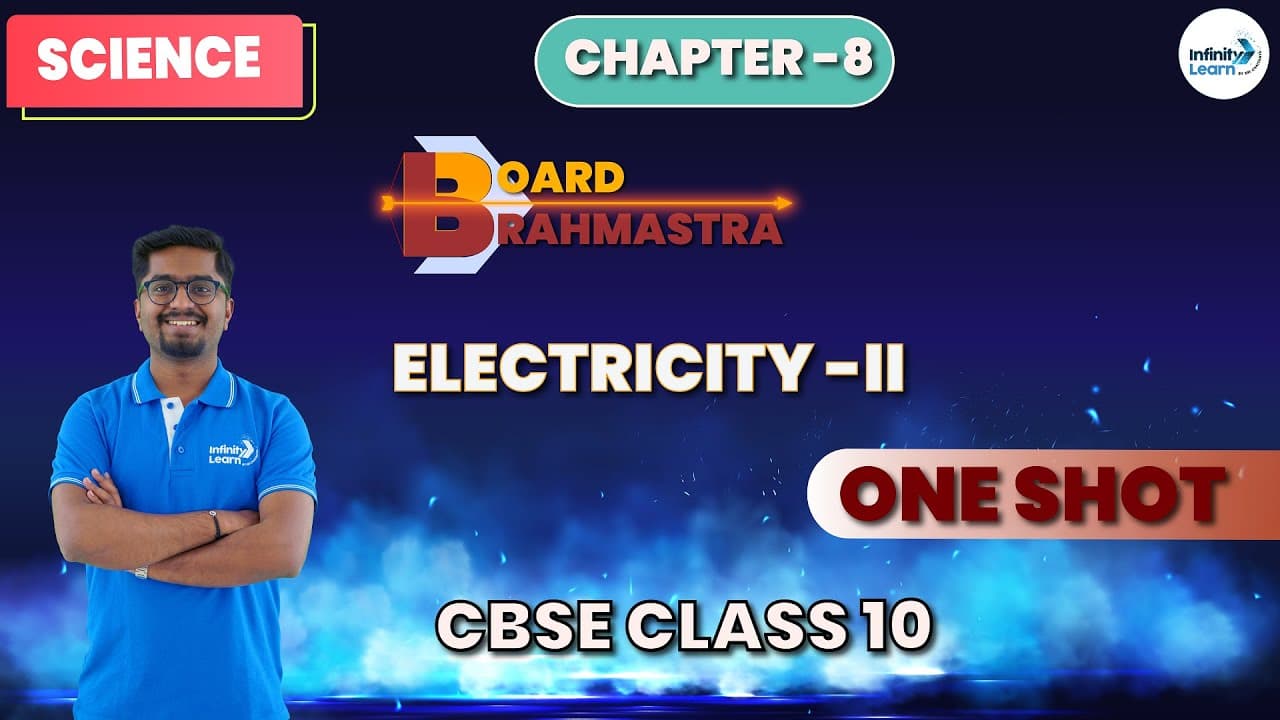
Electricity-II || CBSE Class 10 Science - Board Brahmastra || Dr. Akash Sir || Infinity Learn
TL;DR
This video discusses the concept of combining resistances in series and parallel circuits and provides examples and explanations for calculating total resistance and current in a circuit.
Transcript
foreign good afternoon so welcome to board brahmatra live say hi or say something so that I know you're present okay so today we are going to learn very very very important topic I'll tell you why because at the end I'll show you or I'll will do two previous year questions so that uh one is like uh two years back and another question came three yea... Read More
Key Insights
- ♍ Ohm's law states that V = IR, where V is the potential difference, I is the current, and R is the resistance.
- ❓ Resistors can be arranged in series or parallel combinations, each with different characteristics.
- 🍹 The total resistance in a series combination is the sum of the individual resistances.
- 🍹 The total resistance in a parallel combination is calculated using the reciprocal of the sum of the reciprocals of the individual resistances.
- 👻 Parallel combinations have practical advantages over series combinations, such as maintaining constant voltage and allowing components to draw the required current.
- 💐 Understanding the potential difference and current flow in a circuit helps determine if resistors are arranged in series or parallel.
Install to Summarize YouTube Videos and Get Transcripts
Explore YouTube Video Summarizer or Get YouTube Transcript Extractor
Questions & Answers
Q: What is Ohm's law?
Ohm's law states that the potential difference (V) across a resistance is equal to the current (I) multiplied by the resistance value (R).
Q: How do you calculate the total resistance in a series combination?
Simply add the individual resistances.
Q: How do you calculate the total resistance in a parallel combination?
Take the reciprocal of each resistance, add those reciprocals, and then take the reciprocal of the sum.
Q: What are the advantages of parallel combinations over series combinations?
Parallel combinations maintain constant voltage, allow each component to draw the required current, continue to function if one component fails, and have a lower equivalent resistance than the individual resistances.
Q: How do you determine if resistors are arranged in series or parallel?
If the current is constant, the resistors are in series. If the potential difference is constant, the resistors are in parallel.
Q: How do you calculate the total current in a circuit?
Use the total voltage divided by the total resistance to find the total current.
Q: Can you clarify the difference between voltage and potential difference?
Voltage refers to the potential at a specific terminal, while potential difference is the change in potential between two points.
Q: What is the practical application of parallel combinations?
Parallel combinations are used to maintain constant voltage, allow different components to draw the required current, and ensure the circuit remains functional even if one component fails.
Summary & Key Takeaways
-
The video explains Ohm's law, which states that the potential difference (V) across a resistance is equal to the current (I) multiplied by the resistance value (R).
-
Resistors can be arranged in two ways: series or parallel. In series, the current is constant and the potential difference varies. In parallel, the potential difference is constant and the current varies.
-
To calculate the total resistance in a series combination, simply add the individual resistances. To calculate the total resistance in a parallel combination, use the reciprocal of the sum of the reciprocals of the individual resistances.
-
The video also demonstrates how to solve numerical problems and provides practical applications and advantages of parallel combinations over series combinations.
Read in Other Languages (beta)
Share This Summary 📚
Summarize YouTube Videos and Get Video Transcripts with 1-Click
Try YouTube Summary with ChatGPT & Claude or YouTube Transcript Generator
Explore More Summaries from Infinity Learn NEET 📚

Summarize YouTube Videos and Get Video Transcripts with 1-Click
Try YouTube Summary with ChatGPT & Claude or YouTube Transcript Generator