Why is Equator Hot but Poles are Cold? + more videos | #aumsum #kids #science #education #children
TL;DR
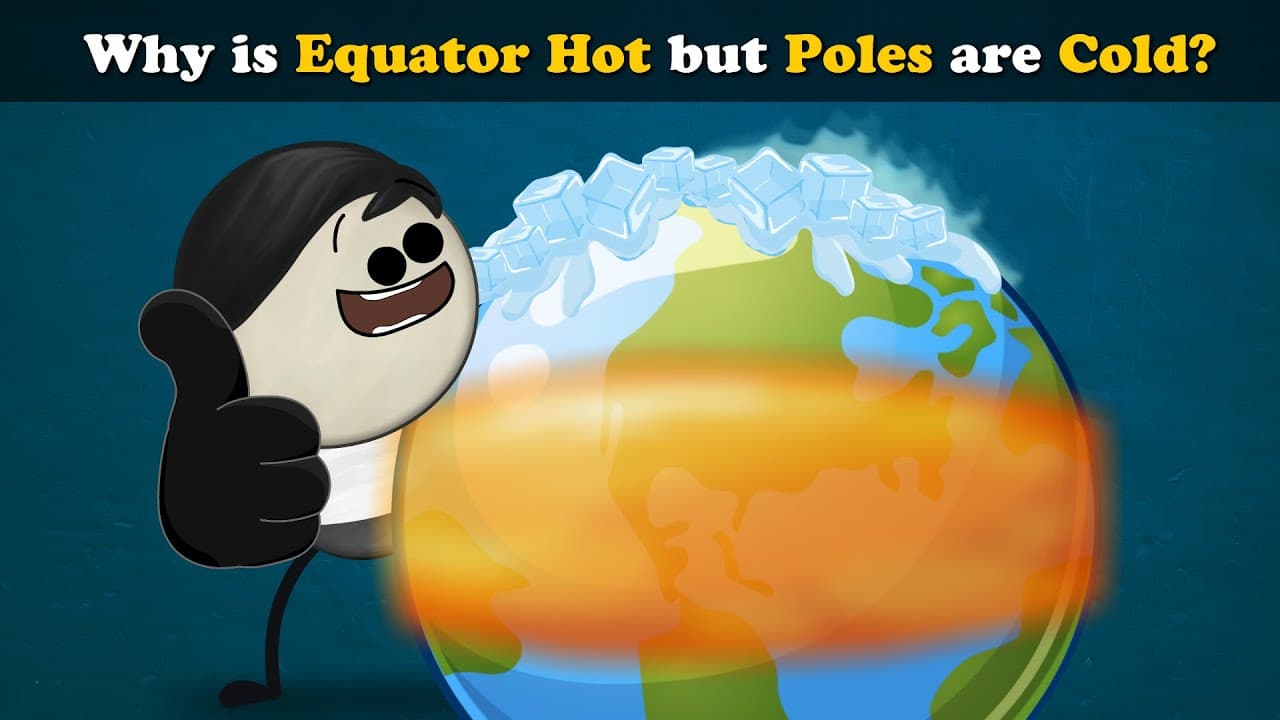
Equator is hot due to direct sunrays, while poles are cold due to tilted angle and snow reflectivity.
Transcript
It's AumSum Time. Why is equator hot but poles are cold? Because equator likes hot burgers and poles like cold burgers. Naahhh. Firstly, around the equator, sunrays hit the ground at a 90-degree angle. Hence, more solar energy falls per unit area, thus making equator hot. However, near the poles, since sunrays hit the ground at a lower angle. The r... Read More
Key Insights
- 💩 Direct sunrays at the equator hit at a 90-degree angle, concentrating more solar energy.
- 😘 Earth's axial tilt causes poles to receive sunlight at lower angles, making them cooler.
- 🥡 The long path sunlight takes to reach the poles results in more absorption and scattering.
- ✋ Snow at the poles reflects a much higher percentage of sunlight compared to the equator.
- 💈 Poles don't receive sunlight for many months during the year due to axial tilt.
- 🍔 Equator likes "hot burgers," while poles prefer "cold burgers."
- 💮 Sunrays spread near the poles due to hitting the ground at a lower angle.
Install to Summarize YouTube Videos and Get Transcripts
Explore YouTube Video Summarizer or Get YouTube Transcript Extractor
Questions & Answers
Q: Why is the equator hotter than the poles?
The equator is hotter due to direct sunrays hitting the ground at a 90-degree angle, concentrating more solar energy per unit area compared to the poles.
Q: How does the earth's axial tilt impact the temperature at the poles?
The earth's axial tilt causes the poles to receive sunlight at lower angles, spreading the rays and resulting in less solar energy per unit area, making the poles cooler.
Q: What role does snow play in the temperature difference between the equator and poles?
Snow at the poles reflects 75 to 95% of sunlight, which is significantly more than the land around the equator, contributing to the cooler temperatures experienced at the poles.
Summary & Key Takeaways
-
Direct sunrays at 90-degree angle make equator hot by concentrating more solar energy per unit area.
-
Earth's axial tilt causes poles to receive sunlight at lower angles, spreading the rays and making them cooler.
-
Snow at the poles reflects a high percentage of sunlight, contributing to their cooler temperatures.
Read in Other Languages (beta)
Share This Summary 📚
Summarize YouTube Videos and Get Video Transcripts with 1-Click
Try YouTube Summary with ChatGPT & Claude or YouTube Transcript Generator
Explore More Summaries from It's AumSum Time 📚






Summarize YouTube Videos and Get Video Transcripts with 1-Click
Try YouTube Summary with ChatGPT & Claude or YouTube Transcript Generator