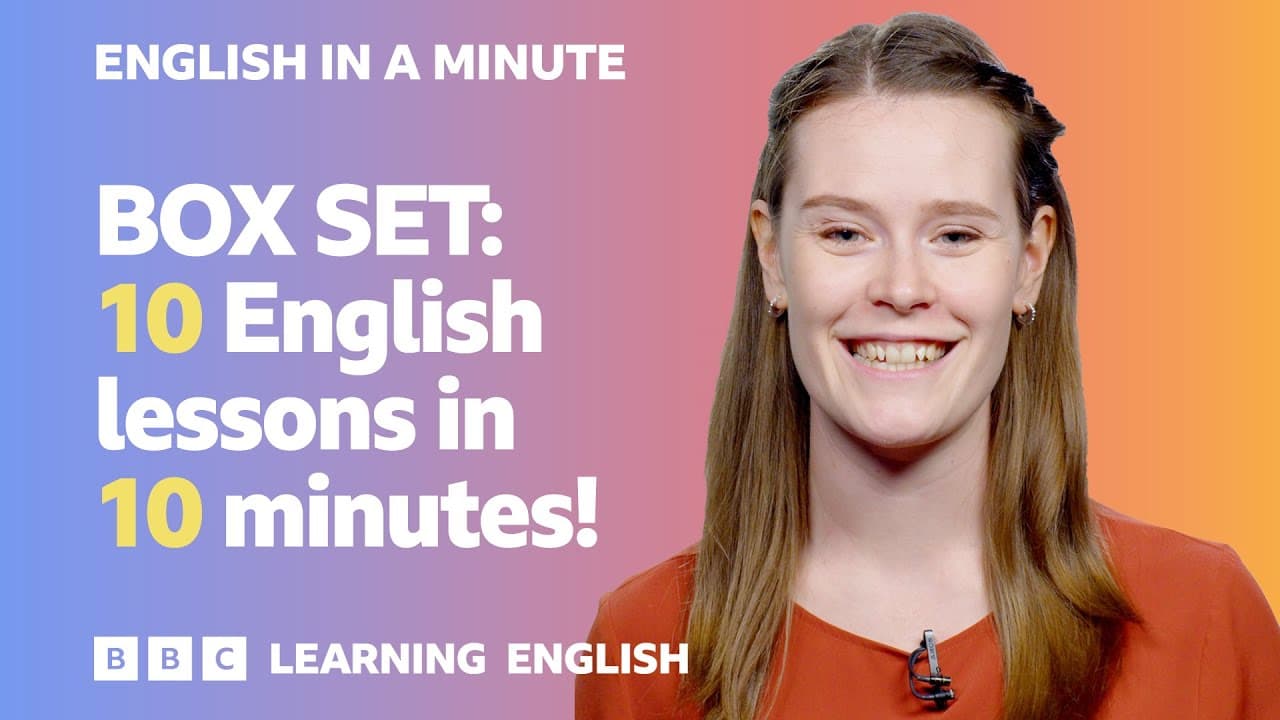
BOX SET: English In A Minute 24 – TEN English lessons in 10 minutes!
TL;DR
Learn essential English vocabulary and grammar in a 10-minute lesson.
Transcript
As a noun, respect can mean admiration for someone or something. I have great respect for my grandmother. She's written more than fifty books. With the same meaning, the verb respect is used to show admiration. I respect the managers for keeping everyone happy when the company is struggling. Also as a noun, respect can be used to show politeness, h... Read More
Key Insights
- Respect can function as both a noun and a verb, denoting admiration or politeness, and is used to show regard for others' belongings or features.
- The word 'as' serves multiple functions, including linking clauses to indicate simultaneous events, reasons, and methods, akin to 'while' or 'because'.
- 'Perspective' is a noun representing a point of view, either literal or figurative, influenced by experiences and opinions.
- The term 'advance' can be a verb, noun, or adjective, indicating progress, development, or early occurrence, and can also refer to early payment.
- 'Executive' describes high-ranking business roles or decision-making powers and is used as both a noun and an adjective.
- 'Still' operates as an adverb or adjective, signifying continuation, surprise, or immobility, and enhances verbs or adjectives.
- 'Exercise' as a noun or verb implies physical or mental activities for improvement, with or without direct objects.
- 'Critical' has diverse meanings, from expressing negative opinions to indicating importance or seriousness, especially in future contexts.
Install to Summarize YouTube Videos and Get Transcripts
Explore YouTube Video Summarizer or Get YouTube Transcript Extractor
Questions & Answers
Q: How is 'respect' used in different contexts?
Respect functions as both a noun and a verb. As a noun, it can mean admiration or politeness towards someone or something, while as a verb, it denotes treating others' belongings with care. It also refers to specific features or details, such as in climate change discussions.
Q: What are the different uses of the word 'as'?
The word 'as' is versatile, linking clauses to indicate simultaneous events, reasons, or methods. It can function similarly to 'while' for actions happening together, 'because' for reasons, and 'in the way' to describe how something is done, making it a valuable word to learn.
Q: What does 'perspective' mean and how is it used?
'Perspective' is a noun that represents a point of view, which can be literal, as in a physical viewpoint, or figurative, influenced by personal experiences and opinions. It's akin to 'point of view' and helps in understanding different angles or opinions on a topic.
Q: Can you explain the different meanings of 'advance'?
Advance can be a verb, noun, or adjective. As a verb, it means to move forward or develop, while as a noun, it refers to progress or early payment. As an adjective, it describes something happening early, such as advance notice of an event or concert.
Q: How is 'executive' used in business contexts?
'Executive' is used as a noun to describe a high-ranking person in a company with decision-making powers. As an adjective, it relates to decision-making authority or suitability for an executive role, like an executive suite in a hotel, indicating high status.
Q: What are the different functions of 'still'?
'Still' functions as an adverb or adjective. As an adverb, it indicates continuation, surprise, or enhances verbs/adjectives. As an adjective, it means immobile. It can introduce contrasting ideas or emphasize the ongoing nature of an action or state.
Q: What does 'exercise' mean as a noun and a verb?
As a noun, 'exercise' refers to activities for improvement, such as physical workouts or academic tasks. As a verb, it means engaging in physical activity or using something, like authority. It highlights actions that enhance physical fitness or skills through practice.
Q: How is the word 'critical' used in different contexts?
'Critical' has multiple meanings: expressing negative opinions, indicating importance for future outcomes, or describing serious situations. It can be used formally to critique something or highlight the necessity of elements like financial support for project success.
Summary & Key Takeaways
-
The video teaches how to use various English words such as 'respect', 'as', 'perspective', and 'advance' in different contexts, enhancing vocabulary understanding.
-
Each word is explained with examples, showing its use in sentences as nouns, verbs, adjectives, or adverbs, depending on the context.
-
The lesson aims to improve English proficiency by clarifying meanings and applications of words, making it easier for learners to use them correctly.
Read in Other Languages (beta)
Share This Summary 📚
Summarize YouTube Videos and Get Video Transcripts with 1-Click
Try YouTube Summary with ChatGPT & Claude or YouTube Transcript Generator
Explore More Summaries from BBC Learning English 📚

Summarize YouTube Videos and Get Video Transcripts with 1-Click
Try YouTube Summary with ChatGPT & Claude or YouTube Transcript Generator