Laplace Transform of Elementary Signal | Laplace Transform | Signals and Systems Problem 04
TL;DR
An in-depth analysis of the Laplace transform problem involving a combination of ramp and square wave signals.
Transcript
click the bell icon to get latest videos from equator other friends and today's topic is problem number 4 based on the Laplace transform of element dissonance now in today's example my question is it consists of a to ramp having positive slope and negative slope and after that it is a combination of two slopes plus one step signal or a square signa... Read More
Key Insights
- 📡 The given signal is a combination of ramp and square wave signals.
- 🥳 The equation for the signal is written based on the slopes and amplitudes of the different parts.
- 🍉 The Laplace transform is calculated by integrating the product of the signal and an exponential term.
Install to Summarize YouTube Videos and Get Transcripts
Explore YouTube Video Summarizer or Get YouTube Transcript Extractor
Questions & Answers
Q: What is the equation for the given signal?
The signal consists of two ramp signals with different slopes and a square wave signal. The equation can be written as x(t) = t for 0 <= t <= 1, x(t) = -t for 1 < t <= 2, and x(t) = 1 for 2 < t <= 3.
Q: How do you calculate the slopes for the ramp signals?
The slope formula is used to calculate the slopes. For the ramp with increasing slope, the slope value is positive. For the ramp with decreasing slope, the slope value is negative.
Q: How do you find the Laplace transform of the signal?
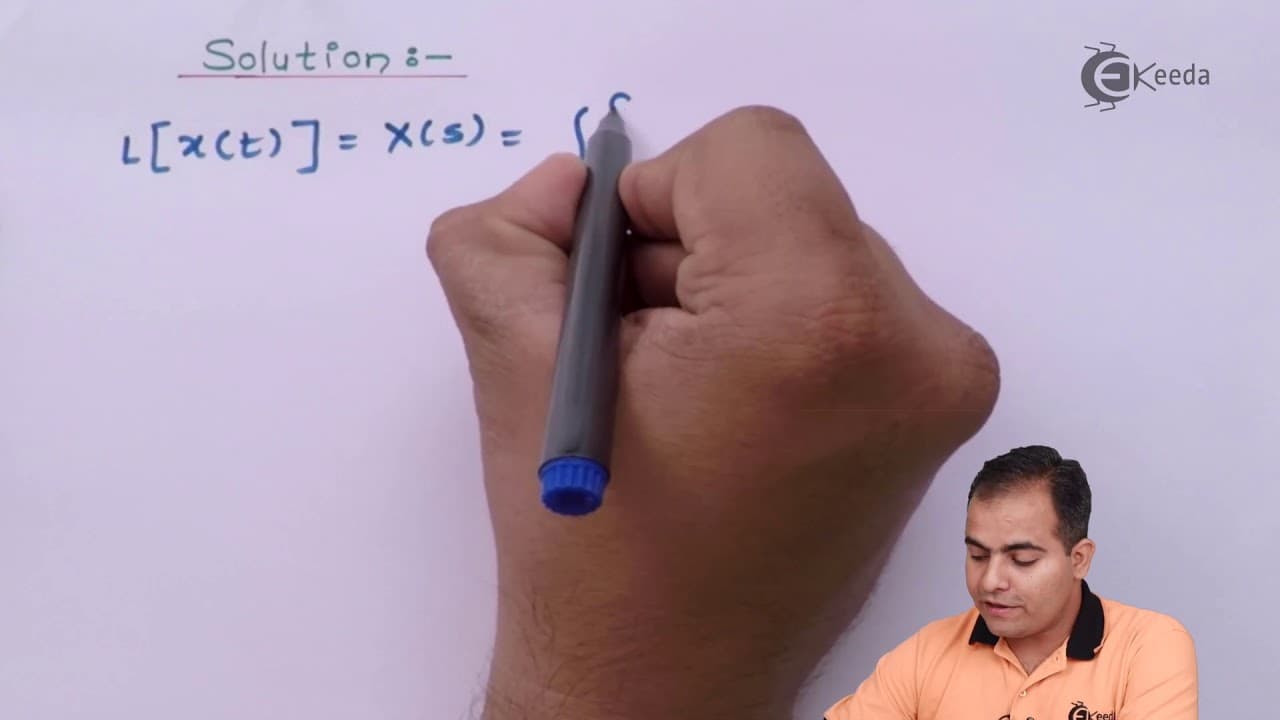
The Laplace transform is calculated using the definition of Laplace transforms, which involves integrating the product of the signal and an exponential term. The signal is divided into three parts, and the Laplace transform is calculated for each part separately and then combined.
Q: What is the result of the Laplace transform?
After performing the integration and simplification, the Laplace transform of the signal is given by X(s) = -s/(s^2) - 2/(s^2) + 1/(s^2) + 2/(s^2-s) - 1/(s^2-s^3).
Summary & Key Takeaways
-
The problem consists of a combination of two ramp signals with positive and negative slopes, followed by a square wave signal.
-
The equation for the given signal is written based on the slopes and amplitudes of the different parts.
-
The Laplace transform of the signal is then calculated using the definition and formulas of Laplace transforms.
Read in Other Languages (beta)
Share This Summary 📚
Summarize YouTube Videos and Get Video Transcripts with 1-Click
Try YouTube Summary with ChatGPT & Claude or YouTube Transcript Generator
Explore More Summaries from Ekeeda 📚


Summarize YouTube Videos and Get Video Transcripts with 1-Click
Try YouTube Summary with ChatGPT & Claude or YouTube Transcript Generator