1.4.4 R1. Understanding Food - Video 3: Data Analysis
TL;DR
This video demonstrates basic data analysis in R, including retrieving and analyzing information on the sodium levels in food.
Transcript
In this video, we will do some basic data analysis. All that I've done since our previous video is clear the console, but R still has all the information stored. In fact, if we use the Up Arrow on our keyboard, we retrieve the last command we typed, which was the summary of the USDA data frame. And as a quick reminder, at the end of our last video,... Read More
Key Insights
- 🥘 R stores previously typed commands, allowing easy retrieval.
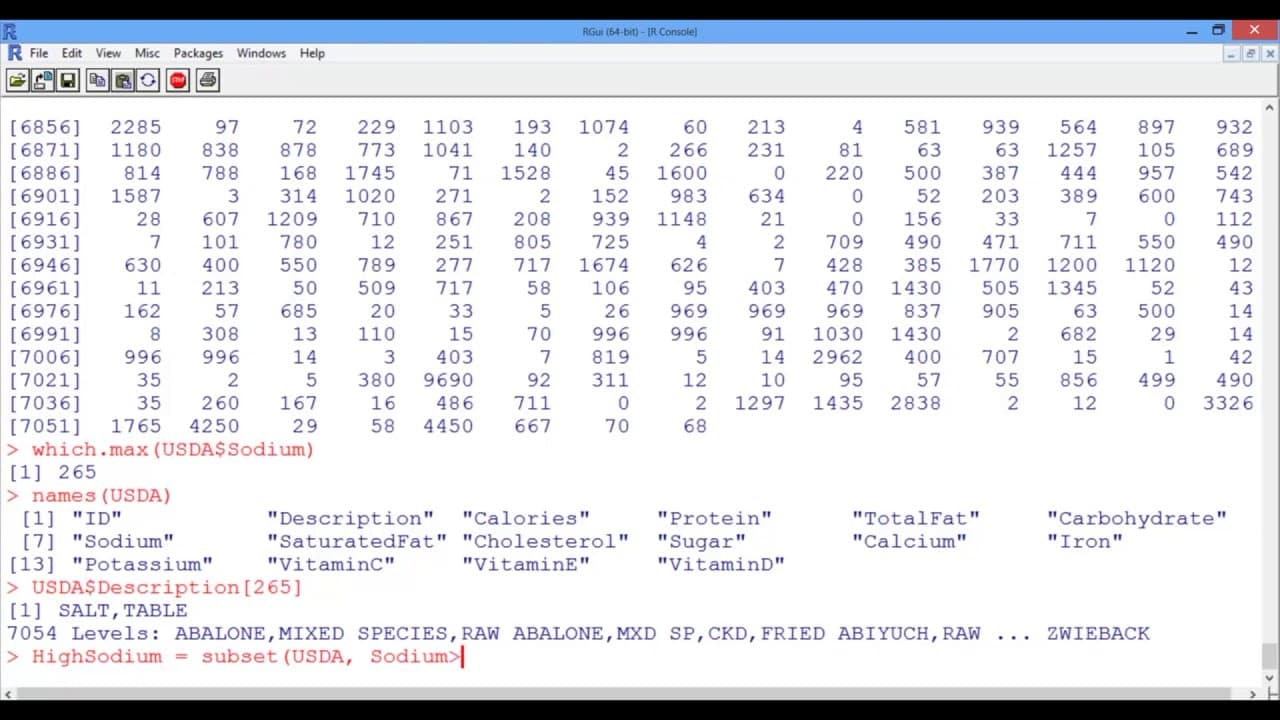
- 😋 The which.max function can find the index of the food with the highest sodium level.
- 😋 Creating subsets of a data frame enables exploration of specific conditions, like foods with high sodium levels.
- 🫰 The match function is useful for finding the index of specific data within a vector.
- ☠️ The summary function provides statistical measures, such as the mean sodium level, while the sd function calculates standard deviation.
Install to Summarize YouTube Videos and Get Transcripts
Explore YouTube Video Summarizer or Get YouTube Transcript Extractor
Questions & Answers
Q: How can R retrieve the last command typed, like the summary of the USDA data frame?
R stores all previously typed commands, and by using the Up Arrow key on the keyboard, the last command, such as the summary of the USDA data frame, can be retrieved.
Q: How can the food with the highest sodium level be identified in the data set?
The function which.max can be used with the Sodium vector to find the index of the food with the highest sodium level, which can then be determined from the Description vector.
Q: How can a subset of the data frame be created for foods with more than 10,000 milligrams of sodium?
By creating a new data frame, called HighSodium, as a subset of the original USDA data frame using the condition for sodium content that exceeds 10,000.
Q: How can the sodium level of a specific food, like caviar, be found in the data set?
The match function can be used with the Description vector to find the index of caviar, which can then be used to retrieve its sodium level from the Sodium vector.
Summary & Key Takeaways
-
The video explores how to retrieve information on sodium levels in food using the USDA data frame in R.
-
It shows how to find the food with the highest sodium level using the which.max function and the Description vector.
-
It also demonstrates how to create a subset of the data frame for foods with more than 10,000 milligrams of sodium and how to find the sodium levels of specific foods, like caviar.
Read in Other Languages (beta)
Share This Summary 📚
Summarize YouTube Videos and Get Video Transcripts with 1-Click
Try YouTube Summary with ChatGPT & Claude or YouTube Transcript Generator
Explore More Summaries from MIT OpenCourseWare 📚



Summarize YouTube Videos and Get Video Transcripts with 1-Click
Try YouTube Summary with ChatGPT & Claude or YouTube Transcript Generator