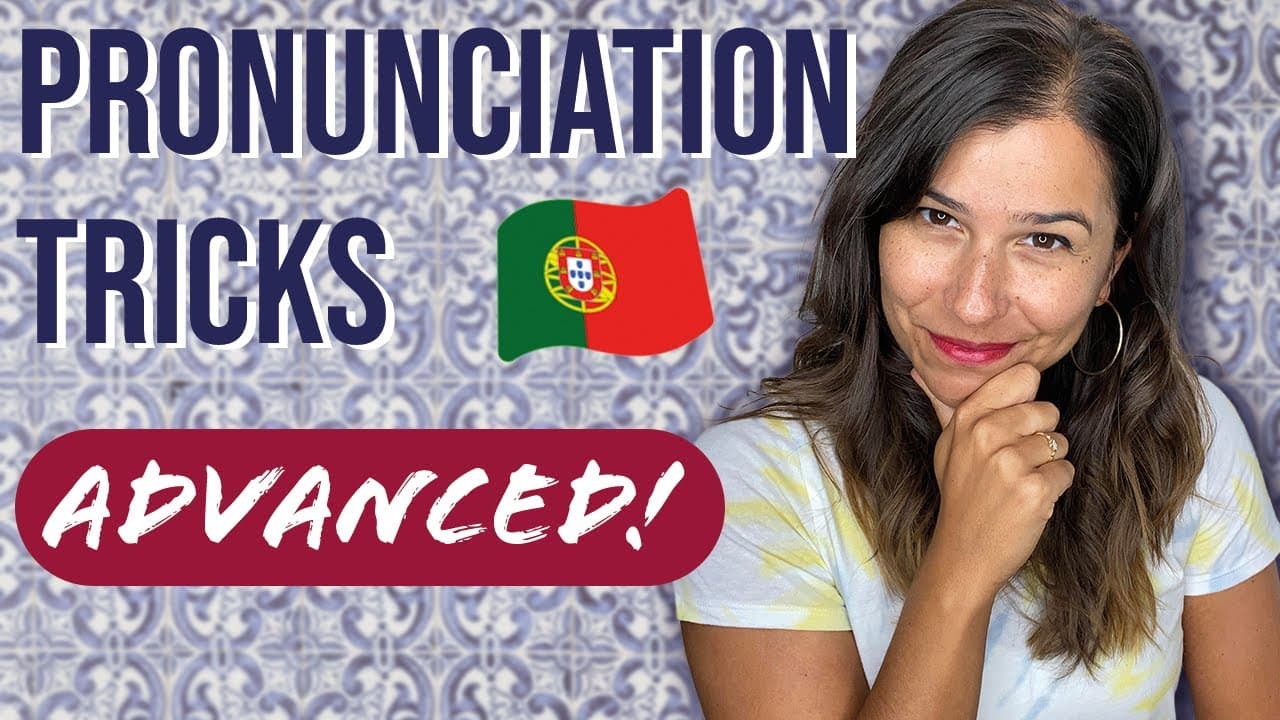
My Advanced Pronunciation Tips for European Portuguese (Sound Like a Local!)
TL;DR
Improve Portuguese pronunciation to sound more local.
Transcript
If you're still getting answered in English here in Portugal, even when you're doing your best to speak Portuguese, it's probably not what you're saying, but it's how you are saying it. And that's actually great news because if you're struggling to remember all those grammar rules, then excellent pronunciation is going to be your secret weapon. Whe... Read More
Key Insights
- Pronunciation is key to being replied to in Portuguese rather than English; mastering it can boost confidence.
- The letter 'S' changes to a 'Z' sound when between vowels, even across words, enhancing natural speech flow.
- Combining 'S' and 'C' in words can be tricky; collapsing them into a 'sh' sound is a useful shortcut.
- Words starting with 'PS' or 'PN' should have a soft 'P' sound, unlike in English where the 'P' is silent.
- When words end in 'SE', the 'E' is barely pronounced, and the 'S' turns into a 'Z' sound.
- The 'tapped R' is crucial in Portuguese, requiring a single tongue tap on the mouth's roof.
- Mastering pronunciation nuances like 'SE' endings and 'tapped R' can significantly improve language skills.
- The video offers additional resources, including a free pronunciation guide and a workshop for beginners.
Install to Summarize YouTube Videos and Get Transcripts
Explore YouTube Video Summarizer or Get YouTube Transcript Extractor
Questions & Answers
Q: Why is pronunciation important in speaking Portuguese?
Pronunciation is crucial because it can determine whether locals respond in Portuguese or switch to English. Proper pronunciation helps in sounding more natural and confident, making it easier for learners to engage in conversations and be perceived as more proficient in the language.
Q: How does the letter 'S' change in Portuguese pronunciation?
In Portuguese, the letter 'S' changes to a 'Z' sound when it is positioned between two vowels, even if the vowels are in separate words. This rule helps in creating a more fluent and natural speech pattern, making the speaker sound more like a native.
Q: What is the cheat code for pronouncing 'SC' in Portuguese?
The cheat code for pronouncing 'SC' in Portuguese is to collapse the sounds into a 'sh' sound. This simplification helps in speaking more fluently and naturally, as it mimics how native speakers often pronounce these combinations in rapid speech.
Q: How should words starting with 'PS' or 'PN' be pronounced?
Words starting with 'PS' or 'PN' in Portuguese require a soft 'P' sound, unlike English where the 'P' is silent. This subtle pronunciation difference is important for sounding more authentic and avoiding common mistakes made by English speakers.
Q: What is the significance of the 'tapped R' in Portuguese?
The 'tapped R' is significant because it is a defining feature of Portuguese pronunciation. It involves a single tap of the tongue on the roof of the mouth and is essential for words with a single 'R' in the middle or end. Mastering it enhances the speaker's authenticity.
Q: How does the pronunciation of words ending in 'SE' differ?
In Portuguese, words ending in 'SE' have a barely pronounced 'E', and the 'S' turns into a 'Z' sound. This subtlety in pronunciation is crucial for sounding more like a native speaker and avoiding the typical mispronunciations made by learners.
Q: What resources are offered to improve Portuguese pronunciation?
The video offers a free pronunciation guide with native speaker audio and drills, as well as a workshop for beginners. These resources are designed to help learners master difficult sounds and improve their overall pronunciation skills in European Portuguese.
Q: How can mastering these pronunciation tips benefit learners?
Mastering these pronunciation tips can significantly boost learners' confidence, making them sound more like native speakers. It enhances their ability to engage in conversations, be understood by locals, and ultimately enjoy a more immersive and rewarding language learning experience.
Summary & Key Takeaways
-
The video emphasizes the importance of pronunciation in European Portuguese to ensure locals respond in Portuguese rather than English. It covers advanced tips like the pronunciation of 'S' between vowels, 'SC' sounds, and 'PS/PN' words.
-
The instructor highlights the 'tapped R' sound, which is crucial for sounding more Portuguese. Viewers are encouraged to practice these sounds to boost their confidence and improve their language skills.
-
Additional resources such as a free pronunciation guide and a beginner's workshop are offered to help learners further enhance their Portuguese pronunciation and listening skills.
Read in Other Languages (beta)
Share This Summary 📚
Summarize YouTube Videos and Get Video Transcripts with 1-Click
Try YouTube Summary with ChatGPT & Claude or YouTube Transcript Generator
Explore More Summaries from Talk the Streets 📚

![Learn European Portuguese Outside of Portugal! [NEW apps & TOP tips!] thumbnail](/_next/image?url=https%3A%2F%2Fi.ytimg.com%2Fvi%2F0K81C-5Z1I0%2Fhqdefault.jpg&w=750&q=75)


![Practice Portuguese with Mixologist Fábio Guerreiro! [English & Portuguese Subtitles] thumbnail](/_next/image?url=https%3A%2F%2Fi.ytimg.com%2Fvi%2F1-T2PNWuiWY%2Fhqdefault.jpg&w=750&q=75)
Summarize YouTube Videos and Get Video Transcripts with 1-Click
Try YouTube Summary with ChatGPT & Claude or YouTube Transcript Generator