Math - Addition, Multiplication, Exponents, & Tetration
TL;DR
Addition and multiplication are commutative operations where the order of numbers does not matter, while exponentiation and tetration are non-commutative operations where the order does matter.
Transcript
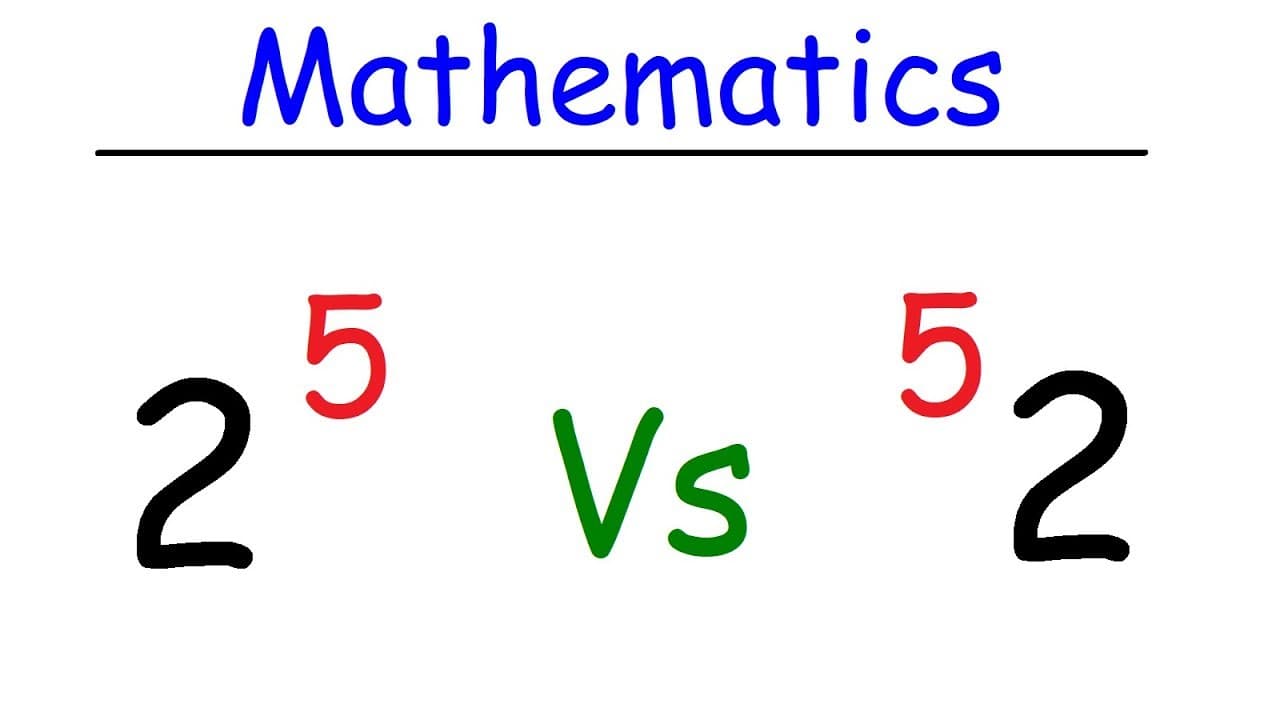
have you ever wondered what is the difference between these two expressions in this video we're going to talk about that but before we get into this let's talk about addition first what is addition when you hear the word addition what comes to mind so let's say if we want to add two numbers two plus five two is basically add in one twice and five i... Read More
Key Insights
- 🚱 Addition and multiplication are commutative operations, while exponentiation and tetration are non-commutative operations.
- 🔁 Addition is combining numbers, multiplication is repeat addition, exponentiation is repeat multiplication, and tetration is repeated exponentiation.
- 🪈 Order matters in exponentiation and tetration, but not in addition and multiplication.
- 💱 The presence of parentheses can drastically change the value when evaluating these operations.
- 🫚 The inverse operation of exponentiation is taking the root, and the inverse operation of tetration is taking the super root.
Install to Summarize YouTube Videos and Get Transcripts
Explore YouTube Video Summarizer or Get YouTube Transcript Extractor
Questions & Answers
Q: What is the difference between addition and multiplication in terms of order?
Addition is commutative, meaning the order of numbers does not matter. For example, 2 + 5 is the same as 5 + 2, both equal to 7. Multiplication is also commutative, where the order of numbers does not matter. For instance, 2 x 5 is the same as 5 x 2, both equal to 10.
Q: How is exponentiation different from addition and multiplication?
Exponentiation is a non-commutative operation, meaning the order of numbers does matter. For example, 5 squared (5^2) is not the same as 2 to the fifth power (2^5). 5^2 equals 25, but 2^5 equals 32.
Q: What is tetration?
Tetration is another type of operation that involves repeated exponentiation. It involves raising a number to the power of itself multiple times. For example, 2 to the super power of 5 (2^^5) means 2 raised to the 2 raised to the 2 raised to the 2 raised to the 2. Evaluating tetration involves evaluating the expression from right to left.
Q: How does tetration differ from exponentiation?
Tetration is also a non-commutative operation, where the order matters. For example, 5 to the second superpower (5^^2) is not the same as 2 to the superpower of five (2^^5). 5^^2 equals 32, while 2^^5 equals a very large number (65,536).
Summary & Key Takeaways
-
Addition and multiplication are operations where the order of numbers does not matter, while exponentiation and tetration are operations where the order does matter.
-
Addition is combining numbers to get a total, while multiplication is repeat addition.
-
Exponentiation is repeat multiplication, and tetration is repeated exponentiation.
Read in Other Languages (beta)
Share This Summary 📚
Summarize YouTube Videos and Get Video Transcripts with 1-Click
Try YouTube Summary with ChatGPT & Claude or YouTube Transcript Generator
Explore More Summaries from The Organic Chemistry Tutor 📚
Summarize YouTube Videos and Get Video Transcripts with 1-Click
Try YouTube Summary with ChatGPT & Claude or YouTube Transcript Generator