Types of Experiment - Research Methods [ A Level Psychology ]
TL;DR
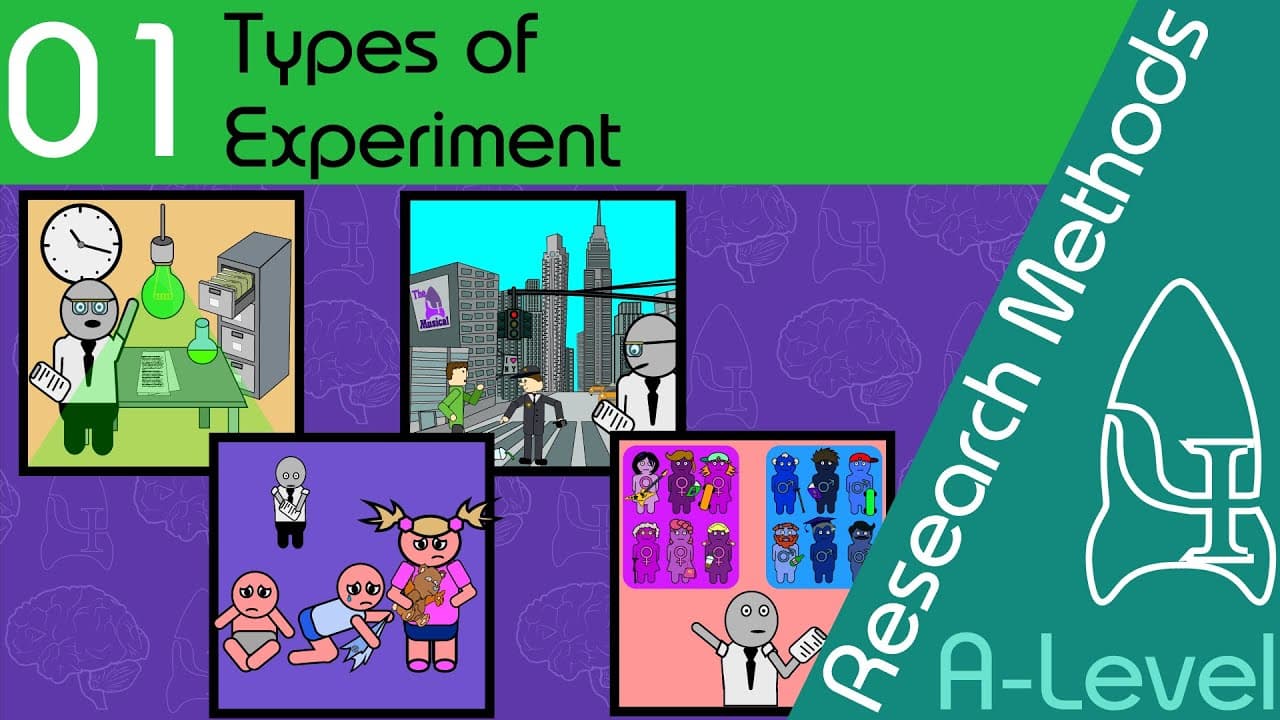
This video discusses laboratory, field, natural, and quasi experiments in psychological research, highlighting their strengths and weaknesses.
Transcript
In this first psychological research methods video, I’m going to discuss the different types of experiments, so Lab, Field, Natural and Quazi, and discuss the strengths and weaknesses of each. If this is your first time coming to research methods, you're going to hear lots of terminology you don’t know. This can be a little intimidating, but the mo... Read More
Key Insights
- 🖤 Lab experiments provide high internal validity and replicability but may lack external validity and mundane realism.
- 🏑 Field experiments offer increased external validity and potential for more naturalistic behavior but have less control over extraneous variables.
- 👻 Natural experiments allow researchers to study phenomena that cannot be manipulated, but causal relationships may be less certain.
- 🧑🏭 Quasi-experiments are necessary for studying certain factors that cannot be controlled or manipulated.
- 😖 Confounding variables in quasi-experiments may impact the interpretation of results.
- 🖐️ Ethical considerations play a role in the choice of research methods.
- 🎮 The different types of experiments have varying levels of control, external validity, and replicability.
Install to Summarize YouTube Videos and Get Transcripts
Explore YouTube Video Summarizer or Get YouTube Transcript Extractor
Questions & Answers
Q: What is the difference between a laboratory experiment and a field experiment?
In a laboratory experiment, the researcher has control over variables in a controlled environment, while a field experiment is conducted in a real-world setting with less control over variables.
Q: What are the advantages of conducting natural experiments?
Natural experiments allow research in areas that would be unethical or costly to manipulate, and they have high external validity since they occur naturally in real life.
Q: What is a confounding variable in a quasi-experiment?
A confounding variable is a factor that systematically changes between conditions and cannot be controlled, potentially influencing the results of the experiment.
Q: How are quasi-experiments different from other types of experiments?
Quasi-experiments are conducted when participants cannot be randomly assigned, and the researcher cannot manipulate the independent variable as in true experiments.
Key Insights:
- Lab experiments provide high internal validity and replicability but may lack external validity and mundane realism.
- Field experiments offer increased external validity and potential for more naturalistic behavior but have less control over extraneous variables.
- Natural experiments allow researchers to study phenomena that cannot be manipulated, but causal relationships may be less certain.
- Quasi-experiments are necessary for studying certain factors that cannot be controlled or manipulated.
- Confounding variables in quasi-experiments may impact the interpretation of results.
- Ethical considerations play a role in the choice of research methods.
- The different types of experiments have varying levels of control, external validity, and replicability.
- Research methods videos on psych boost provide exam tips and worked examples for students studying AS and A-level psychology.
Summary & Key Takeaways
-
The video provides an overview of laboratory experiments, where the experimenter has full control over the variables in a controlled environment.
-
Field experiments are conducted in real-world settings to increase external validity and naturalistic behavior.
-
Natural experiments examine naturally occurring independent variables and their impact on dependent variables.
-
Quasi-experiments are used when participants cannot be randomly assigned, such as studying gender or age differences.
Read in Other Languages (beta)
Share This Summary 📚
Summarize YouTube Videos and Get Video Transcripts with 1-Click
Try YouTube Summary with ChatGPT & Claude or YouTube Transcript Generator
Explore More Summaries from Psych Boost 📚
![Minority influence & social change - Social influence [ A Level Psychology ] thumbnail](/_next/image?url=https%3A%2F%2Fi.ytimg.com%2Fvi%2Ft5LsJ5v_j7k%2Fhqdefault.jpg&w=750&q=75)
Summarize YouTube Videos and Get Video Transcripts with 1-Click
Try YouTube Summary with ChatGPT & Claude or YouTube Transcript Generator