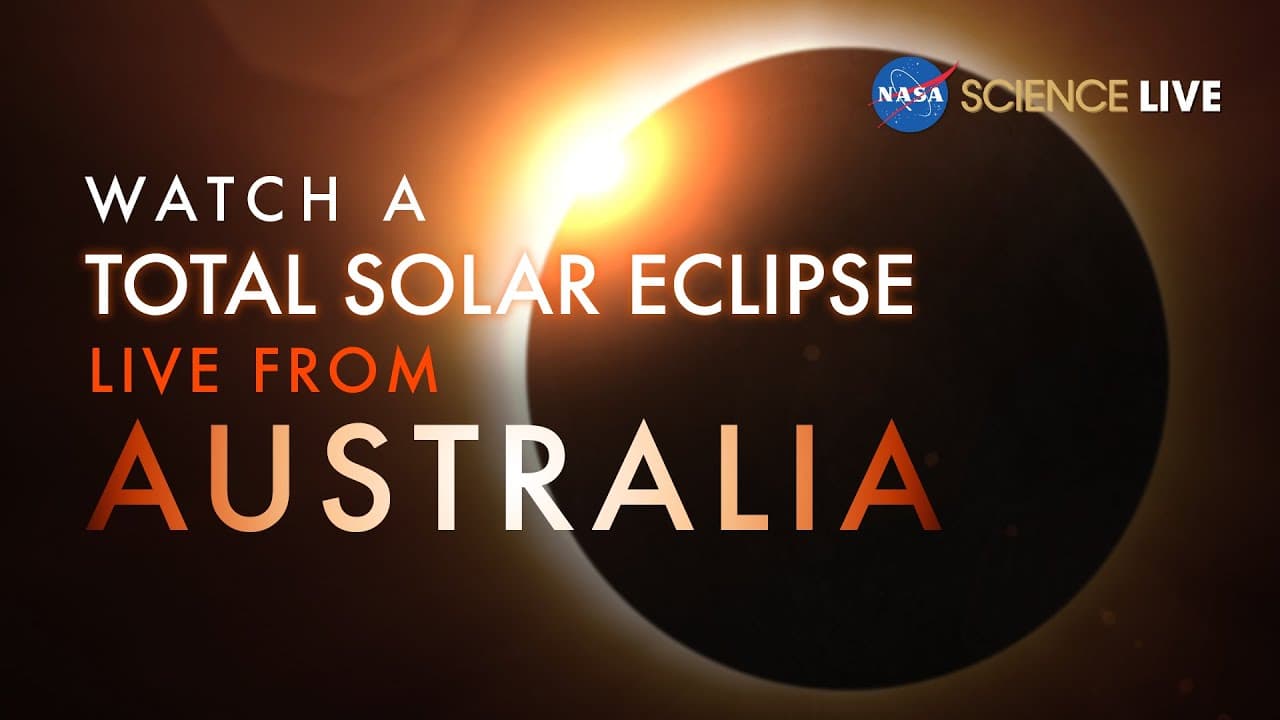
NASA Science Live: Watch a Total Solar Eclipse in Australia
TL;DR
A hybrid total and annular solar eclipse is taking place in Australia, providing a unique viewing opportunity. NASA scientists discuss the science and significance of solar eclipses, as well as ongoing research and upcoming eclipse events.
Transcript
foreign thank you thank you foreign hello and welcome to another episode of NASA's science live this is an opportunity for you to interact with NASA experts and have your questions answered in real time I'm your host Denise Hill and we are taking you all the way to Australia where there's a total solar eclipse happening right now this event is uniq... Read More
Key Insights
- 👨🔬 Solar eclipses are unique and rare celestial events that provide valuable opportunities for scientific research and observations.
- 🧑⚕️ The Sun's influence extends into various aspects of our lives, including agriculture, climate change, and human health.
- 😎 Eclipse events like the upcoming annular and total solar eclipses in 2023 and 2024 provide exciting opportunities for people to participate in sun science projects and learn more about the Sun's impact on our planet.
Install to Summarize YouTube Videos and Get Transcripts
Explore YouTube Video Summarizer or Get YouTube Transcript Extractor
Questions & Answers
Q: How do solar eclipses work, and what is a hybrid eclipse?
Solar eclipses occur when the Moon aligns between the Earth and the Sun, casting a shadow on the Earth. A total solar eclipse occurs when the Moon completely blocks the Sun. A hybrid eclipse, like the one in Australia, is a combination of both total and annular eclipses, depending on the location along the eclipse path.
Q: Why do scientists care about observing solar eclipses?
Solar eclipses provide scientists with the opportunity to observe the Sun's corona and study phenomena such as solar wind. Historically, eclipses have led to discoveries in general relativity and the identification of elements in the Sun.
Q: What is the purpose of the kite experiment during the eclipse?
The kite experiment aims to gather data on the Sun's constant solar wind during the eclipse. By analyzing the spectrometer readings, scientists hope to understand how solar wind escapes the Sun and its impact on Earth's atmosphere.
Q: How can people participate in sun science and citizen science projects related to eclipses?
NASA encourages people to participate in sun science through various citizen science projects like eclipse soundscaping and the Nationwide Eclipse Ballooning Project. These projects allow individuals to collect data and contribute to research during the eclipse events.
Summary & Key Takeaways
-
The total solar eclipse in Australia is a rare hybrid eclipse, where some regions experience a total eclipse and others witness an annular eclipse.
-
Scientists study solar eclipses to observe the Sun's corona and conduct experiments in general relativity and the discovery of elements.
-
NASA is conducting a research project during the eclipse using a kite to gather data on the Sun's constant solar wind.
Read in Other Languages (beta)
Share This Summary 📚
Summarize YouTube Videos and Get Video Transcripts with 1-Click
Try YouTube Summary with ChatGPT & Claude or YouTube Transcript Generator
Explore More Summaries from NASA 📚

Summarize YouTube Videos and Get Video Transcripts with 1-Click
Try YouTube Summary with ChatGPT & Claude or YouTube Transcript Generator