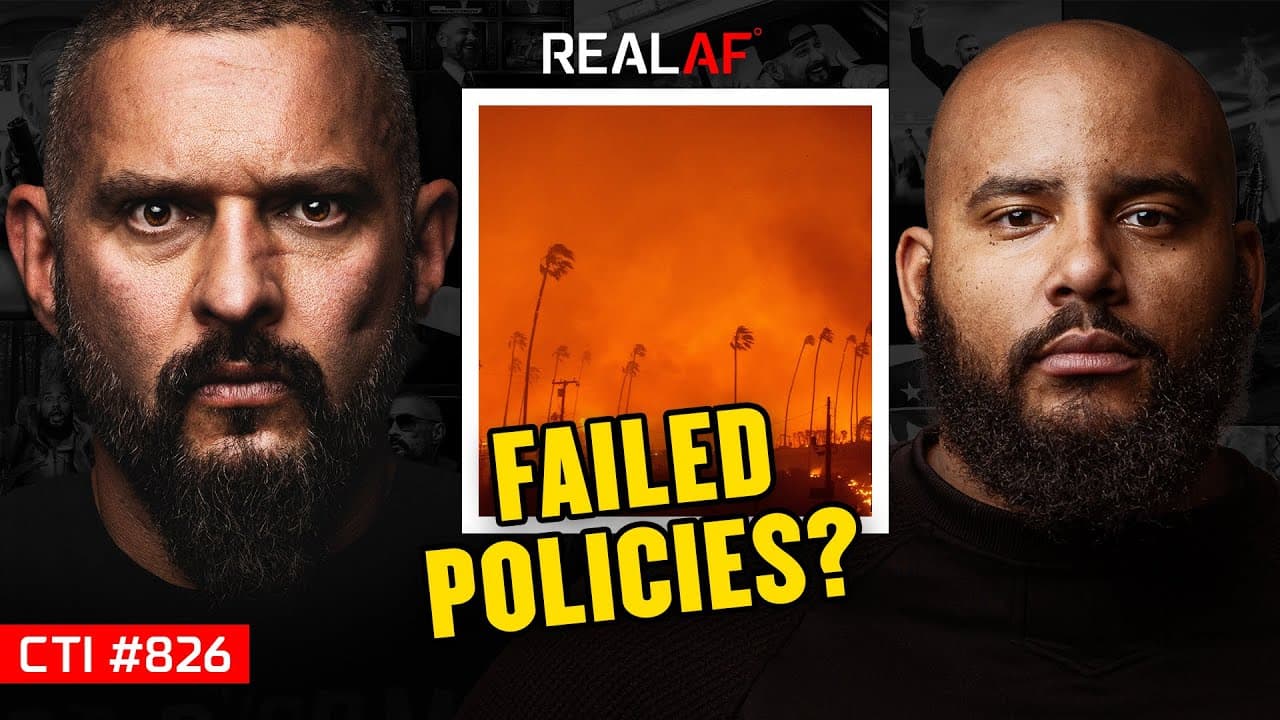
Failed Leadership Caused L.A. Wildfires, Here's Why... - Ep 826 CTI
TL;DR
Discussion on L.A. wildfires, leadership failures, and U.S. interest in Greenland.
Transcript
yeah California wildfires man it it's it's horrible I was up uh last night watching it on TV for like what was crazy was that new ones just kept popping up yeah isn't that weird you know what I'm saying like they cut 17 million from the fire but yeah let's fund this this is why we have to return to meritocracy we have to return to voting not becaus... Read More
Key Insights
- The Los Angeles wildfires are devastating, with new fires continuously emerging, highlighting potential leadership failures in resource management.
- California's leadership is criticized for cutting fire department budgets, leading to inadequate response to the wildfires.
- The podcast emphasizes the need for meritocracy in leadership roles, arguing that competence should outweigh identity politics.
- The hosts discuss the potential acquisition of Greenland by the U.S., citing strategic and resource-based motivations rather than expansionist ambitions.
- The conversation touches on the historical context of leadership and the importance of effective governance in preventing disasters.
- There's a critique of the media's portrayal of Trump's intentions regarding Greenland, suggesting a bias in reporting.
- The podcast highlights the impact of political decisions on everyday citizens, especially in crisis situations like the wildfires.
- The hosts express frustration with identity politics, arguing that it detracts from addressing real issues like disaster preparedness.
Install to Summarize YouTube Videos and Get Transcripts
Explore YouTube Video Summarizer or Get YouTube Transcript Extractor
Questions & Answers
Q: What are the main criticisms of the leadership in handling the L.A. wildfires?
The leadership is criticized for cutting the fire department's budget, which is seen as a significant factor in the inadequate response to the wildfires. The hosts argue that these budget cuts reflect a lack of preparedness and poor prioritization of resources, which has led to devastating consequences for residents.
Q: Why do the hosts believe meritocracy is important in leadership?
The hosts argue that leadership should be based on competence and skills rather than identity politics. They believe that prioritizing identity over ability leads to ineffective governance, as seen in the handling of the wildfires. They emphasize that meritocracy ensures the most capable individuals are in positions to make critical decisions.
Q: What is the podcast's perspective on the U.S. interest in Greenland?
The hosts suggest that the U.S. interest in Greenland is driven by strategic and resource-based motivations, such as natural resources and geographical positioning. They argue that media portrayals of Trump's intentions as purely expansionist are misleading and fail to consider these strategic factors.
Q: How do the hosts view the media's portrayal of Trump's actions?
The hosts criticize the media for bias in reporting, particularly in the context of Trump's interest in Greenland. They argue that the media often frames Trump's actions in a negative light without considering the strategic reasoning behind them, which they believe is misleading to the public.
Q: What are the potential consequences of identity politics, according to the hosts?
The hosts argue that identity politics can lead to ineffective governance by prioritizing identity over competence. They believe this approach detracts from addressing real issues, such as disaster preparedness, and can result in poor decision-making and leadership failures, as seen in the handling of the L.A. wildfires.
Q: What historical context do the hosts provide regarding leadership?
The hosts discuss the importance of effective governance throughout history, emphasizing that successful leaders have always prioritized competence and skill. They argue that current political dynamics, which often prioritize identity, are a departure from this historical precedent and lead to governance challenges.
Q: How do the hosts suggest improving the current political climate?
The hosts suggest a return to merit-based leadership, where individuals are chosen for their roles based on competence and skills rather than identity. They believe this approach will lead to more effective governance and better preparedness for crises like natural disasters.
Q: What is the podcast's stance on the impact of political decisions on citizens?
The podcast emphasizes that political decisions have significant impacts on everyday citizens, particularly in crisis situations like the wildfires. The hosts argue that poor leadership and decision-making can lead to devastating consequences for residents, highlighting the need for competent governance.
Summary & Key Takeaways
-
The episode discusses the devastating wildfires in Los Angeles, criticizing local leadership for budget cuts to the fire department and emphasizing the need for competent governance.
-
The hosts explore the idea of the U.S. acquiring Greenland, suggesting strategic motivations behind such a move, and critique media portrayals of Trump's intentions.
-
The conversation underscores the importance of merit-based leadership and the dangers of identity politics, especially in critical situations like natural disasters.
Read in Other Languages (beta)
Share This Summary 📚
Summarize YouTube Videos and Get Video Transcripts with 1-Click
Try YouTube Summary with ChatGPT & Claude or YouTube Transcript Generator
Explore More Summaries from Andy Frisella 📚


Summarize YouTube Videos and Get Video Transcripts with 1-Click
Try YouTube Summary with ChatGPT & Claude or YouTube Transcript Generator