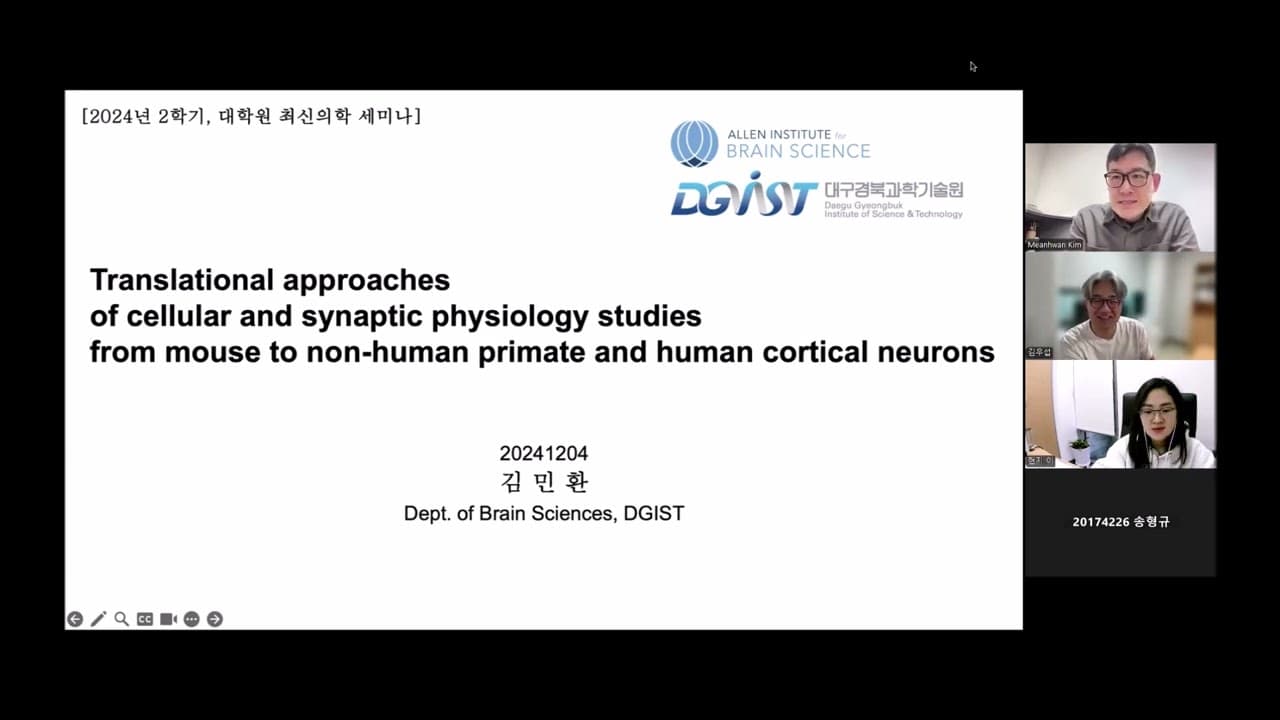
Translational approaches of cellular and synaptic physiology studies from mouse to non human primate
TL;DR
Exploring cellular and synaptic physiology from mice to humans.
Transcript
e e e e e e e e e e e p for for for oh for for for e po Science Institute for brain science scien for yes thank you thank you for very much uh for your kind invitation and introduction um it's a great honor for me to present in the class so the title today uh I'm I'm going to present about like cellular synaps physiology stu... Read More
Key Insights
- The speaker's research journey spans from cellular studies in Switzerland to human brain studies at the Allen Institute, highlighting the transition from mouse to human cortical studies.
- There are significant cultural differences between European and American scientific environments, with Europe offering more stable funding and work-life balance.
- The human cerebral cortex has more varied excitatory cell types compared to mice, reflecting evolutionary changes in cortical structure.
- In human brains, the proportion of interneurons increases compared to mice, with a notable rise in bipolar interneurons.
- Human synapses are larger than those in mice, potentially influencing synaptic efficiency and communication.
- The speaker's research focuses on synaptic connectivity and dynamics using patch clamp recording techniques to study neuronal communication.
- Collaborations with local neurosurgeons enable the study of human brain tissues, offering insights into human cortical neuron physiology.
- The speaker plans to continue research in Korea, exploring translational approaches in neuroscience with potential collaborations for human and primate tissue studies.
Install to Summarize YouTube Videos and Get Transcripts
Explore YouTube Video Summarizer or Get YouTube Transcript Extractor
Questions & Answers
Q: What is the main focus of the speaker's research?
The speaker's research primarily focuses on exploring the cellular and synaptic physiology of cortical neurons, transitioning from mouse models to human studies. This involves understanding the differences in synaptic connectivity, dynamics, and efficiency between species, using advanced techniques like patch clamp recording and collaborations with neurosurgeons for human tissue studies.
Q: How does the research environment differ between Europe and the United States?
The speaker notes significant differences between Europe and the United States in terms of research environments. Europe offers more stable funding and a better work-life balance, with larger holidays and a focus on enjoying festivals and nature. In contrast, the United States is more grant-based, with a tighter focus on rapid progress to secure funding, making it more challenging to sustain research without continuous results.
Q: What evolutionary differences exist between mouse and human brains according to the research?
The research highlights several evolutionary differences between mouse and human brains. Human brains have a more diverse range of excitatory cell types and a higher proportion of interneurons, particularly bipolar interneurons. Additionally, human synapses are larger, which may affect synaptic efficiency and communication. These differences reflect the evolutionary expansion and complexity of the human cerebral cortex.
Q: What techniques are used to study synaptic connectivity and dynamics?
The speaker employs patch clamp recording techniques to study synaptic connectivity and dynamics. This method involves using electrodes to stimulate individual neurons and measure their synaptic responses, allowing researchers to analyze synaptic strength, connectivity, and dynamics. These techniques are applied to both mouse and human brain tissues to understand differences in neuronal communication across species.
Q: How are human brain tissues obtained for research?
Human brain tissues are obtained through collaborations with local neurosurgeons, particularly during surgeries for epilepsy or tumor removal. These tissues, which would otherwise be discarded as surgical waste, are brought to the lab for physiological studies. This collaboration allows researchers to study human cortical neurons and gain insights into human brain physiology, complementing studies conducted on mouse models.
Q: What plans does the speaker have for future research in Korea?
In Korea, the speaker plans to continue research on cellular and synaptic physiology, focusing on translational approaches from mouse to human studies. The speaker aims to establish collaborations with local hospitals and research centers to obtain human and primate brain tissues, enabling further exploration of synaptic dynamics and connectivity in different brain regions. The research will also explore neuromodulation and disease models.
Q: What are the challenges of studying human brain tissues?
Studying human brain tissues presents several challenges, including the limited availability of specific brain regions due to surgical constraints. Additionally, ensuring the quality and preservation of tissues during transportation is crucial. The research must also account for potential pathological changes in tissues obtained from epilepsy or tumor surgeries, although efforts are made to use tissues away from the affected sites.
Q: What insights have been gained from comparing mouse and human synaptic physiology?
Comparisons between mouse and human synaptic physiology reveal that humans have a more diverse range of excitatory cell types and a higher proportion of interneurons, particularly bipolar interneurons. Human synapses are larger, influencing synaptic efficiency and communication. These differences highlight the evolutionary expansion and complexity of the human cerebral cortex, providing insights into the unique aspects of human brain function.
Summary & Key Takeaways
-
The research explores the translational approaches in cellular and synaptic physiology from mouse models to human cortical neurons, emphasizing the evolutionary differences in brain structure and function. It highlights the speaker's journey from Switzerland to the Allen Institute and future plans in Korea.
-
Key findings include the increased diversity of excitatory cell types and interneurons in humans compared to mice, as well as the larger size of human synapses. These differences are explored through collaborations with neurosurgeons and advanced imaging techniques.
-
The speaker's research utilizes patch clamp recording to study synaptic connectivity and dynamics, with a focus on understanding the differences in synaptic efficiency and communication between species. Future research aims to expand these studies in Korea, leveraging collaborations with hospitals and research centers.
Read in Other Languages (beta)
Share This Summary 📚
Summarize YouTube Videos and Get Video Transcripts with 1-Click
Try YouTube Summary with ChatGPT & Claude or YouTube Transcript Generator
Explore More Summaries from 고대 의과대학행정팀 📚

Summarize YouTube Videos and Get Video Transcripts with 1-Click
Try YouTube Summary with ChatGPT & Claude or YouTube Transcript Generator