16.2.3 Page Faults
TL;DR
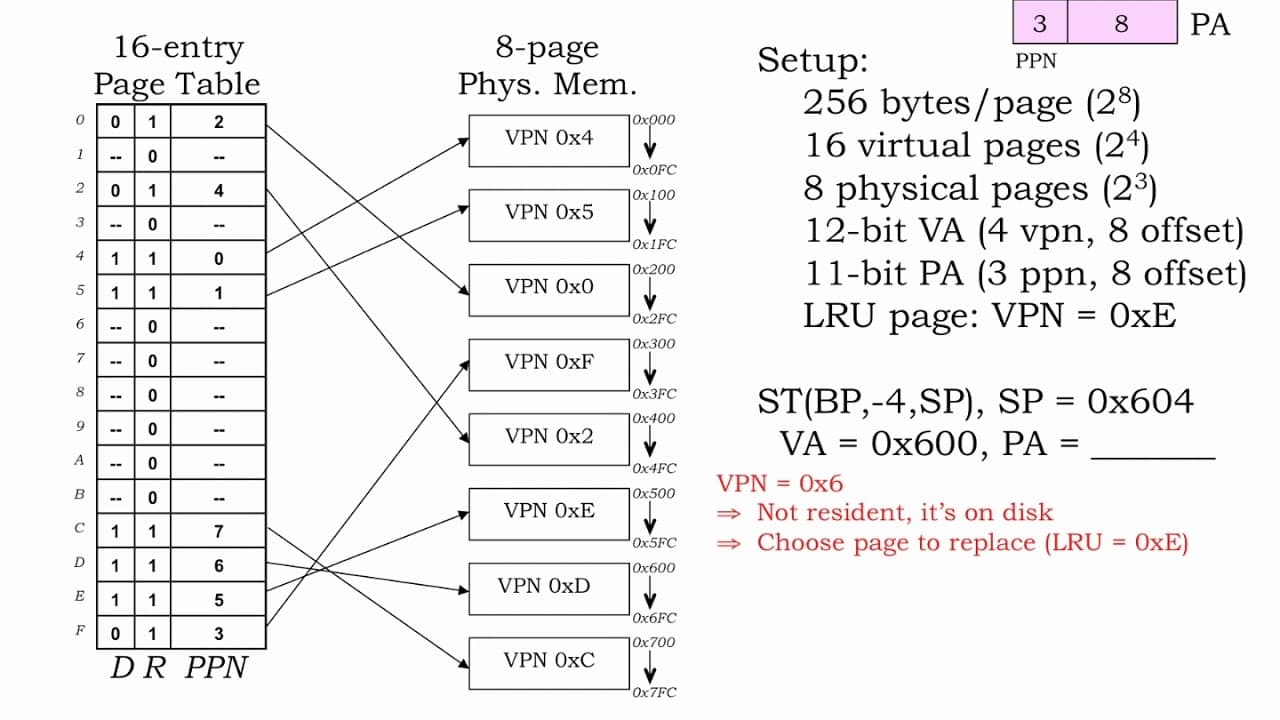
When the CPU tries to access a non-resident virtual page, a page fault exception is triggered, and the page fault handler is executed to handle the exception.
Transcript
Let's review what happens when the CPU accesses a non-resident virtual page, i.e., a page with its resident bit set to 0. In the example shown here, the CPU is trying to access virtual page 5. In this case, the MMU signals a page fault exception, causing the CPU to suspend execution of the program and switch to the page fault handler, which is code... Read More
Key Insights
- 📟 When the CPU accesses a non-resident virtual page, a page fault exception occurs.
- 📟 The page fault handler is responsible for finding or creating an unused physical page, writing back dirty pages, and updating the page table.
- 📟 Selecting the optimal replacement page is not feasible without knowledge of future execution paths.
- 📟 The aging algorithm is frequently used for choosing a replacement page due to its near optimal performance.
- 📟 The page fault handler ensures that changes in dirty pages are not lost by writing them back to secondary storage.
- 💦 The MMU's work can be divided into two tasks: the VtoP procedure for address translation and the PageFault procedure for handling page faults.
- 📟 Hardware is used for the VtoP functionality, while the PageFault procedure is executed via a page fault exception.
- ❓ The choice between special-purpose hardware (MMU) and general-purpose hardware (CPU) involves tradeoffs.
Install to Summarize YouTube Videos and Get Transcripts
Explore YouTube Video Summarizer or Get YouTube Transcript Extractor
Questions & Answers
Q: What happens when the CPU accesses a non-resident virtual page?
When the CPU accesses a non-resident virtual page, a page fault exception occurs, and the CPU switches to the page fault handler. The handler finds or creates an unused physical page and updates the page table accordingly.
Q: How does the page fault handler select a replacement page?
The page fault handler selects a replacement page by choosing either an unused physical page or an in-use page, depending on availability. The optimal strategy is to choose the page whose next use will occur farthest in the future, but this requires knowledge of future execution paths, which is not feasible.
Q: What happens to the dirty pages before selecting a replacement page?
If the selected page is dirty, meaning its contents have changed since being read from secondary storage, the handler writes it back to secondary storage before marking it as non-resident. This ensures that the changes are not lost.
Q: How is the desired virtual page loaded into the selected physical page?
The desired virtual page is read from secondary storage into the selected physical page. The corresponding page table entry is updated to indicate the new physical page for the virtual page.
Summary & Key Takeaways
-
When the CPU tries to access a non-resident virtual page, a page fault exception occurs, and the CPU switches to the page fault handler.
-
The page fault handler finds or creates an unused physical page, writes back dirty pages to secondary storage, and marks the selected virtual page as non-resident.
-
The optimal strategy for selecting a replacement page is to choose the page whose next use will occur farthest in the future, but this is not feasible.
Read in Other Languages (beta)
Share This Summary 📚
Summarize YouTube Videos and Get Video Transcripts with 1-Click
Try YouTube Summary with ChatGPT & Claude or YouTube Transcript Generator
Explore More Summaries from MIT OpenCourseWare 📚



Summarize YouTube Videos and Get Video Transcripts with 1-Click
Try YouTube Summary with ChatGPT & Claude or YouTube Transcript Generator