Complete Docker Course - From BEGINNER to PRO! (Learn Containers)
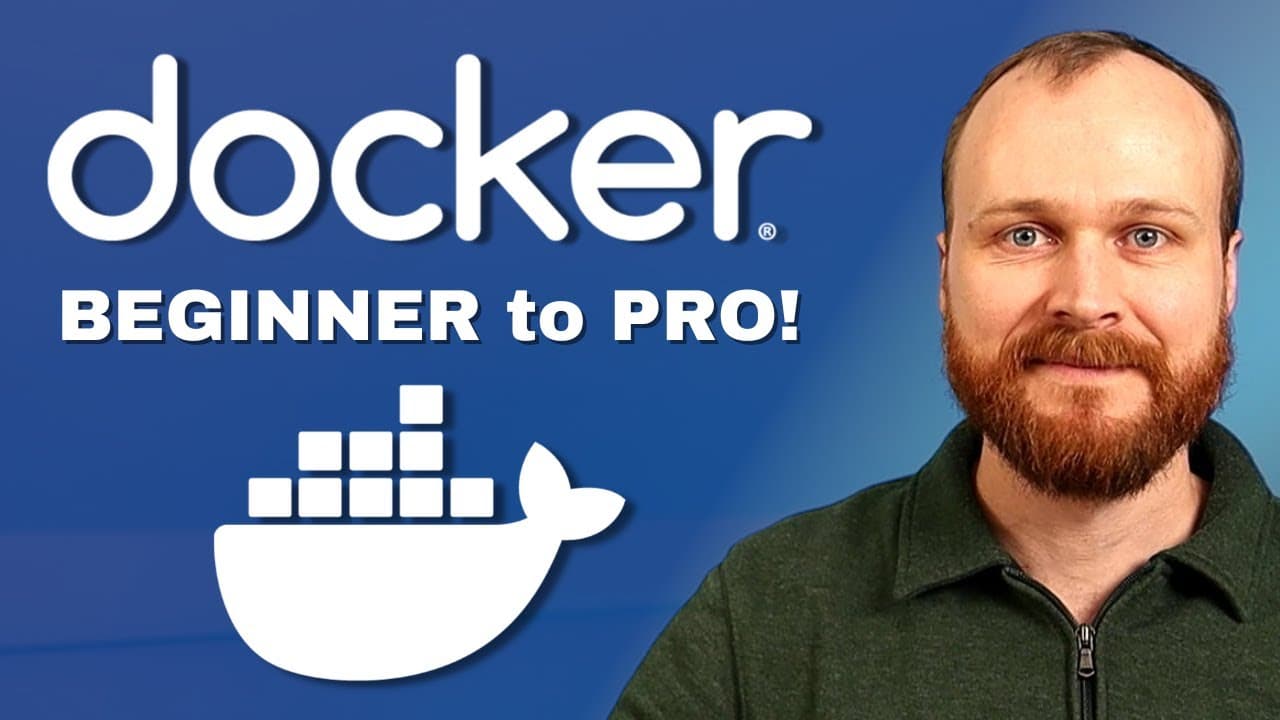
TL;DR
Comprehensive course on Docker and containers, from basics to cloud deployment.
Transcript
hey team welcome to this complete course on Docker and containers my goal with this course is for it to be the most efficient way for you to ramp up on your Docker and container skills starting from the basics and progressing through to intermediate and advanced concepts by the end of the course you'll have the Knowledge and Skills to be pr... Read More
Key Insights
- The course provides a thorough understanding of Docker and containerization, starting from basic concepts to advanced deployment strategies.
- It emphasizes the importance of using containers for consistent development and production environments, reducing errors and increasing efficiency.
- The course includes practical demonstrations and encourages hands-on learning by providing a GitHub repository with all necessary code and configurations.
- Key technologies discussed include Docker Swarm, Kubernetes, and Railway for deploying containerized applications to the cloud.
- The course highlights the benefits of using Docker for managing dependencies and ensuring high utilization of resources.
- It explains the foundational Linux kernel features like namespaces, control groups, and union file systems that make containers possible.
- Practical advice is given on optimizing Dockerfiles and managing container data using volumes and bind mounts.
- The course is sponsored by Shipyard, which offers tools for creating ephemeral environments for containerized applications.
Install to Summarize YouTube Videos and Get Transcripts
Explore YouTube Video Summarizer or Get YouTube Transcript Extractor
Questions & Answers
Q: What is the main goal of this Docker course?
The main goal of the course is to efficiently ramp up participants' Docker and container skills, starting from the basics and progressing through intermediate and advanced concepts. By the end of the course, participants will be able to use containers productively within a team for both development and deployment of applications.
Q: What prerequisites are recommended for this course?
While the course is designed to be accessible to beginners, having some familiarity with web application development and basic shell commands is recommended. This background will help participants understand which aspects are container-specific and which are general application architecture concerns.
Q: How is the course structured?
The course is structured into learning modules, each building progressively upon the last. It includes both theoretical concepts and practical exercises, with timestamps provided for easy navigation. Sections cover everything from the motivation for containers to deploying containerized applications to the cloud.
Q: What technologies are covered in the course?
The course covers a range of technologies including Docker Swarm, Kubernetes, and Railway for deploying containers. It also delves into the foundational Linux kernel features that make containers possible, such as namespaces, control groups, and union file systems.
Q: How does the course address container data management?
The course explains the importance of managing container data using volumes and bind mounts. It provides guidance on when to use each method and demonstrates how to persist data beyond the lifecycle of a container, ensuring that applications can store and retrieve necessary information.
Q: What is the role of Shipyard in the course?
Shipyard sponsors the course, allowing it to be offered for free. Shipyard provides tools for generating on-demand ephemeral environments for containerized applications, which are demonstrated in the course. An exclusive coupon code is also offered to course participants for additional free days on Shipyard's plans.
Q: What is the significance of the demo application in the course?
The demo application serves to illustrate real-world use cases of Docker and containerization. It includes a minimal three-tier web application with a React frontend, Node.js and Go backend APIs, and a PostgreSQL database. This setup helps demonstrate networking, configuration, and deployment in a realistic context.
Q: What are the benefits of using Docker as highlighted in the course?
Docker offers numerous benefits including consistent environments for development and production, simplified dependency management, and efficient resource utilization. It also enables rapid provisioning and decommissioning of containers, making it a powerful tool for modern software development and deployment workflows.
Summary & Key Takeaways
-
This course offers a complete guide to Docker and containers, starting from the basics and progressing to advanced deployment techniques. It covers the history, technology, and practical applications of Docker, making it a valuable resource for developers.
-
Participants will learn how to integrate Docker into their workflows, with a focus on creating consistent environments for development and production. The course includes a demo application to illustrate real-world use cases.
-
The course is sponsored by Shipyard, providing tools for on-demand environments. Additional resources include a GitHub repository and bonus videos for further learning. The course is free, thanks to Shipyard's support.
Read in Other Languages (beta)
Share This Summary 📚
Summarize YouTube Videos and Get Video Transcripts with 1-Click
Try YouTube Summary with ChatGPT & Claude or YouTube Transcript Generator
Explore More Summaries from DevOps Directive 📚
Summarize YouTube Videos and Get Video Transcripts with 1-Click
Try YouTube Summary with ChatGPT & Claude or YouTube Transcript Generator