How to Build a Regression Model for Predicting NBA Points
TL;DR
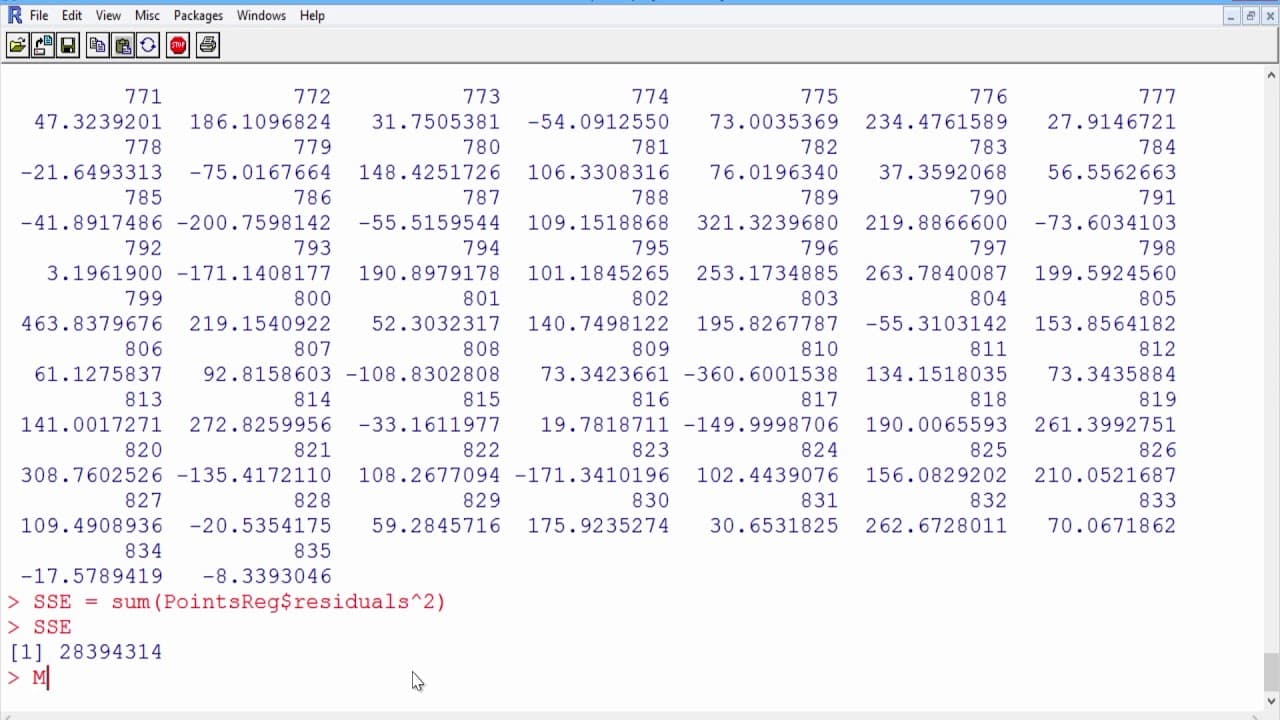
To predict points scored in NBA games using regression analysis, include basketball statistics like field goal attempts, assists, and offensive rebounds. The model, tested for significance, achieved an R-squared value of 0.8992, indicating a strong relationship, while the root mean squared error (RMSE) remained approximately 184.4, showing reasonable predictive accuracy.
Transcript
So now let's build an equation to predict points scored using some common basketball statistics. So our dependent variable would now be points, and our independent variables would be some of the common basketball statistics that we have in our data set. So for example, the number of two-point field goal attempts, the number of three-point field goa... Read More
Key Insights
- 😥 Regression analysis can be used to predict basketball points using various statistics.
- 😥 Some variables, such as field goal attempts and assists, have higher significance in predicting points.
- 😥 The R-squared value of 0.8992 suggests a strong linear relationship between points and the considered basketball statistics.
- ❓ The RMSE of 184.4 indicates a reasonable average error in the predictions.
- ❓ Removing statistically insignificant variables does not significantly affect the model's performance.
- 🎚️ The simplified model with significant variables still maintains a similar level of error.
Install to Summarize YouTube Videos and Get Transcripts
Explore YouTube Video Summarizer or Get YouTube Transcript Extractor
Questions & Answers
Q: What variables are used to build the regression model?
The regression model includes variables such as field goal attempts (two-point and three-point), free throw attempts, assists, offensive rebounds, defensive rebounds, steals, blocks, and turnovers.
Q: How are the significance of the variables determined?
The significance of the variables is determined by the p-values. Higher p-values indicate less statistical significance, while lower p-values suggest greater significance.
Q: What is the interpretation of the R-squared value in the model?
The high R-squared value (0.8992) indicates that there is a strong linear relationship between points and the basketball statistics considered in the model.
Q: How is the root mean squared error (RMSE) calculated?
RMSE is calculated by taking the square root of the sum of squared errors divided by the number of data points. In this case, the RMSE is 184.4, indicating an average error of approximately 184.4 points in the predictions.
Q: How does removing statistically insignificant variables affect the model's performance?
Removing statistically insignificant variables (e.g., turnovers, defensive rebounds, blocks) slightly decreases the R-squared value but has minimal impact on the root mean squared error (RMSE).
Summary & Key Takeaways
-
The content discusses the process of building a regression model to predict basketball points using common statistics such as field goal attempts, rebounds, assists, steals, blocks, turnovers, and free throw attempts.
-
The author demonstrates how to create the regression model and analyzes the significance of each variable.
-
The content introduces the concept of sum of squared errors (SSE) and root mean squared error (RMSE) to measure the accuracy of the predictions.
-
The author explores the impact of removing statistically insignificant variables on the model's performance.
Read in Other Languages (beta)
Share This Summary 📚
Summarize YouTube Videos and Get Video Transcripts with 1-Click
Try YouTube Summary with ChatGPT & Claude or YouTube Transcript Generator
Explore More Summaries from MIT OpenCourseWare 📚


Summarize YouTube Videos and Get Video Transcripts with 1-Click
Try YouTube Summary with ChatGPT & Claude or YouTube Transcript Generator