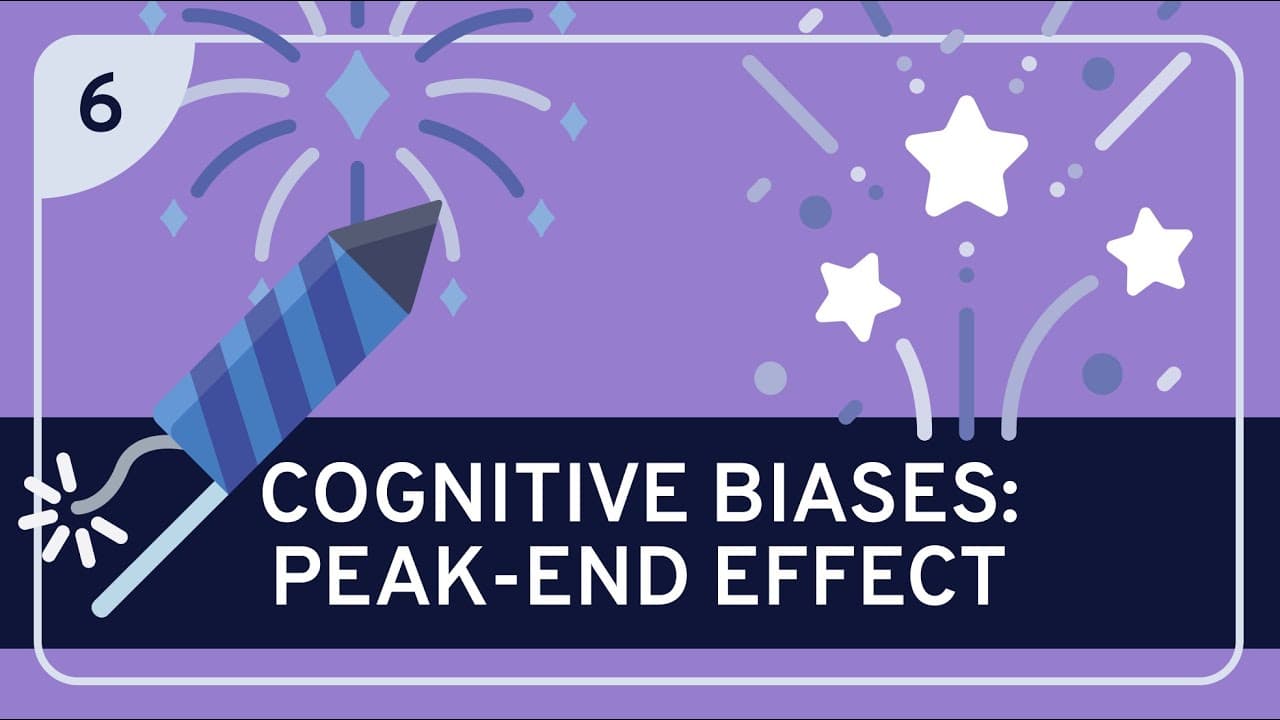
CRITICAL THINKING - Cognitive Biases: Peak-End Effect [HD]
TL;DR
Peak-end effect biases event memories, ignoring duration.
Transcript
(intro music) My name is Laurie Santos. I teach psychology at Yale University, and today I want to talk to you about peak-end effects. This lecture is part of a series on cognitive biases. I want you to think back to the last time you went to a restaurant and had an expensive meal. Now remember all the different parts of that event. Done? Well, the... Read More
Key Insights
- The peak-end effect is a cognitive bias where people judge experiences based on their peak and end moments, ignoring other aspects.
- Danny Kahneman's studies show that people prefer experiences with a better ending, even if they are longer and more painful.
- This bias demonstrates 'duration neglect,' where the length of an experience does not significantly impact our memory of it.
- In real-world applications, the peak-end effect can influence how medical procedures are perceived, with less painful endings improving patient satisfaction.
- Memories of events are simplified by focusing on the most intense and final moments, rather than every detail.
- The peak-end effect suggests strategies for enhancing experiences, such as ending events on a high note to improve overall perception.
- Understanding this bias can help in designing more enjoyable experiences by ensuring a positive end.
- The phenomenon explains why we might enjoy short, intense experiences and tolerate longer, unpleasant ones if they end well.
Install to Summarize YouTube Videos and Get Transcripts
Explore YouTube Video Summarizer or Get YouTube Transcript Extractor
Questions & Answers
Q: What is the peak-end effect?
The peak-end effect is a cognitive bias where people judge an experience primarily by its most intense point (the peak) and its conclusion (the end), rather than considering the entire duration. This bias can lead to skewed memories, where the overall length and other details of the experience are ignored.
Q: How does the peak-end effect relate to duration neglect?
Duration neglect is a phenomenon where the length of an experience does not significantly impact how we remember it. The peak-end effect contributes to this by focusing our memories on the peak and end moments, causing us to overlook the duration entirely, regardless of how long or short the experience was.
Q: How did Danny Kahneman study the peak-end effect?
Danny Kahneman studied the peak-end effect through experiments involving painful experiences. Participants were subjected to cold water immersion, with variations in duration and intensity. Despite longer exposure, participants preferred experiences with less painful endings, demonstrating the influence of the peak-end effect on memory and preference.
Q: What are the practical implications of the peak-end effect in medical procedures?
In medical procedures, understanding the peak-end effect can improve patient satisfaction by managing the procedure's conclusion. By ensuring a less painful ending, patients may remember the procedure more favorably, despite its overall length or intensity, potentially increasing their willingness to undergo future treatments.
Q: How can the peak-end effect be applied to improve experiences?
To improve experiences using the peak-end effect, focus on creating memorable peaks and ensuring a positive conclusion. This can be achieved by ending events on a high note, such as a grand finale or a satisfying conclusion, which can enhance the overall perception and enjoyment of the experience.
Q: Why might people prefer short, intense experiences?
People might prefer short, intense experiences because the peak-end effect emphasizes the most intense and final moments. A short experience with a strong peak and satisfying end can be more memorable and enjoyable than a longer one, as the duration is often overlooked in our retrospective evaluations.
Q: Can the peak-end effect influence decision-making?
Yes, the peak-end effect can influence decision-making by skewing our memories of past experiences. When recalling an event, we may base our decisions on the peak and end moments, potentially leading to choices that prioritize these aspects over other important factors, such as duration or frequency.
Q: What strategies can be used to mitigate the peak-end effect?
To mitigate the peak-end effect, individuals can practice mindfulness and reflection, consciously considering the entire duration and all aspects of an experience. By being aware of this bias, people can make more balanced evaluations and decisions, taking into account factors beyond just the peak and end moments.
Summary & Key Takeaways
-
Laurie Santos discusses the peak-end effect, a cognitive bias where people evaluate experiences based on the most intense moment and the end, ignoring the duration. This bias can lead to surprising preferences, such as choosing longer, less pleasant experiences if they end positively.
-
Danny Kahneman's research highlights how the peak-end effect influences memory and satisfaction, showing that people prefer experiences with a better ending despite longer durations. This insight has practical applications in areas like medical procedures, where less painful endings can improve patient perceptions.
-
The peak-end effect illustrates 'duration neglect,' where the length of an event is overlooked in memory. Understanding this bias can help in crafting more enjoyable experiences by focusing on creating memorable peaks and positive endings, enhancing overall perception.
Read in Other Languages (beta)
Share This Summary 📚
Summarize YouTube Videos and Get Video Transcripts with 1-Click
Try YouTube Summary with ChatGPT & Claude or YouTube Transcript Generator
Explore More Summaries from Wireless Philosophy 📚
Summarize YouTube Videos and Get Video Transcripts with 1-Click
Try YouTube Summary with ChatGPT & Claude or YouTube Transcript Generator